CISCO · 350-601

Cisco 350-601 DCCOR Exam Practice Questions

526 questionsPDF by emailUpdated September 2026

US$39

Try 10 questions free

Card, Apple Pay or Google Pay. Your PDF is sent by email as soon as you check out.

Pass or your money backFail the exam after using this pack and we refund it. How the guarantee works
Category:
TRY BEFORE YOU BUY

Three of the 526 questions in this pack

Question 1

Which virtual MAC address is the default for HSRP version 2 group 10?

  1. 0000.5E00.0110
  2. 0000.0C9F.F00A
  3. 3784.0898.1C0A
  4. 0000.0C9F.F010
Show answer and explanation

Correct answer: B. 0000.0C9F.F00A

HSRP version 2 for IPv4 uses the virtual MAC range 0000.0C9F.Fxxx, where xxx is the three hex digit representation of the group number. Group 10 in hex is 00A, so the default virtual MAC is 0000.0C9F.F00A. HSRPv1 uses a different range, 0000.0C07.ACxx, which would give 0000.0C07.AC0A for the same group.

Why the other options are wrong

  • A. 0000.5E00.01xx is the VRRP virtual MAC range, so this address belongs to VRRP group 16, not HSRP.
  • C. 3784.0898.1C0A is a burned-in style address and does not match any HSRP virtual MAC range.
  • D. 0000.0C9F.F010 is the HSRPv2 virtual MAC for group 16, because 010 hex equals 16 decimal.

Question 2

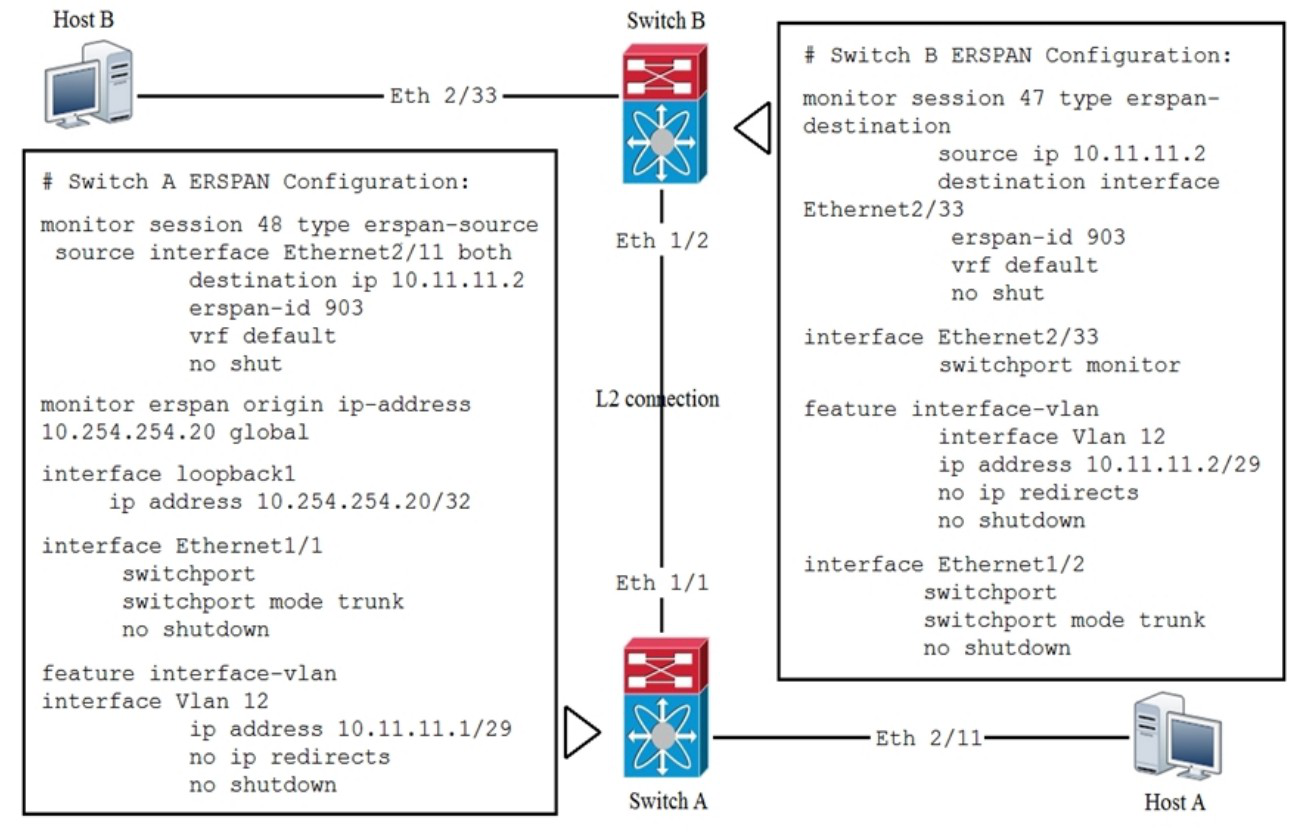
Refer to the exhibit.

Which statement about the ERSPAN configuration in this environment is true?

Exhibit for question 2

  1. The session number of the source of ERSPAN spanned traffic must have a session ID of 47 for the traffic analyzer to receive the traffic.
  2. Host B is the source of ERSPAN spanned traffic and host A is the traffic analyzer.
  3. The session number of the source of ERSPAN spanned traffic must have a session ID of 48 for the traffic analyzer to receive the traffic.
  4. Host A is the source of ERSPAN spanned traffic and host B is the traffic analyzer.
Show answer and explanation

Correct answer: D. Host A is the source of ERSPAN spanned traffic and host B is the traffic analyzer.

host B is the traffic analyzer. In ERSPAN configurations, the source is the switch that monitors traffic using the monitor session command, and the destination is the switch receiving the mirrored traffic at the destination IP address. Switch A is configured with 'monitor session 48 type erspan- source' monitoring Ethernet2/11 with destination IP 10.11.11.2, making it the traffic source. Switch B is configured with 'monitor session 47 type erspan-destination' receiving traffic from source IP 10.11.11.2 on interface Ethernet2/33, making it the traffic analyzer. Host A is connected to Switch A (the source), and Host B is connected to Switch B (the destination/analyzer). Therefore, Host A is the source of ERSPAN spanned traffic and Host B is the traffic analyzer.

Why the other options are wrong

  • A. Session 47 is the destination session number on Switch B (the analyzer), not the source session number that controls traffic capture.
  • B. This is reversed; Host B is the traffic analyzer and Host A is the source, not the other way around.
  • C. While session 48 is correctly identified as the source session, the statement incorrectly implies session 48 must match on the analyzer, when in fact the ERSPAN destination uses session 47.

Question 3

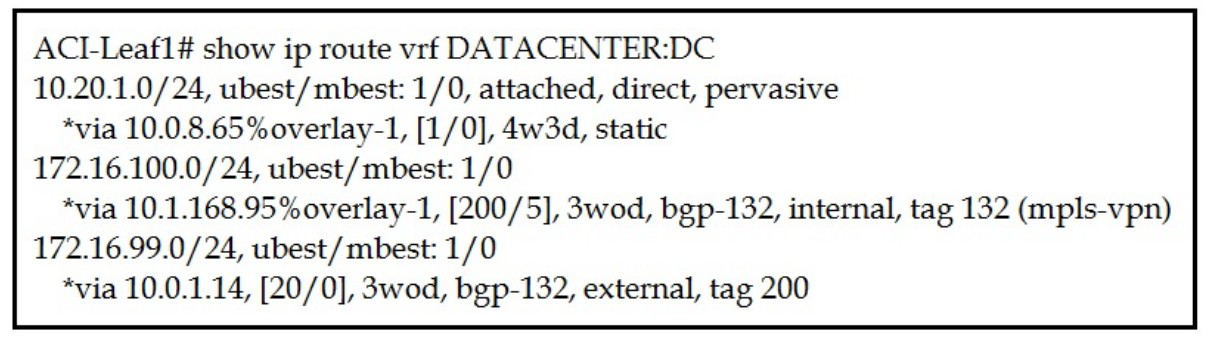
Refer to the exhibit.

Which two statements about the routing table of the leaf switch are true? (Choose two.)

Exhibit for question 3

  1. 10.20.1.0/24 is a BD subnet in ACI.
  2. The next hop 10.0.1.14 for route 172.16.99.0/24 is the TEP address of a border leaf in ACI.
  3. 172.16.100.0/24 is a BD subnet in ACI.
  4. The next hop 10.1.168.95 for route 172.16.100.0/24 is the TEP address of a border leaf in ACI.
  5. The next hop 10.0.8.65 for route 10.20.1.0/24 is the TEP address of a border leaf in ACI.
Show answer and explanation

Correct answer: A, D

A. 10.20.1.0/24 is a BD subnet in ACI. D. The next hop 10.1.168.95 for route 172.16.100.0/24 is the TEP address of a border leaf in ACI. The 10.20.1.0/24 entry is marked attached, direct, pervasive, which is exactly how ACI installs a bridge domain subnet on the leaf switches, so A is true. The 172.16.100.0/24 entry is learned through MP-BGP and marked internal with mpls-vpn tagging, and its next hop 10.1.168.95 sits in overlay-1, identifying the TEP of the border leaf that advertised the prefix, so D is true.

Why the other options are wrong

  • B. 172.16.99.0/24 is marked external, meaning it is learned directly from an outside peer, so 10.0.1.14 is the external router next hop rather than a border leaf TEP.
  • C. 172.16.100.0/24 is an MP-BGP learned external route carried inside the fabric, not a bridge domain subnet.
  • E. 10.0.8.65 is the local pervasive overlay next hop used for the BD subnet gateway, not the TEP of a border leaf.

See all 10 free questions Get the full pack, US$39

526 practice questions for Cisco Implementing and Operating Cisco Data Center Core Technologies (350-601 DCCOR), with full explanations.

Every question comes with the correct answer, the reasoning behind it, and a note on why each wrong option is wrong. Work through it once with the answers, then again with the questions-only copy under exam conditions.

  • 526 questions across all five DCCOR domains
  • Answers and explanations for every question, including the wrong options
  • A questions-only PDF for timed practice runs
  • Instant delivery by email the moment you check out
  • Free monthly updates for as long as the exam is live
  • Pass or your money back

A failed DCCOR attempt costs another US$400. This pack is US$39, paid once, and refunded if you fail.

Try 10 questions free before you buy.

Last updated September 2026 · 526 questions

What makes the DCCOR hard

DCCOR is the core exam for both CCNP Data Center and CCIE Data Center, so passing it also earns the Cisco Certified Specialist, Data Center Core certification on its own. It is a broad exam spanning five domains across networking, compute, storage, automation and security.

What decides it: VXLAN EVPN and overlay design, vPC and the switching protocols underneath it, ACI concepts and policy model, Cisco UCS rack and blade compute plus Intersight-managed systems, Fibre Channel and modern storage approaches like NFS and iSCSI, and the automation side, NX-API, Ansible and streaming telemetry. The v1.2 refresh pushed the exam further towards cloud, automation and AI-ready infrastructure, and renamed the automation domain to Automation and Artificial Intelligence. Network and Compute are 25% each, so half the paper sits in those two domains before you reach storage, automation or security.

About the exam

Implementing Cisco Data Center Core Technologies (350-601 DCCOR) validates knowledge of core data center technologies across network, compute, storage network, automation and artificial intelligence, and security. It is the core requirement for the CCNP Data Center and CCIE Data Center certifications, and passing it also awards the Cisco Certified Specialist, Data Center Core certification. Current blueprint v1.2.

Exam domains (v1.2)

  • Network: 25%
  • Compute: 25%
  • Storage network: 20%
  • Automation and artificial intelligence: 15%
  • Security: 15%

120 minutes, passing score not publicly disclosed, US$400 per attempt, Pearson VUE testing centres or online proctored, certification valid for three years.
Reviews

There are no reviews yet.

Only logged in customers who have purchased this product may leave a review.

Questions before you buy

What do I get when I buy the Cisco 350-601 DCCOR pack?

526 practice questions as a PDF, each with the correct answer, a full explanation and a note on why the other options are wrong, plus a separate questions-only PDF for timed practice.

How quickly do I receive it?

Your PDF is prepared and sent to your email address after checkout, and you get a confirmation as soon as it is on its way.

Is there a free sample?

Yes. Ten questions from this pack, with answers and explanations, are free on this page and as a PDF, so you can judge the quality before you pay.

Are updates included?

Yes. The pack is updated every month for as long as the exam is live, and updates are free for everyone who has bought it.

What if I fail the exam?

We refund the pack. Sit the exam 7 to 30 days after buying, then send your official score report within 7 days of the exam date, as set out in the refund policy.

Can I share it with colleagues?

Each purchase is licensed to one person. For a team, school or training organisation, email support@certstash.com for a licence that fits.