JUNIPER · JN0-637

Juniper JN0-637 JNCIP-SEC Exam Practice Questions

103 questionsPDF by emailUpdated September 2026

US$39

Try 10 questions free

Card, Apple Pay or Google Pay. Your PDF is sent by email as soon as you check out.

Pass or your money backFail the exam after using this pack and we refund it. How the guarantee works
Category:
TRY BEFORE YOU BUY

Three of the 103 questions in this pack

Question 1

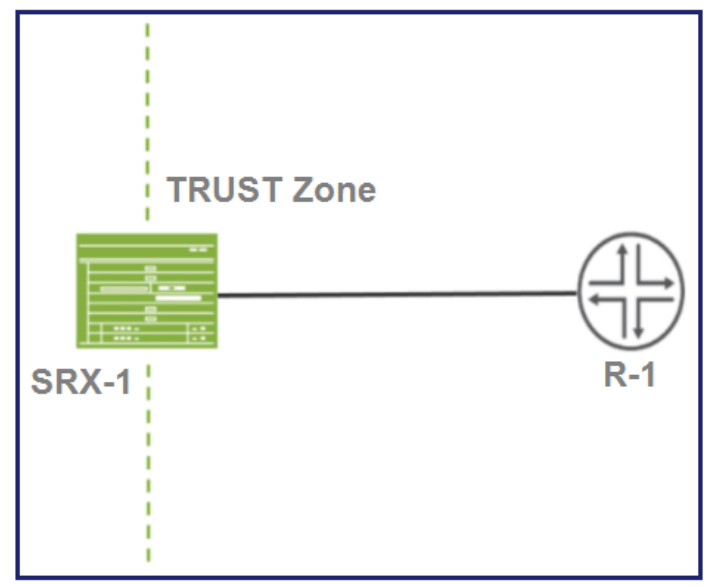
Click the Exhibit button.

You can use SSH from SRX-1 to R-1 but not telnet. Both telnet and SSH services are enabled on R-1.

Referring to the exhibit, which configuration on SRX-1 is denying the access?

Exhibit for question 1

  1. The security policy from the junos-host zone to the TRUST zone is denying port 22.
  2. The security policy from the TRUST zone to the junos-host zone is denying port 22.
  3. The security policy from the junos-host zone to the TRUST zone is denying port 23.
  4. The security policy from the TRUST zone to the junos-host zone is denying port 23.
Show answer and explanation

Correct answer: C. The security policy from the junos-host zone to the TRUST zone is denying port 23.

TRUST zone is denying port 23. The diagram shows SRX-1 in the TRUST zone attempting to connect to R-1. When SRX-1 initiates a connection to R-1, the traffic originates from the junos-host zone (SRX-1's management/control plane) and is destined for the TRUST zone (where R-1 resides). Since SSH (port 22) works but telnet (port 23) does not, the security policy blocking telnet must be the one governing this traffic direction. The policy denying port 23 from the junos- host zone to the TRUST zone is what prevents telnet access while allowing SSH.

Why the other options are wrong

  • A. Port 22 (SSH) is working, so a policy denying port 22 in this direction would block SSH, contradicting the scenario.
  • B. The policy from TRUST to junos-host would govern return traffic or responses, not the initial connection attempt that is being denied.
  • D. While this policy direction exists, port 23 denial in the reverse direction (TRUST to junos-host) would not block the initial telnet connection attempt from SRX-1.

Question 2

In a multimode HA environment, which service must be configured to synchronize between nodes?

  1. PKI certificated
  2. IDP
  3. IPsec VPN
  4. advanced policy-based routing
Show answer and explanation

Correct answer: B. IDP

In a multimode HA environment, the Identity Provider (IDP) service must be synchronized between nodes to ensure consistent threat detection and security policy enforcement. IDP handles security services like antivirus, anti-spam, and content filtering, which require state synchronization in HA deployments to maintain consistent protection across both nodes.

Why the other options are wrong

  • A. PKI certificates are not typically synchronized as a dedicated service in HA; certificate management is handled separately.
  • C. IPsec VPN is a user service, not a core infrastructure service requiring HA synchronization.
  • D. Advanced policy-based routing is a forwarding function, not a synchronized service in HA deployments.

Question 3

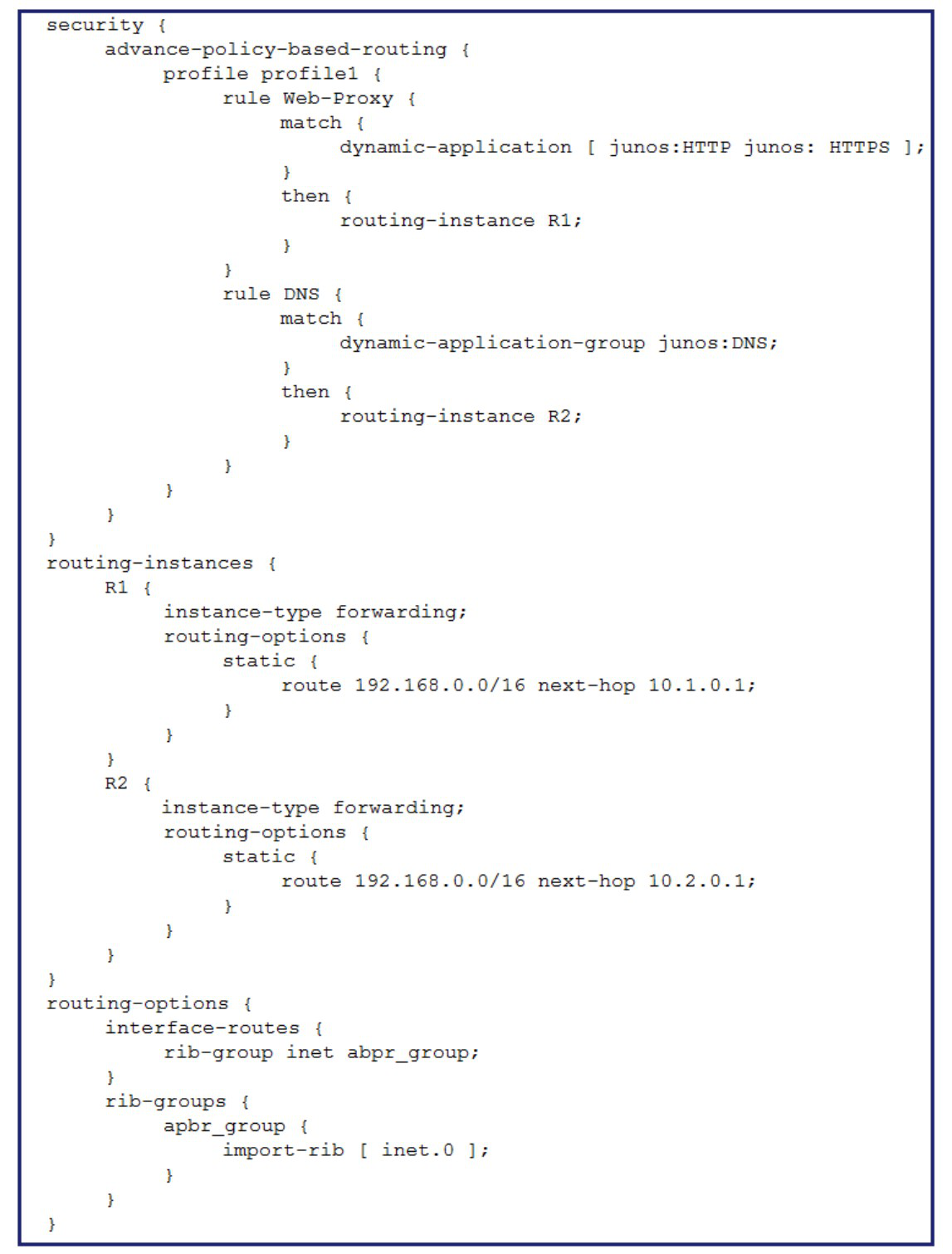
Click the Exhibit button.

Referring to the exhibit, which statement about TLS 1.2 traffic is correct?

Exhibit for question 3

  1. TLS 1.2 traffic will be sent to routing instance R2 but not forwarded to the next hop.
  2. TLS 1.2 traffic will be sent to routing instance R2 and forwarded to next hop 10.2.0.1.
  3. TLS 1.2 traffic will be sent to routing instance R1 and forwarded to next hop 10.1.0.1.
  4. TLS 1.2 traffic will be sent to routing instance R1 but not forwarded to the next hop.
Show answer and explanation

Correct answer: C. TLS 1.2 traffic will be sent to routing instance R1 and forwarded to next hop 10.1.0.1.

forwarded to next hop 10.1.0.1. TLS 1.2 traffic uses HTTPS (port 443), which matches the first rule 'Web-Proxy' that specifies 'dynamic-application [ junos:HTTP junos: HTTPS ]'. This rule directs matching traffic to routing-instance R1. Routing instance R1 is configured with instance-type forwarding and a static route for 192.168.0.0/16 via next-hop 10.1.0.1, so the traffic will be forwarded to that next hop. The DNS rule only matches the junos:DNS dynamic- application-group and directs to R2, which does not apply to TLS 1.2 traffic.

Why the other options are wrong

  • A. R2 is only used for DNS traffic, not TLS 1.2 traffic which matches the Web-Proxy rule routing to R1.
  • B. TLS 1.2 traffic matches the Web-Proxy rule which routes to R1, not R2.
  • D. R1 is configured with forwarding enabled and has a static route, so traffic will be forwarded to next hop 10.1.0.1.

See all 10 free questions Get the full pack, US$39

103 practice questions for Juniper Networks Certified Professional, Security (JNCIP-SEC), exam JN0-637, with full explanations.

Every question comes with the correct answer, the reasoning behind it, and a short note on why each wrong option is wrong. Work through it once with the answers, then again with the questions-only copy under exam conditions.

  • 103 questions mapped to the JN0-637 exam objectives
  • Answers and explanations for every question, including the wrong options
  • A questions-only PDF for timed practice runs
  • Instant delivery by email the moment you check out
  • Free monthly updates for as long as the exam is live
  • Pass or your money back

A JN0-637 attempt costs US$400. This pack is US$39, paid once.

Try 10 questions free before you buy.

Last updated September 2026 · 103 questions

What makes the JNCIP-SEC hard

JNCIP-SEC is the professional SRX exam, and the JN0-637 version leans harder on troubleshooting than its predecessor: the first objective is diagnosing security policies and zones with logging and tracing, and several others are phrased as configure or monitor rather than describe. It requires an active JNCIS-SEC, runs 65 questions in 90 minutes, and Juniper does not publish weightings, so every objective has to be covered.

The objectives split into SRX features that only show up at professional level: logical and tenant systems and resource isolation; Layer 2 security including transparent mode and secure wire; advanced NAT including persistent NAT and NAT64; advanced IPsec VPNs including ADVPN and IKEv2; advanced policy-based routing; multinode high availability including role election and session persistence; and automated threat mitigation with Juniper ATP Cloud and SecIntel feeds. Candidates consistently report the multinode HA and tenant system questions as the ones where small configuration differences change the answer.

This pack has 103 practice questions for the JN0-637 JNCIP-SEC exam.

About the exam

JN0-637 earns the JNCIP-SEC certification and is the prerequisite for JNCIE-SEC. It covers troubleshooting security policies and zones, logical and tenant systems, Layer 2 security, advanced NAT, advanced IPsec VPNs, advanced policy-based routing, multinode high availability and automated threat mitigation on Junos OS for SRX Series. The prerequisite is an active JNCIS-SEC certification.

Exam domains

  • Troubleshooting security policies and security zones
  • Logical systems and tenant systems
  • Layer 2 security
  • Advanced network address translation
  • Advanced IPsec VPNs
  • Advanced policy-based routing
  • Multinode high availability
  • Automated threat mitigation

Juniper does not publish weightings for these objectives.

65 multiple-choice questions, 90 minutes, US$400 per attempt, Pearson VUE test centre or online proctored, certification valid for three years. Juniper does not publish a fixed passing score.
Reviews

There are no reviews yet.

Only logged in customers who have purchased this product may leave a review.

Questions before you buy

What do I get when I buy the Juniper JN0-637 JNCIP-SEC pack?

103 practice questions as a PDF, each with the correct answer, a full explanation and a note on why the other options are wrong, plus a separate questions-only PDF for timed practice.

How quickly do I receive it?

Your PDF is prepared and sent to your email address after checkout, and you get a confirmation as soon as it is on its way.

Is there a free sample?

Yes. Ten questions from this pack, with answers and explanations, are free on this page and as a PDF, so you can judge the quality before you pay.

Are updates included?

Yes. The pack is updated every month for as long as the exam is live, and updates are free for everyone who has bought it.

What if I fail the exam?

We refund the pack. Sit the exam 7 to 30 days after buying, then send your official score report within 7 days of the exam date, as set out in the refund policy.

Can I share it with colleagues?

Each purchase is licensed to one person. For a team, school or training organisation, email support@certstash.com for a licence that fits.