JUNIPER · JN0-253

Juniper JN0-253 JNCIA-MistAI Exam Practice Questions

98 questionsPDF by emailUpdated September 2026

US$39

Try 10 questions free

Card, Apple Pay or Google Pay. Your PDF is sent by email as soon as you check out.

Pass or your money backFail the exam after using this pack and we refund it. How the guarantee works
Category:
TRY BEFORE YOU BUY

Three of the 98 questions in this pack

Question 1

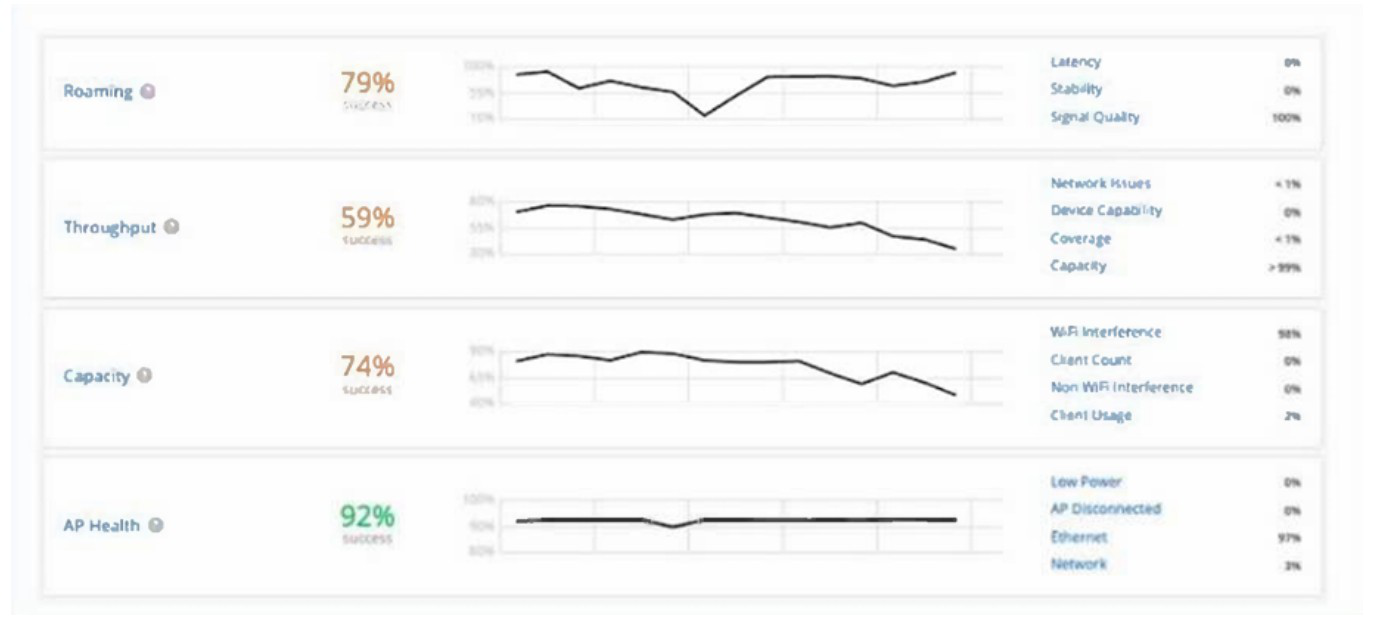
Click the Exhibit button.

Referring to the exhibit, which Roaming Classifier is responsible for the sub-threshold SLEs?

Exhibit for question 1

  1. Capacity
  2. Signal Quality
  3. Ethernet
  4. WiFi interference
Show answer and explanation

Correct answer: B. Signal Quality

The Roaming section displays 79% success with a graph showing relatively stable performance. The right-side metrics for Roaming include Latency (0%), Stability (0%), and Signal Quality (100%). When a roaming classifier shows sub-threshold SLEs (Service Level Events), it indicates performance issues. The Signal Quality metric at 100% is listed as a classifier for Roaming, meaning degradation in signal quality would directly impact roaming success. Since the exhibit shows Roaming at 79% success (not optimal), and Signal Quality is the associated metric, signal quality is the responsible classifier for any sub-threshold SLEs in the Roaming domain.

Why the other options are wrong

  • A. Capacity is the classifier associated with Throughput metrics (Device Capability, Coverage, Capacity), not Roaming performance issues.
  • C. Ethernet is listed as a classifier for AP Health (97%), not for Roaming metrics.
  • D. WiFi Interference is a classifier for Capacity and AP Health (WiFi Interference at 98%), not specifically for Roaming sub-threshold SLEs.

Question 2

You are asked to display your network devices using the Juniper Mist GUI as a single solution. Your network is made up of a wireless infrastructure of only Juniper APs and the wired infrastructure has a mix of Juniper and non-Juniper switches. Your solution must ensure that all devices are displayed in the Juniper Mist GUI.

Given this scenario, how would you accomplish this task?

  1. Use Wired Assurance with the Monitoring option.
  2. Use WiFi Management and Assurance with LLDP enabled on all switches.
  3. Use Juniper Mist Marvis Actions.
  4. Use Juniper Mist Asset Visibility.
Show answer and explanation

Correct answer: D. Use Juniper Mist Asset Visibility.

Asset Visibility is the Juniper Mist feature specifically designed to display and manage all network devices, both Juniper and non-Juniper, in a single unified GUI. It provides comprehensive visibility across the entire network infrastructure regardless of vendor, making it the correct solution for this mixed-vendor environment.

Why the other options are wrong

  • A. Wired Assurance with Monitoring focuses on performance metrics and health status rather than device discovery and display across mixed vendors.
  • B. WiFi Management and Assurance handles only wireless infrastructure; LLDP alone does not provide unified GUI display of mixed-vendor wired devices.
  • C. Marvis Actions is an AI-driven analytics and remediation feature, not a device visibility and management tool.

Question 3

Which two statements about webhooks and APIs are correct? (Choose two.)

  1. 100% of all Juniper Mist objects are configurable using webhooks.
  2. Webhooks are a push from Juniper Mist, and APIs are a pull by the client.
  3. There is an hourly limit to the number of webhooks that an organization can have.
  4. There is an hourly limit to the number of API calls that an organization can have.
Show answer and explanation

Correct answer: B, D

B. Webhooks are a push from Juniper Mist, and APIs are a pull by the client. D. There is an hourly limit to the number of API calls that an organization can have. Webhooks operate as a push mechanism where Juniper Mist sends data to configured endpoints, while APIs operate as a pull mechanism where clients request data from Juniper Mist. Additionally, API calls are subject to hourly rate limits to prevent abuse and ensure service stability, though webhook counts may not have the same restrictions.

Why the other options are wrong

  • A. Not all Juniper Mist objects are configurable via webhooks; webhooks are primarily event-driven notifications rather than a complete configuration interface.
  • C. Webhooks typically do not have hourly count limits; rate limiting is more commonly applied to API calls.

See all 10 free questions Get the full pack, US$39

98 practice questions for Juniper Networks Certified Associate, Mist AI (JNCIA-MistAI), exam JN0-253, with full explanations.

Every question comes with the correct answer, the reasoning behind it, and a short note on why each wrong option is wrong. Work through it once with the answers, then again with the questions-only copy under exam conditions.

  • 98 questions mapped to the JN0-253 exam objectives
  • Answers and explanations for every question, including the wrong options
  • A questions-only PDF for timed practice runs
  • Instant delivery by email the moment you check out
  • Free monthly updates for as long as the exam is live
  • Pass or your money back

A JN0-253 attempt costs US$200. This pack is US$39, paid once.

Try 10 questions free before you buy.

Last updated September 2026 · 98 questions

What makes the JNCIA-MistAI hard

JNCIA-MistAI is the one Juniper associate exam that does not require JNCIA-Junos and does not touch the Junos CLI. It is the entry point to the Mist AI track, and JN0-253 is the current version. The whole exam lives in the Mist cloud dashboard and Marvis, which makes it approachable for wireless people and disorienting for router people.

The objectives start with WLAN fundamentals: RF basics, channel width, the 2.4, 5 and 6 GHz bands, Wi-Fi 6 and 6E, SSIDs and roaming. Mist AI cloud and architecture covers organisations, sites and templates, and the AP claim process. Wireless assurance covers the service level expectation metrics such as time to connect, throughput and coverage. Wired assurance covers EX switch onboarding and the wired SLEs. Marvis covers the conversational assistant and its root cause workflow, and location services covers Bluetooth LE beacons and wayfinding. Juniper does not publish weightings or a passing score, and the questions expect knowledge of which dashboard view answers which question.

This pack has 98 practice questions for the JN0-253 JNCIA-MistAI exam.

About the exam

JN0-253 earns the JNCIA-MistAI certification, the entry point to the Mist AI track leading to JNCIS-MistAI Wireless and Wired and JNCIP-MistAI. It covers WLAN fundamentals, the Mist AI cloud architecture, wireless assurance, wired assurance, Marvis, and location services. There are no prerequisites.

Exam domains

  • WLAN fundamentals
  • Mist AI cloud architecture and organisation setup
  • Wireless assurance and service level expectations
  • Wired assurance
  • Marvis virtual network assistant
  • Location services

Juniper does not publish weightings for these objectives.

65 multiple-choice questions, 90 minutes, US$200 per attempt, Pearson VUE test centre or OnVUE online, certification valid for three years. Juniper does not publish a fixed passing score.


Reviews

There are no reviews yet.

Only logged in customers who have purchased this product may leave a review.

Questions before you buy

What do I get when I buy the Juniper JN0-253 JNCIA-MistAI pack?

98 practice questions as a PDF, each with the correct answer, a full explanation and a note on why the other options are wrong, plus a separate questions-only PDF for timed practice.

How quickly do I receive it?

Your PDF is prepared and sent to your email address after checkout, and you get a confirmation as soon as it is on its way.

Is there a free sample?

Yes. Ten questions from this pack, with answers and explanations, are free on this page and as a PDF, so you can judge the quality before you pay.

Are updates included?

Yes. The pack is updated every month for as long as the exam is live, and updates are free for everyone who has bought it.

What if I fail the exam?

We refund the pack. Sit the exam 7 to 30 days after buying, then send your official score report within 7 days of the exam date, as set out in the refund policy.

Can I share it with colleagues?

Each purchase is licensed to one person. For a team, school or training organisation, email support@certstash.com for a licence that fits.