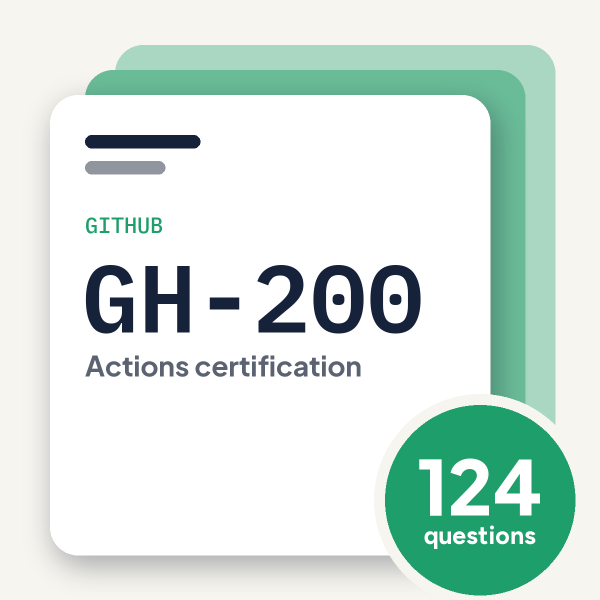
GITHUB · GH-200

GitHub GH-200 Actions Exam Practice Questions

124 questionsPDF by emailUpdated September 2026

US$39

Try 10 questions free

Card, Apple Pay or Google Pay. Your PDF is sent by email as soon as you check out.

Pass or your money backFail the exam after using this pack and we refund it. How the guarantee works
Category:
TRY BEFORE YOU BUY

Three of the 124 questions in this pack

Question 1

How should you print a debug message in your workflow?

  1. echo "::debug::Set variable myVariable to true"
  2. echo "Set variable MyVariable to true" >> $DEBUG_MESSAGE
  3. echo "::add-mask::Set variable myVariable to true"
  4. echo "debug_message=Set variable myVariable to true" >> &GITHUB_OUTPUT
Show answer and explanation

Correct answer: A. echo "::debug::Set variable myVariable to true"

GitHub Actions uses the workflow command syntax `::debug::` to print debug messages to the workflow logs. This is the standard mechanism for outputting debug-level information that appears in the runner's output when debug logging is enabled. Option A correctly formats this command with the proper syntax.

Why the other options are wrong

  • B. Writing to a $DEBUG_MESSAGE variable is not a recognized GitHub Actions mechanism for debug output.
  • C. The `::add-mask::` command is used to mask sensitive values in logs, not to print debug messages.
  • D. This syntax attempts to set an output variable, not print a debug message, and uses incorrect shell redirection syntax for GitHub Actions.

Question 2

As a developer, you are designing a workflow and need to communicate with the runner machine to set environment variables, output values used by other actions, add debug messages to the output logs, and other tasks.

Which of the following options should you use?

  1. composite run step
  2. enable debug logging
  3. self-hosted runners
  4. environment variables
  5. workflow commands
Show answer and explanation

Correct answer: E. workflow commands

Workflow commands are the designated mechanism for communicating with the GitHub Actions runner to perform tasks such as setting environment variables, outputting values for other actions, adding debug messages, and masking values. Workflow commands use the `::command::` syntax and are the standard interface for runner machine interaction.

Why the other options are wrong

  • A. Composite run steps are used to combine multiple run steps into a reusable action, not for communicating with the runner.
  • B. Debug logging is used to enable verbose output but is not the mechanism for performing these communication tasks.
  • C. Self-hosted runners are runner machines, not a communication method.
  • D. Environment variables are one tool that can be set, but workflow commands are the broader mechanism that handles all these tasks.

Question 3

When should you use the GITHUB_TOKEN in a workflow?

  1. when you want to make authenticated calls to the GitHub API
  2. when you want to connect to the runner via SSH
  3. when you want to access repository-level secrets
  4. when you want to call an action from the marketplace
Show answer and explanation

Correct answer: A. when you want to make authenticated calls to the GitHub API

GitHub API The GITHUB_TOKEN is an automatically generated authentication token provided to workflows by GitHub Actions. Its primary purpose is to enable authenticated calls to the GitHub REST API, allowing workflows to perform operations like creating issues, managing releases, or accessing repository data while maintaining proper authentication and authorization.

Why the other options are wrong

  • B. SSH connections to the runner are managed through SSH keys and runner configuration, not the GITHUB_TOKEN.
  • C. Repository-level secrets are accessed through the secrets context in workflows, not through the GITHUB_TOKEN.
  • D. Actions from the marketplace are called by reference in the workflow file; no authentication token is required to call them.

See all 10 free questions Get the full pack, US$39

124 practice questions for GitHub Actions certification (GH-200), with full explanations.

Every question comes with the correct answer, the reasoning behind it, and a short note on why each wrong option is wrong. Work through it once with the answers, then again with the questions-only copy under exam conditions.

  • 124 questions mapped to the GH-200 exam objectives
  • Answers and explanations for every question, including the wrong options
  • A questions-only PDF for timed practice runs
  • Instant delivery by email the moment you check out
  • Free monthly updates for as long as the exam is live
  • Pass or your money back

A GH-200 attempt costs US$99. This pack is US$39, paid once.

Try 10 questions free before you buy.

Last updated September 2026 · 124 questions

What makes the GH-200 hard

GH-200 was rebuilt in January 2026. It went from four domains to five, added a security and optimisation domain, and Microsoft’s change log says objectives were added, removed, moved and reworded throughout, so an older four-domain question set is for a different exam.

What it tests now is whether a candidate can run Actions at scale, not just write a YAML file. Workflow authoring and enterprise management are the two biggest domains at 20 to 25% each: workflow_dispatch inputs mapped into workflow_call, service containers, matrix strategies, contexts and expression evaluation, then runner groups, IP allow lists and secrets managed through the REST API.

The newer security domain covers GITHUB_TOKEN versus PAT permissions, OIDC federation to cloud providers, pinning actions to full commit SHAs under immutable actions enforcement, script injection mitigation, and SLSA artifact attestations. The blueprint even names the Ubuntu 20.04 deprecation and the Windows Server 2025 move for windows-latest, which shows how current the questions are.

About the exam

GH-200 (GitHub Actions) is delivered by Microsoft and maintained by GitHub. It covers authoring and managing workflows, consuming and troubleshooting workflows, authoring and distributing custom actions, managing Actions for the enterprise including runners and secrets, and securing and optimising automation. It is an intermediate-level exam with no prerequisites, and skills are measured as of January 2026.

Exam domains

  • Author and manage workflows: 20 to 25%
  • Consume and troubleshoot workflows: 15 to 20%
  • Author and maintain actions: 15 to 20%
  • Manage GitHub Actions for the enterprise: 20 to 25%
  • Secure and optimize automation: 10 to 15%

Passing score 700 out of 1000, US$99 per attempt, online proctored or test centre, certification valid for two years.
Reviews

There are no reviews yet.

Only logged in customers who have purchased this product may leave a review.

Questions before you buy

What do I get when I buy the GitHub GH-200 Actions pack?

124 practice questions as a PDF, each with the correct answer, a full explanation and a note on why the other options are wrong, plus a separate questions-only PDF for timed practice.

How quickly do I receive it?

Your PDF is prepared and sent to your email address after checkout, and you get a confirmation as soon as it is on its way.

Is there a free sample?

Yes. Ten questions from this pack, with answers and explanations, are free on this page and as a PDF, so you can judge the quality before you pay.

Are updates included?

Yes. The pack is updated every month for as long as the exam is live, and updates are free for everyone who has bought it.

What if I fail the exam?

We refund the pack. Sit the exam 7 to 30 days after buying, then send your official score report within 7 days of the exam date, as set out in the refund policy.

Can I share it with colleagues?

Each purchase is licensed to one person. For a team, school or training organisation, email support@certstash.com for a licence that fits.