CISCO · 300-815

Cisco 300-815 CLACC Exam Practice Questions

245 questionsPDF by emailUpdated September 2026

US$39

Try 10 questions free

Card, Apple Pay or Google Pay. Your PDF is sent by email as soon as you check out.

Pass or your money backFail the exam after using this pack and we refund it. How the guarantee works
Category:
TRY BEFORE YOU BUY

Three of the 245 questions in this pack

Question 1

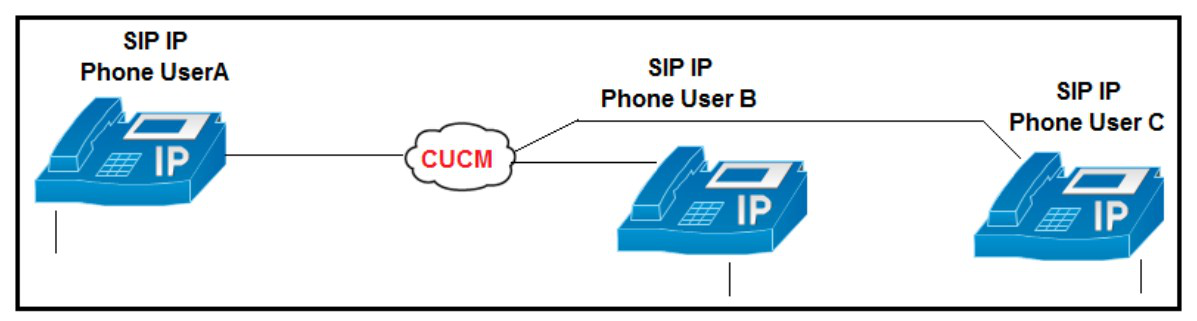
Refer to the exhibit. In an active SIP call between phone user A and phone user B, phone A initiates a call transfer to phone user C. Which two scenarios are correct? (Choose two.)

Exhibit for question 1

  1. Phone_A sends a SIP-REFER message to the Cisco Unified Communications Manager with Phone_C information in the Refer-To section.
  2. Phone_B sends a SIP-REFER message to the Cisco Unified CM with Phone_C information in the Refer-To section.
  3. As soon as Phone_A presses the Transfer button for the first time, Phone_B hears the MOH and the MOH audio is chosen from Phone_B User Hold MOH Audio Source settings.
  4. As soon as Phone_A presses the Transfer button for the first time, Phone_B hears the music on hold and the MOH audio is chosen from Phone_A Network Hold MOH Audio Source settings.
  5. As soon as Phone_A presses the Transfer button for the first time, Phone_B hears the MOH and the MOH audio is chosen from Phone_A User Hold MOH Audio Source settings.
Show answer and explanation

Correct answer: A, D

A. Phone_A sends a SIP-REFER message to the Cisco Unified Communications Manager with Phone_C information in the Refer-To section. D. As soon as Phone_A presses the Transfer button for the first time, Phone_B hears the music on hold and the MOH audio is chosen from Phone_A Network Hold MOH Audio Source settings. When Phone A initiates a blind transfer by pressing the Transfer button, Phone A sends the SIP REFER message to the CUCM (not Phone B), making option A correct. When Phone A puts Phone B on hold by pressing Transfer, Phone B immediately hears music on hold. The MOH source is determined by Phone A's Network Hold MOH Audio Source settings, not Phone B's User Hold settings and not Phone A's User Hold settings. The Network Hold MOH Audio Source is used when a call is placed on hold during transfer or other network-initiated hold scenarios, making option D correct.

Why the other options are wrong

  • B. Phone B does not send the SIP REFER message; Phone A (the initiating party) sends it to the CUCM.
  • C. The MOH audio source is determined by the holding party's (Phone A's) Network Hold settings, not Phone B's User Hold settings.
  • E. The MOH audio is chosen from Phone A's Network Hold MOH Audio Source settings during transfer, not from User Hold settings.

Question 2

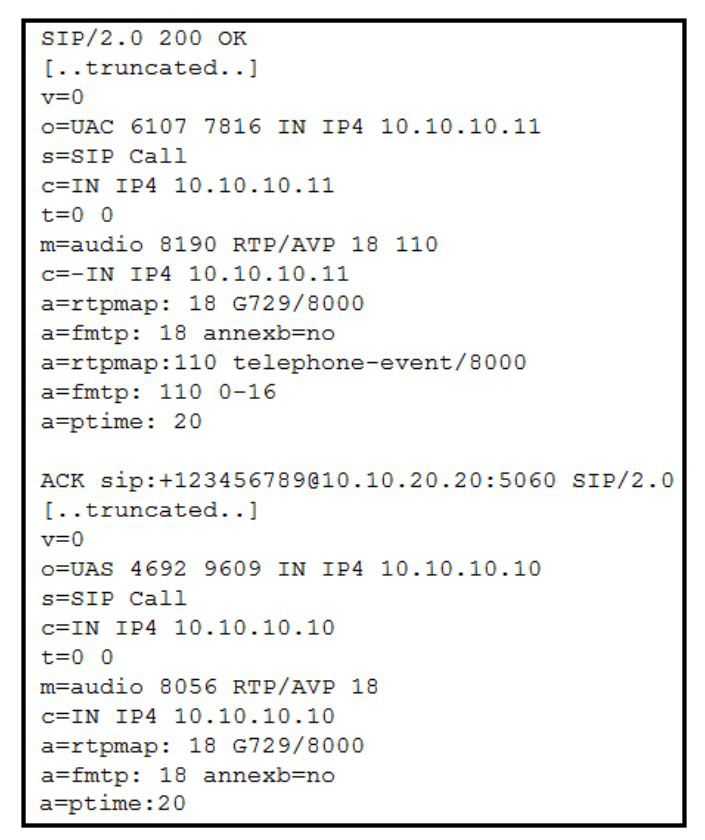
Refer to the exhibit. Users report that when they dial to Cisco Unity Connection from an external network, they cannot enter any digits. Assuming only in-band DTMF is supported, what is a reason for this malfunction?

Exhibit for question 2

  1. The negotiated RTP port is outside of the range described by RFC, so in-band DTMFs do not work.
  2. There is SIP Delayed Offer. DTMF is supported only in Early Offer.
  3. The rtpmap:0 value for the negotiated codec is marking DTMF as inactive.
  4. No DTMF is negotiated.
Show answer and explanation

Correct answer: D. No DTMF is negotiated.

The SIP 200 OK response shows media negotiation for the call. In the first SDP (offer), the payload type 110 is defined as 'a=rtpmap:110 telephone-event/8000', which is the standard in-band DTMF mechanism. However, in the ACK response from the other endpoint, the media line shows 'm=audio 8056 RTP/AVP 18' with only payload type 18 (G729) negotiated. Critically, there is no corresponding 'a=rtpmap:110 telephone-event/8000' in the ACK response, meaning the telephone-event payload type was not accepted by the far end. Since only codec 18 is negotiated and no DTMF mechanism is agreed upon in the final SDP, DTMF digits cannot be transmitted in-band, causing the inability to enter digits.

Why the other options are wrong

  • A. RFC standards define RTP ports flexibly; the port numbers 8190 and 8056 are within valid ranges and not the cause of DTMF failure.
  • B. The SDP exchange shows Early Offer negotiation occurring (offer in 200 OK, answer in ACK), which is consistent with DTMF support; this is not a Delayed Offer scenario.
  • C. The rtpmap:0 refers to PCMU codec, not DTMF; the DTMF issue is that rtpmap:110 for telephone-event is missing from the ACK, not that payload 0 is marked inactive.

Question 3

The administrator of ABC company is troubleshooting a one-way audio issue for a call that uses H.323 protocol (slow-start mode). The administrator requests that you provide the IP and port information of the Real-Time Transport Protocol traffic that had the one- way audio call.

You gather the H.225 and H.245 messages for one of the one-way audio calls.

Where can you find the RTP IP and port information for both sides?

(Note: This call flow has not invoked any media resources like MTP or transcoders).

  1. H.245 Terminal Capability Set
  2. H.245 Open Logical Channel
  3. H.225 Connect
  4. H.245 Open Logical Channel Ack
Show answer and explanation

Correct answer: D. H.245 Open Logical Channel Ack

In H.323 slow-start mode, the RTP IP and port information for both sides of a call is communicated in the H.245 Open Logical Channel Ack message. The originating endpoint sends an Open Logical Channel message proposing media parameters, and the responding endpoint confirms the agreed-upon RTP parameters (including IP address and port) in the Open Logical Channel Ack. This acknowledgment contains the actual media endpoint details that both sides will use for RTP transmission.

Why the other options are wrong

  • A. Terminal Capability Set messages describe what codecs and capabilities an endpoint supports, not the actual RTP transport addresses.
  • B. The Open Logical Channel message is a proposal; it does not contain confirmed RTP endpoint information from both sides.
  • C. H.225 Connect is a call signaling message that does not carry the detailed RTP transport address information negotiated during H.245 media setup.

See all 10 free questions Get the full pack, US$39

245 practice questions for Cisco 300-815 CLACC v2.0, the on-premises call control concentration for CCNP Collaboration, with full explanations.

Every question comes with the correct answer, the reasoning behind it, and a note on why each wrong option is wrong. Work through it once with the answers, then again with the questions-only copy under exam conditions.

  • 245 questions across all five CLACC domains
  • Answers and explanations for every question, including the wrong options
  • A questions-only PDF for timed practice runs
  • Instant delivery by email the moment you check out
  • Free monthly updates for as long as the exam is live
  • Pass or your money back

A failed 300-815 attempt costs another US$300. This pack is US$39, paid once, and refunded if you fail.

Try 10 questions free before you buy.

Last updated September 2026 · 245 questions

What makes the CLACC hard

300-815 kept its number but not its name. The v1.2 exam was CLACCM, Advanced Call Control and Mobility Services. The v2.0 exam that replaced it in February 2026 is CLACC, Advanced Call Control On-Premises, and the domains were rebuilt: mobility was folded into supplemental features, business-to-business joined remote connectivity, and the session border controller domain grew to nearly a third of the exam.

Session Border Controller and Voice Gateway Technologies is 30%: UCME and SIP SRST, troubleshooting CUBE dial plans, DTMF interop, SIP profiles, TLS profiles and SRTP, and dial peer groups. Advanced Call Control at 25% covers SIP normalisation in UCM, SIP trunk security profiles, and troubleshooting globalised routing. Supplemental features and security adds certificate trust stores, secure phone registration, hunt groups, Unified Mobility and Extension Mobility, plus GDPR. Remote connectivity is MRA configuration and troubleshooting, Expressway media traversal, TLS and mTLS, and B2B troubleshooting. Signalling protocols opens the exam at 10% with PRACK, UPDATE, STUN, TURN and ICE.

About the exam

300-815 (Implementing Cisco Advanced Call Control On-Premises v2.0, CLACC) earns the Cisco Certified Specialist, Collaboration Call Control and Mobility Implementation certification and counts as a concentration exam for CCNP Collaboration. It covers SIP signalling and media, CUBE and voice gateway technologies, advanced UCM call control, supplemental features, security and mobility, and MRA, Expressway and business-to-business solutions. No prerequisites.

Exam domains

  • Signaling and Media Protocols: 10%
  • Session Border Controller and Voice Gateway Technologies: 30%
  • Advanced Call Control: 25%
  • Supplemental Features and Security: 20%
  • Remote Connectivity and Business to Business Solutions: 15%

90 minutes, US$300 per attempt, Pearson VUE test centre or online, certification valid for three years. Cisco does not publish a fixed passing score.
Reviews

There are no reviews yet.

Only logged in customers who have purchased this product may leave a review.

Questions before you buy

What do I get when I buy the Cisco 300-815 CLACC pack?

245 practice questions as a PDF, each with the correct answer, a full explanation and a note on why the other options are wrong, plus a separate questions-only PDF for timed practice.

How quickly do I receive it?

Your PDF is prepared and sent to your email address after checkout, and you get a confirmation as soon as it is on its way.

Is there a free sample?

Yes. Ten questions from this pack, with answers and explanations, are free on this page and as a PDF, so you can judge the quality before you pay.

Are updates included?

Yes. The pack is updated every month for as long as the exam is live, and updates are free for everyone who has bought it.

What if I fail the exam?

We refund the pack. Sit the exam 7 to 30 days after buying, then send your official score report within 7 days of the exam date, as set out in the refund policy.

Can I share it with colleagues?

Each purchase is licensed to one person. For a team, school or training organisation, email support@certstash.com for a licence that fits.