THE OPEN GROUP · OGEA-103

The Open Group OGEA-103 Exam Practice Questions

183 questionsPDF by emailUpdated September 2026

US$39

Try 10 questions free

Card, Apple Pay or Google Pay. Your PDF is sent by email as soon as you check out.

Pass or your money backFail the exam after using this pack and we refund it. How the guarantee works
Category:
TRY BEFORE YOU BUY

Three of the 183 questions in this pack

Question 1

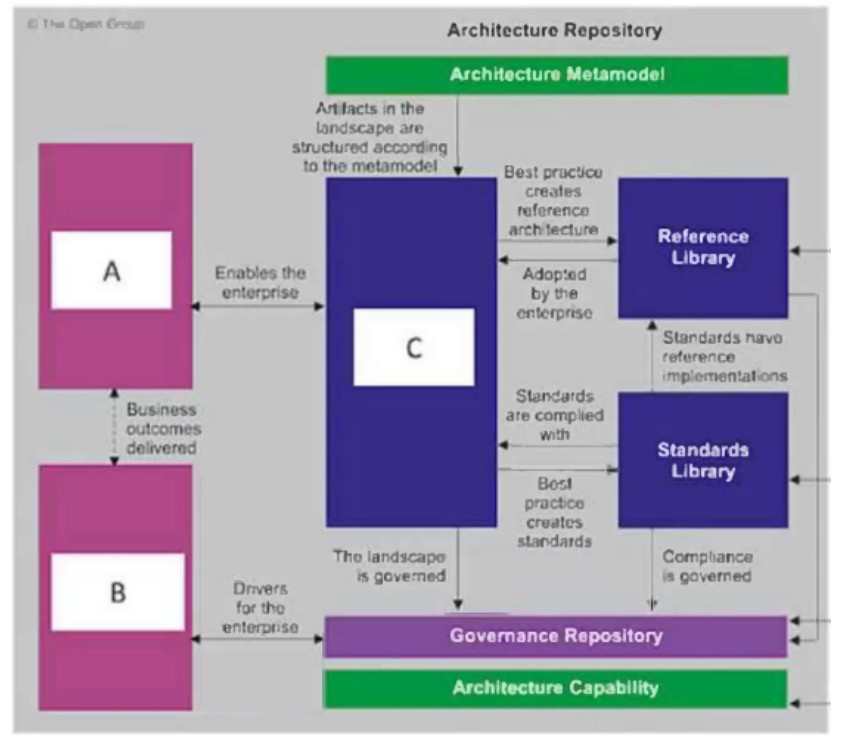
Consider the illustration. What are the items labelled A, B and C?

Exhibit for question 1

  1. A-Solution Landscape, B-Architecture Requirements Repository, C-Architecture Landscape
  2. A-Architecture Landscape, B-Architecture Requirements Repository, C-Solutions Landscape
  3. A-EA Landscape, B-Requirements Repository, C-Artifacts Landscape
  4. A-Architecture Requirements Repository, B-Solutions Repository, C-Architecture Landscape
Show answer and explanation

Correct answer: B. A-Architecture Landscape, B-Architecture Requirements Repository, C-Solutions Landscape

Requirements Repository, C-Solutions Landscape The diagram shows three key enterprise components on the left side: A represents the Architecture Landscape (the current state of IT systems and their relationships), B represents the Solutions Landscape (planned solutions and implementations), and C represents the Artifacts Landscape (the collection of artifacts structured by the Architecture Metamodel). The flow demonstrates how A (Architecture Landscape) enables the enterprise, B (Solutions Landscape) drives the enterprise, and both feed into C (Artifacts Landscape) which forms the central repository governed by the metamodel and connected to Reference Library, Standards Library, and Governance Repository.

Why the other options are wrong

  • A. This option incorrectly labels A as Solution Landscape and C as Architecture Landscape, reversing their actual designations.
  • C. This option uses incomplete or non-standard terminology (EA Landscape, Requirements Repository, Artifacts Landscape) that does not match the standard TOGAF architecture repository framework shown.
  • D. This option misidentifies all three components, labeling A as Architecture Requirements Repository and B as Solutions Repository, which contradicts the diagram's clear positioning and relationships.

Question 2

Which phase of the ADM has the purpose to develop an Enterprise Architecture Capability?

  1. Phase A
  2. Phase G
  3. Phase B
  4. Preliminary Phase
Show answer and explanation

Correct answer: D. Preliminary Phase

The Preliminary Phase of the ADM has the specific purpose of developing an Enterprise Architecture Capability. This phase establishes the foundation for architecture work by defining the architecture function, identifying stakeholders, securing sponsorship, and determining the tools and processes needed to support ongoing architecture development. Phase A initiates the architecture work itself, Phase B develops business architecture, and Phase G closes the iteration.

Why the other options are wrong

  • A. Phase A is the Architecture Vision phase, which sets direction and scope, not capability development.
  • B. Phase G is the Implementation Governance phase, focused on overseeing execution.
  • C. Phase B develops the business architecture domain, not the capability framework.

Question 3

Which statement about Requirements Management is most correct?

  1. Requirements Management and stakeholder engagement are placed at the center of architecture development.
  2. Requirements Management is a step of all ADM Phases.
  3. The purpose of Requirements Management is to process change requests.
  4. Stakeholder requirements are captured once in Phase A and managed throughout the ADM cycle.
Show answer and explanation

Correct answer: A. Requirements Management and stakeholder engagement are placed at the center of architecture development.

engagement are placed at the center of architecture development. Requirements Management and stakeholder engagement are central to TOGAF architecture development, forming a continuous process rather than isolated activities. Requirements are identified, managed, and refined throughout the entire ADM cycle, with stakeholder input essential at every phase to ensure the architecture meets organizational needs.

Why the other options are wrong

  • B. While Requirements Management is ongoing, it is not formally structured as a sequential step in all phases; it is continuous.
  • C. Requirements Management processes stakeholder needs and architecture requirements, not solely change requests.
  • D. Requirements are not captured once in Phase A; they are identified progressively and refined throughout the ADM cycle.

See all 10 free questions Get the full pack, US$39

183 practice questions for The Open Group TOGAF Enterprise Architecture Combined Part 1 and Part 2 Exam (OGEA-103), with full explanations.

Every question comes with the correct answer, the reasoning behind it, and a short note on why each wrong option is wrong. Work through it once with the answers, then again with the questions-only copy under exam conditions.

  • 183 questions mapped to the OGEA-103 Part 1 and Part 2 exam plans
  • Answers and explanations for every question, including the wrong options
  • A questions-only PDF for timed practice runs
  • Instant delivery by email the moment you check out
  • Free monthly updates for as long as the exam is live
  • Pass or your money back

An OGEA-103 attempt costs US$610. This pack is US$39, paid once.

Try 10 questions free before you buy.

Last updated September 2026 · 183 questions

What makes the OGEA-103 hard

OGEA-103 is both TOGAF Enterprise Architecture exams in one sitting on the 10th Edition of the standard: the 40-question closed-book Part 1 in 60 minutes, then the 8-question open-book Part 2 in 90 minutes, and candidates must score 60% on each section separately. Once Part 1 is submitted it cannot be revisited, and a fail on either half fails the whole US$610 booking, which is why the combined route saves money but punishes an unbalanced revision plan.

Part 1 follows the published exam plan: 14 questions on the ADM, 8 on concepts and terminology, 6 on ADM techniques, 5 on architecture content, 4 on applying the ADM and 3 on governance. Part 2 is where the exam changes character: each of the eight questions is a scenario, often a page long, with four graded answers, the best answer earns five points, the second best three, the third one and the distractor zero, so it is possible to pass Part 2 without picking the best answer every time, but not by knowing definitions alone.

The Part 2 syllabus covers the context for enterprise architecture, stakeholder management, Phase A through Phase H and Requirements Management in practice, architecture principles, gap analysis and business scenarios applied, architecture governance and compliance, and the architecture content framework. The electronic copy of the standard is available during that section for reference, not for reading from scratch.

About the exam

OGEA-103 (TOGAF Enterprise Architecture Combined Part 1 and Part 2 Exam) earns TOGAF Enterprise Architecture Practitioner from The Open Group in one sitting, based on the TOGAF Standard, 10th Edition. Part 1 covers enterprise architecture concepts, the ADM, ADM techniques, applying the ADM, architecture governance and architecture content; Part 2 applies the ADM, techniques, governance and the content framework to scenarios. There are no prerequisites.

Exam structure

  • Part 1: 40 multiple-choice questions, 60 minutes, closed book. 14 on the ADM, 8 on concepts, 6 on ADM techniques, 5 on architecture content, 4 on applying the ADM, 3 on governance
  • Part 2: 8 scenario-based complex multiple-choice questions, 90 minutes, open book with the electronic TOGAF Standard, graded answers worth 5, 3, 1 or 0 points

48 questions, 150 minutes total, passing score 60% on each part, US$610 per attempt, Pearson VUE test centre or online. The certification does not expire.
Reviews

There are no reviews yet.

Only logged in customers who have purchased this product may leave a review.

Questions before you buy

What do I get when I buy the The Open Group OGEA-103 pack?

183 practice questions as a PDF, each with the correct answer, a full explanation and a note on why the other options are wrong, plus a separate questions-only PDF for timed practice.

How quickly do I receive it?

Your PDF is prepared and sent to your email address after checkout, and you get a confirmation as soon as it is on its way.

Is there a free sample?

Yes. Ten questions from this pack, with answers and explanations, are free on this page and as a PDF, so you can judge the quality before you pay.

Are updates included?

Yes. The pack is updated every month for as long as the exam is live, and updates are free for everyone who has bought it.

What if I fail the exam?

We refund the pack. Sit the exam 7 to 30 days after buying, then send your official score report within 7 days of the exam date, as set out in the refund policy.

Can I share it with colleagues?

Each purchase is licensed to one person. For a team, school or training organisation, email support@certstash.com for a licence that fits.