
10 free The Open Group OGEA-103 practice questions with the correct answer and a full explanation for each, taken from the CertStash pack of 183 questions. Work through them, then open each answer to check your reasoning.
Get all 183 questions (US$39) · Download these 10 as a PDF
Question 1
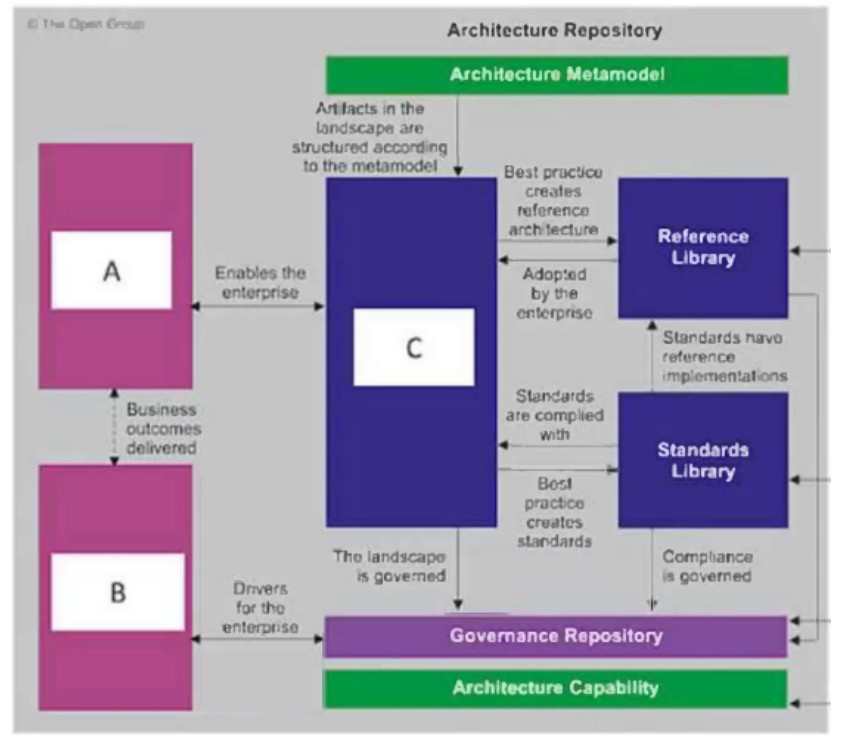
Consider the illustration.
What are the items labelled A, B and C?
Show answer and explanation
Correct answer: B. A-Architecture Landscape, B-Architecture Requirements Repository, C-Solutions Landscape
Requirements Repository, C-Solutions Landscape The diagram shows three key enterprise components on the left side: A represents the Architecture Landscape (the current state of IT systems and their relationships), B represents the Solutions Landscape (planned solutions and implementations), and C represents the Artifacts Landscape (the collection of artifacts structured by the Architecture Metamodel). The flow demonstrates how A (Architecture Landscape) enables the enterprise, B (Solutions Landscape) drives the enterprise, and both feed into C (Artifacts Landscape) which forms the central repository governed by the metamodel and connected to Reference Library, Standards Library, and Governance Repository.
Why the other options are wrong
- A. This option incorrectly labels A as Solution Landscape and C as Architecture Landscape, reversing their actual designations.
- C. This option uses incomplete or non-standard terminology (EA Landscape, Requirements Repository, Artifacts Landscape) that does not match the standard TOGAF architecture repository framework shown.
- D. This option misidentifies all three components, labeling A as Architecture Requirements Repository and B as Solutions Repository, which contradicts the diagram's clear positioning and relationships.
Question 2
Which phase of the ADM has the purpose to develop an Enterprise Architecture Capability?
Show answer and explanation
Correct answer: D. Preliminary Phase
The Preliminary Phase of the ADM has the specific purpose of developing an Enterprise Architecture Capability. This phase establishes the foundation for architecture work by defining the architecture function, identifying stakeholders, securing sponsorship, and determining the tools and processes needed to support ongoing architecture development. Phase A initiates the architecture work itself, Phase B develops business architecture, and Phase G closes the iteration.
Why the other options are wrong
- A. Phase A is the Architecture Vision phase, which sets direction and scope, not capability development.
- B. Phase G is the Implementation Governance phase, focused on overseeing execution.
- C. Phase B develops the business architecture domain, not the capability framework.
Question 3
Which statement about Requirements Management is most correct?
Show answer and explanation
Correct answer: A. Requirements Management and stakeholder engagement are placed at the center of architecture development.
engagement are placed at the center of architecture development. Requirements Management and stakeholder engagement are central to TOGAF architecture development, forming a continuous process rather than isolated activities. Requirements are identified, managed, and refined throughout the entire ADM cycle, with stakeholder input essential at every phase to ensure the architecture meets organizational needs.
Why the other options are wrong
- B. While Requirements Management is ongoing, it is not formally structured as a sequential step in all phases; it is continuous.
- C. Requirements Management processes stakeholder needs and architecture requirements, not solely change requests.
- D. Requirements are not captured once in Phase A; they are identified progressively and refined throughout the ADM cycle.
Question 4
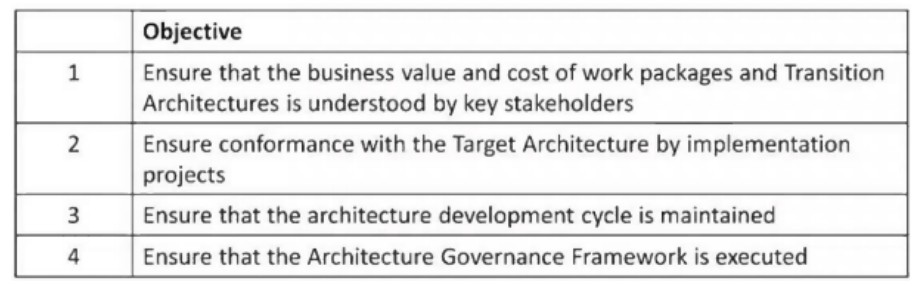
Consider the following ADM phases objectives.
Which phase does each objective match?
Show answer and explanation
Correct answer: C. 1F-2G-3H-4H
The objectives map to ADM phases as follows: Objective 1 (understanding business value and cost) corresponds to Phase F (Preliminary), which establishes baseline understanding and business context; Objective 2 (ensuring conformance with Target Architecture) corresponds to Phase G (Architecture Definition), which develops and defines the target architecture; Objective 3 (maintaining the development cycle) corresponds to Phase H (Architecture Realization), which implements and monitors the architecture through its lifecycle; Objective 4 (executing the Architecture Governance Framework) corresponds to Phase H (Architecture Change Management), which provides ongoing governance and manages changes. This sequence (1F-2G-3H-4H) reflects the logical progression from initial planning and business understanding through definition, realization, and continuous governance.
Why the other options are wrong
- A. Incorrectly assigns Objective 3 to Phase G and Objective 4 to Phase H, failing to recognize that maintaining the development cycle and executing governance frameworks both occur in the realization and change management phases.
- B. Reverses the assignments of Objectives 1 and 2 to Phases G and H respectively, placing business value understanding after architecture definition rather than before it.
- D. Incorrectly starts with Objective 1 in Phase H and assigns Objectives 2 and 3 to earlier phases, which contradicts the proper sequence of planning before definition before realization.
Question 5
Which of the following is a responsibility of an Architecture Board?
Show answer and explanation
Correct answer: A. Establishing targets for re-use of components
An Architecture Board is responsible for establishing targets for the reuse of components, ensuring consistency and efficiency across architecture assets. This governance responsibility helps maintain architectural standards and promotes the use of proven, reusable architectural patterns within the organization.
Why the other options are wrong
- B. Creating the Statement of Architecture Work is an ADM activity, not an Architecture Board responsibility.
- C. Allocating resources for architecture projects is a management responsibility, not specifically an Architecture Board function.
- D. Conducting maturity assessments is performed during architecture capability evaluations, not as a core Architecture Board responsibility.
Question 6
What is used to structure architectural information in an orderly way so that it can be processed to meet stakeholder needs?
Show answer and explanation
Correct answer: D. A Content Metamodel
A Content Metamodel is used to structure architectural information in an orderly, consistent way so that it can be processed and understood to meet stakeholder needs. It defines the types of architecture artifacts, their properties, and their relationships, providing a framework for organizing and managing architectural data.
Why the other options are wrong
- A. A Stakeholder Map identifies stakeholders and their interests; it does not structure architectural information.
- B. An Architecture Framework provides the overall methodology and structure for developing architecture, but the metamodel is what organizes the specific content.
- C. An EA Library stores reusable architecture assets but does not define how to structure the information itself.
Question 7
Complete the sentence. The TOGAF standard covers the development of four architecture domains, Business, Data, Technology and __________.
Show answer and explanation
Correct answer: D. Application
The TOGAF standard defines four architecture domains: Business, Data, Application, and Technology. These domains together provide a comprehensive view of the enterprise architecture across all critical dimensions of the organization.
Why the other options are wrong
- A. Segment is a scope concept, not one of the four architecture domains.
- B. Capability is an architectural concept but not one of the four primary architecture domains.
- C. Transition refers to the migration from current to future state, not a domain of architecture itself.
Question 8
Complete the sentence. The Enterprise Continuum provides methods for classifying architecture artifacts as they evolve from ____________________.
Show answer and explanation
Correct answer: B. generic architectures to Organization-Specific Architectures
Architectures The Enterprise Continuum provides methods for classifying architecture artifacts as they evolve from generic architectures, broadly applicable across industries, to Organization- Specific Architectures tailored to a particular enterprise's unique requirements and context.
Why the other options are wrong
- A. While Solution Building Blocks are important, the progression is from generic to organization-specific, not to building blocks.
- C. Foundation Architectures are one type of generic architecture; the direction is from these toward specific implementations.
- D. Solutions Architectures and Solution Building Blocks are endpoints in the continuum, not the primary progression described.
Question 9
What is defined as the effect of uncertainty on objectives?
Show answer and explanation
Correct answer: A. Risk
Risk is formally defined as the effect of uncertainty on objectives. It encompasses the potential impact that uncertain events may have on achieving organizational goals, combining both the probability of an event occurring and the consequences of that event.
Why the other options are wrong
- B. Vulnerability refers to a weakness that could be exploited, not the effect of uncertainty on objectives.
- C. Threat is an external agent or circumstance that could cause harm, distinct from risk.
- D. Continuity refers to maintaining business operations, not the definition of risk itself.
Question 10
What is an objective of the ADM Preliminary Phase?
Show answer and explanation
Correct answer: D. To select and implement tools to support the Architecture Capability
Architecture Capability An objective of the ADM Preliminary Phase is to select and implement tools to support the Architecture Capability. This includes establishing the technical and organizational infrastructure needed to conduct architecture work effectively, such as modeling tools, repositories, and governance mechanisms.
Why the other options are wrong
- A. Obtaining approval for the Statement of Architecture Work is an objective of Phase A, not the Preliminary Phase.
- B. Creating the initial Architecture Roadmap occurs during Phase E (Opportunities and Solutions), not the Preliminary Phase.
- C. Developing the vision of business value is addressed in Phase A (Architecture Vision), which follows the Preliminary Phase.
That was 10 of 183.
The full The Open Group OGEA-103 pack has all 183 questions, each with the answer, the explanation and why the other options are wrong, plus a questions-only copy for timed runs. US$39, paid once, with free monthly updates and a pass-or-your-money-back guarantee.