SALESFORCE · MuleSoft Developer

Salesforce MuleSoft Developer Exam Practice Questions

60 questionsPDF by emailUpdated September 2026

US$39

Try 10 questions free

Card, Apple Pay or Google Pay. Your PDF is sent by email as soon as you check out.

Pass or your money backFail the exam after using this pack and we refund it. How the guarantee works
Category:
TRY BEFORE YOU BUY

Three of the 60 questions in this pack

Question 1

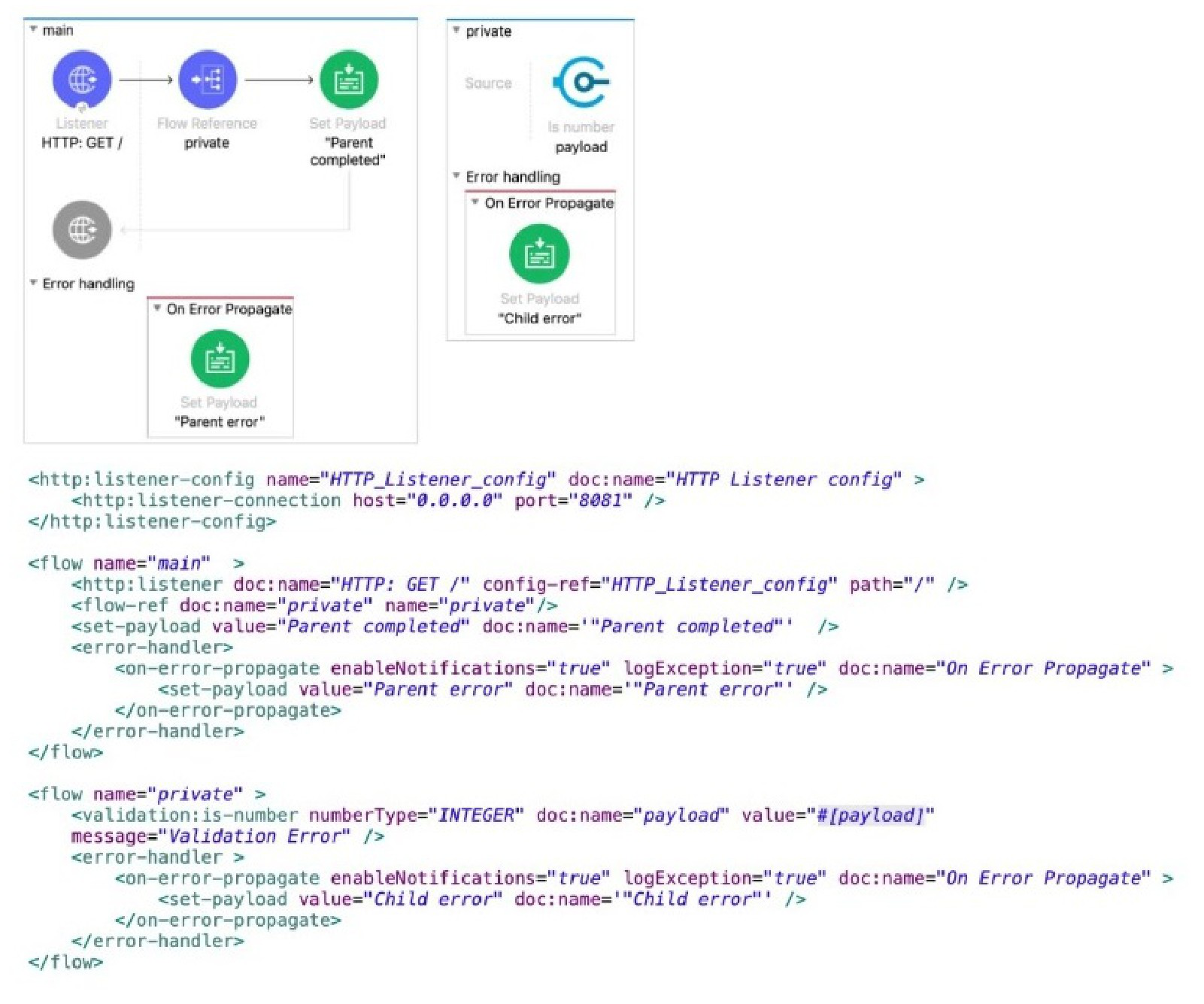
Refer to the exhibits. The Mule application does NOT define any global error handlers. The Validation component in the private flow throws an error. What response message is returned to a web client request to the main flow's HTTP Listener?

Exhibit for question 1

  1. "Parent error"
  2. "Child error"
  3. "Parent completed"
  4. "Validation Error''
Show answer and explanation

Correct answer: B. "Child error"

When the Validation component in the private flow throws an error, the private flow's error handler catches it via the On Error Propagate handler, which sets the payload to 'Child error' and propagates the error up to the calling flow. Since there are no global error handlers defined, the error propagates from the private flow back to the main flow. The main flow's error handler then catches this propagated error via its On Error Propagate handler, which would set the payload to 'Parent error'. However, the question asks what response is returned to the web client. The error propagates through the main flow's error handler, but the 'Child error' payload from the private flow's error handler is what gets returned to the client because error propagation passes the modified message context back up the chain. The private flow's error handler executes first, sets the payload to 'Child error', and this modified message is what propagates to the main flow's error handler and ultimately back to the HTTP Listener client.

Why the other options are wrong

  • A. This is the payload set by the main flow's error handler, but it would only be returned if the error originated in the main flow or if the main flow's error handler overwrites the child error payload.
  • C. This payload is set by the main flow's normal (non-error) path execution and would only be returned on successful completion without errors.
  • D. The Validation Error is the message attribute, not the payload that would be returned to the client in the response body.

Question 2

A function named toUpper needs to be defined that accepts a string named userName and returns the string in uppercase. What is the correct DataWeave code to define the toUpper function?

  1. var toUpper(userName) = upper(userName)
  2. fun toUpper(userName) = upper(userName)
  3. var toUpper(userName) -> upper(userName)
  4. fun toUpper(userName) -> upper(userName)
Show answer and explanation

Correct answer: B. fun toUpper(userName) = upper(userName)

In DataWeave, functions are defined using the `fun` keyword followed by the function name, parameters in parentheses, an equals sign, and the function body. The correct syntax is `fun toUpper(userName) = upper(userName)`, which declares a function named toUpper that accepts a userName parameter and returns the result of the upper() function applied to that parameter.

Why the other options are wrong

  • A. Uses `var` keyword instead of `fun`; `var` is for variable assignment, not function definition.
  • C. Uses `var` keyword with incorrect arrow syntax `->` instead of the equals sign required for function definitions.
  • D. Uses the `fun` keyword correctly but employs arrow syntax `->` instead of the equals sign `=` required in DataWeave function definitions.

Question 3

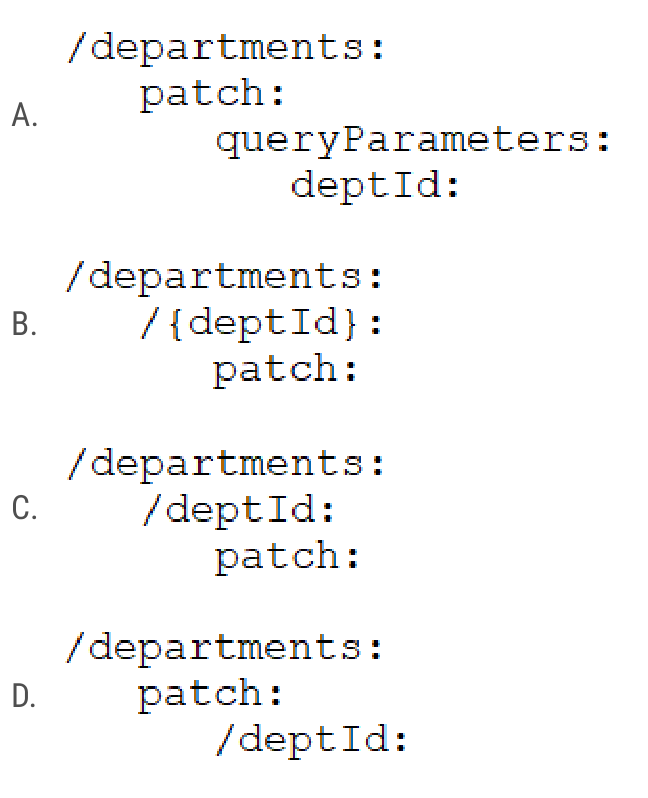
Northern Trail Outfitters (NTO) has an API to manage departments, with each department identified by a unique deptId. The API was built with RAML according to MuleSoft best practices. What is valid RAML to specify a method to update the details for a specific department?

Exhibit for question 3

Show answer and explanation

Correct answer: B. /departments:

/{deptId}: patch: According to RAML best practices and MuleSoft standards, path parameters that identify specific resources should be defined using curly braces in the resource path itself, not as query parameters. Option B correctly specifies the endpoint as /departments/{deptId} with the patch method, which is the proper RAML syntax for updating a specific department resource identified by its unique deptId. The curly braces denote a URI parameter that is part of the resource path, which is the standard approach for RESTful APIs when targeting a specific resource.

Why the other options are wrong

  • A. Uses queryParameters for deptId, which is inappropriate for identifying a specific resource in a RESTful API; path parameters should be used instead.
  • C. Uses /deptId without curly braces, which does not define it as a valid URI parameter and does not follow RAML syntax conventions.
  • D. Places /deptId after the patch method instead of in the resource path hierarchy, which is structurally incorrect RAML.

See all 10 free questions Get the full pack, US$39

60 practice questions for Salesforce Certified MuleSoft Developer, with full explanations.

Every question comes with the correct answer, the reasoning behind it, and a short note on why each wrong option is wrong. Work through it once with the answers, then again with the questions-only copy under exam conditions.

  • 60 questions mapped to the MuleSoft Developer exam guide
  • Answers and explanations for every question, including the wrong options
  • A questions-only PDF for timed practice runs
  • Instant delivery by email the moment you check out
  • Free monthly updates for as long as the exam is live
  • Pass or your money back

A MuleSoft Developer attempt costs US$200 (US$100 for a retake). This pack is US$39, paid once.

Try 10 questions free before you buy.

Last updated September 2026 · 60 questions

What makes the MuleSoft Developer hard

MuleSoft Developer is the Mule 4 exam, previously called MuleSoft Certified Developer Level 1 before Salesforce folded it into the Trailhead Academy catalogue, and it is a prerequisite for Developer II. It is 60 questions in 120 minutes with a 70% pass mark and no reference material allowed, and the question style is distinctive: most items show a flow, a piece of DataWeave or a configuration and ask you to predict the outcome, so architecture vocabulary alone will not get you through.

The twelve sections are almost evenly weighted, which is the point. Five carry 10% each: accessing and modifying Mule events (payload, attributes and variables, and how they change across a flow); structuring Mule applications with flows, subflows, private flows, properties and global configurations; using connectors for databases, files, web services, SaaS applications and JMS; processing records with For Each, batch jobs and streaming; and transforming data with DataWeave 2.0, where candidates must write and read map, filter, reduce and pluck, coerce types and predict script output. Designing APIs, routing events and handling errors are 8% each. Creating application networks, building API implementation interfaces with APIkit, and deploying and managing APIs and integrations with CloudHub and API Manager policies are 7% each, and debugging and troubleshooting with the Studio debugger is 5%.

Two minutes per question is only enough time if you have actually built the things in Anypoint Studio.

About the exam

The Salesforce Certified MuleSoft Developer credential validates the ability to design, build, test, debug, deploy and manage basic Mule 4 APIs and integrations using Anypoint Platform and Anypoint Studio. There are no prerequisites; it is itself the prerequisite for MuleSoft Developer II.

Exam domains

  • Creating application networks: 7%
  • Designing APIs: 8%
  • Accessing and modifying Mule events: 10%
  • Structuring Mule applications: 10%
  • Building API implementation interfaces: 7%
  • Using connectors: 10%
  • Processing records: 10%
  • Transforming data with DataWeave: 10%
  • Routing events: 8%
  • Handling errors: 8%
  • Debugging and troubleshooting Mule applications: 5%
  • Deploying and managing APIs and integrations: 7%

60 multiple-choice questions plus up to 5 unscored, 120 minutes, passing score 70%, US$200 per attempt, US$100 retake, delivered through Trailhead Academy at Pearson VUE test centres or online, no reference materials permitted, maintained through release maintenance.

Reviews

There are no reviews yet.

Only logged in customers who have purchased this product may leave a review.

Questions before you buy

What do I get when I buy the Salesforce MuleSoft Developer pack?

60 practice questions as a PDF, each with the correct answer, a full explanation and a note on why the other options are wrong, plus a separate questions-only PDF for timed practice.

How quickly do I receive it?

Your PDF is prepared and sent to your email address after checkout, and you get a confirmation as soon as it is on its way.

Is there a free sample?

Yes. Ten questions from this pack, with answers and explanations, are free on this page and as a PDF, so you can judge the quality before you pay.

Are updates included?

Yes. The pack is updated every month for as long as the exam is live, and updates are free for everyone who has bought it.

What if I fail the exam?

We refund the pack. Sit the exam 7 to 30 days after buying, then send your official score report within 7 days of the exam date, as set out in the refund policy.

Can I share it with colleagues?

Each purchase is licensed to one person. For a team, school or training organisation, email support@certstash.com for a licence that fits.