
MICROSOFT · MB-820

Microsoft MB-820 Exam Practice Questions

131 questionsPDF by emailUpdated September 2026

US$39

Try 10 questions free

Card, Apple Pay or Google Pay. Your PDF is sent by email as soon as you check out.

Pass or your money backFail the exam after using this pack and we refund it. How the guarantee works
Category:
TRY BEFORE YOU BUY

Three of the 131 questions in this pack

Question 1

A company is deploying Business Central on-premises. The company plans to use a single-tenant deployment architecture. You need to describe how the data is stored and how the Business Central Server is configured. In which two ways should you describe the single-tenant architecture? Each correct answer presents a complete solution. NOTE: Each correct selection is worth one point.

  1. Each customer has their own Business Central Server.
  2. The application and the business data are stored in the same database.
  3. Multiple customers share a single Business Central Server.
  4. The application and business data are stored in separate databases.
  5. Multiple customers share multiple Business Central Server instances.
Show answer and explanation

Correct answer: B, D

B. The application and the business data are stored in the same database. D. The application and business data are stored in separate databases. In a single-tenant on-premises deployment, each customer has their own dedicated Business Central Server instance, and the application code and business data are stored together in the same database. This contrasts with multi-tenant deployments where customers share server resources. Option B correctly describes the data storage model, and option D is incorrect because single-tenant architectures do not separate application and business data into different databases.

Why the other options are wrong

  • A. Each customer having their own server is true, but this is not a distinguishing characteristic specific to single-tenant architecture.
  • C. Multiple customers sharing a single server is characteristic of multi-tenant, not single- tenant architecture.
  • E. Multiple customers sharing multiple server instances describes a multi-tenant deployment model.

Question 2

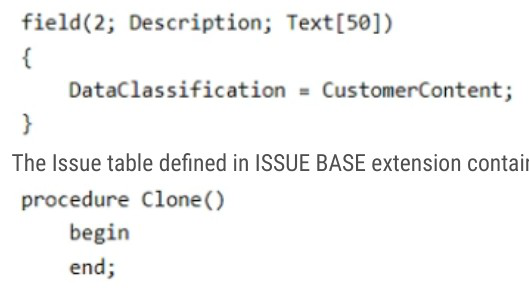
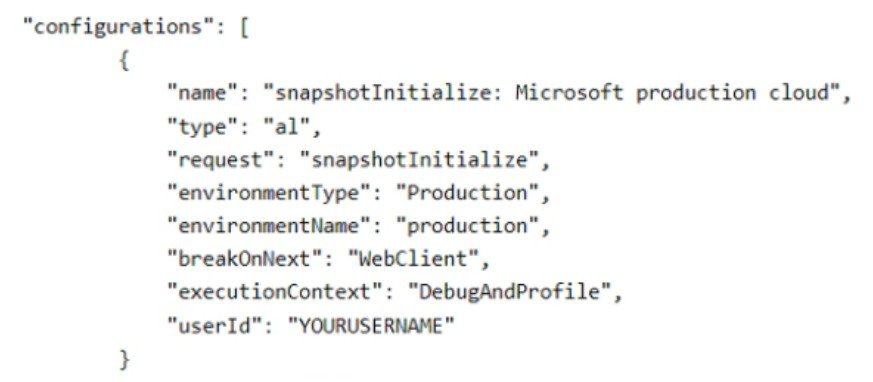
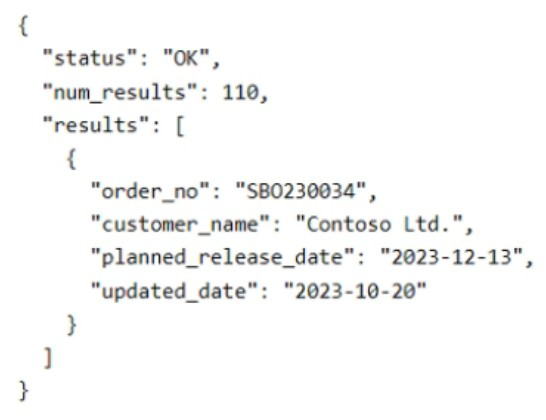
CASE STUDY This is a case study. Case studies are not timed separately. You can use as much exam time as you would like to complete each case. However, there may be additional case studies and sections on this exam. You must manage your time to ensure that you are able to complete all questions included on this exam in the time provided. To answer the questions included in a case study, you will need to reference information that is provided in the case study. Case studies might contain exhibits and other resources that provide more information about the scenario that is described in the case study. Each question is independent of the other questions in this case study. At the end of this case study, a review screen will appear. This screen allows you to review your answers and to make changes before you move to the next section of the exam. After you begin a new section, you cannot return to this section. To start the case study -To display the first question in this case study, click the Next button. Use the buttons in the left pane to explore the content of the case study before you answer the questions. Clicking these buttons displays information such as business requirements, existing environment, and problem statements. If the case study has an All Information tab, note that the information displayed is identical to the information displayed on the subsequent tabs. When you are ready to answer a question, click the Question button to return to the question. Background Contoso, Ltd. is a sales company in the manufacturing industry. It has subsidiaries in multiple countries/regions, each with its own localization. The subsidiaries must be data-independent from each other. Contoso. Ltd. uses an external business partner to manage the subcontracting of some manufacturing items. Contoso, Ltd. has different sectors with data security between sectors required. Current environment -Contoso, Ltd. uses Business Central online as the main ERP for financials, sales, purchase, warehouse, and manufacturing processes. It has employees that use the Business Central web application and external applications. The company has a custom external mobile app under development. The IT department and its partners installed custom extensions to satisfy the company's requirements where the functionality is not available natively. Contoso, Ltd. interacts with external services provided by customers and partners. Different applications interact with SOAP and OData endpoints exposed from Business Central. An external business partner of Contoso, Ltd. exposed a REST API for receiving details about new subcontracting orders and for sending the planned release date of each subcontracting order received. Contoso, Ltd. has not activated the monitoring of the tenant and has no internal telemetry for its apps. Custom reporting must be created to meet the requirements of the different departments. Tenant management -Contoso, Ltd. has the following tenant management considerations: IT department -The IT department requires the ability to monitor the tenant to prevent performance problems and detect possible anomalies. The IT department plans to use Azure Application Insights and Log Analytics to inspect the ingested telemetry signals. All tenant upgrades are automatically handled by Microsoft. The IT department does not check for update availability or for tenant-related notifications. The IT department has not configured the receipt of tenant-related notifications from the Business Central admin center. External business partner -The external business partner must add custom telemetry to an application created for Contoso, Ltd. to monitor a business process. Custom telemetry signals for the application must be visible only on the partner's telemetry. SOAP Contoso, Ltd. plans to dismiss using the SOAP protocol for integrations. Contoso, Ltd. must be able to detect if external applications are using its Business Central SOAP endpoints. Issue The Business Central tenant is upgraded by Microsoft to a new major version during the night. Users report that one of the Contoso, Ltd. extensions disappeared from the tenant. The IT department confirms that the extension is still published. Custom mobile application requirements Contoso, Ltd. plans to create a custom mobile application that has the following requirements: The app must be used by employees to check item details from the ERP in real time and to report issues that occur during the manufacturing process. An AL extension must be created for handling archived issues. Business Central development guidelines must be followed when implementing modules. A module must be implemented for the reporting and tracking of issues information. You plan to call this module Issue Management. The module must expose a method named PostIssue. Code modifications will be required over time. The Issue Management process must be split into two extensions: • ISSUE BASE: main extension • ISSUE EXT: second extension with dependency from ISSUE BASE In the version 1.0.0.0 of the ISSUE BASE extension, you plan to create an Issue table that contains a global Decimal variable named IssueTotal. In the version 1.0.0.0 of the ISSUE BASE extension, you plan to define a table named Issue Category with a Description field defined as follows: The Issue table defined in ISSUE BASE extension contains a Clone procedure defined as follows: In the ISSUE EXT extension, you create a tableextension object of the Issue table. The tableextension object of the Issue table must access the IssueTotal: Decimal variable. After weeks of usage, you discover that you must remove the Description field and the Clone procedure because they are no longer required. In a new version of the ISSUE BASE extension, you create a new Issue Type table. You must move data row by row from a previously obsolete Issue Category table to the new Issue Type table. Because a large amount of data must be moved, you must write an Upgrade codeunit by using the DataTransfer object. The IT department creates a custom API for exposing the custom Issue table. The API provides an action for copying an issue to a new table. The action is defined as follows: Contoso, Ltd. must create an API in Business Central to expose item details to the mobile application. The API must have the lowest possible impact on the production environment when used during working hours. The API must only support Get operations. Debugging problems -A user of the ISSUE BASE extension in Business Central reports a problem. To debug the problem, snapshot debugging with the following configuration was activated: You discover that the debugging is not triggering. Integration with business partner for subcontracting Contoso, Ltd. must connect Business Central to the external API provided by the business partner. This will be used for the partner to send the details of new subcontracting orders to fulfill the sales demand, and for receiving the planned release date of each order sent. The integration requirements are as follows: The business partner will provide a REST API secured with basic authentication. Credentials to access the API will be shared with Contoso, Ltd. The API for sending subcontracting orders must be called by sending an authenticated POST request to the given endpoint. The API for retrieving the order no. and planned release date of each subcontracting order responds with the following JSON: Each order no. must be retrieved. You need to determine why the extension does not appear in the tenant. What are two possible reasons for the disappearance? Each correct answer presents a complete solution. NOTE: Each correct selection is worth one point.

Exhibit for question 2

Exhibit for question 2

Exhibit for question 2

Exhibit for question 2

  1. The extension was published as a DEV extension.
  2. The extension was not compatible with the new version within 60 days of the first notification.
  3. The extension was published as PTE, and the Platform parameter was not updated in the app.json file.
  4. The extension was published as PTE, and the Platform and Runtime parameters were not updated in the app.json file.
  5. The extension was not compatible with the new version within 90 days of the first notification.
Show answer and explanation

Correct answer: A, E

A. The extension was published as a DEV extension. E. The extension was not compatible with the new version within 90 days of the first notification. When Microsoft upgrades Business Central to a new major version, extensions must maintain compatibility or they are automatically removed from the tenant. Option A is correct because DEV extensions are only for development purposes and are automatically removed during production upgrades or tenant management operations. Option E is correct because Business Central enforces a compatibility window: extensions published as PTE (Per-Tenant Extension) or AppSource extensions must be compatible with the new platform version within 90 days of the first notification, or they are automatically uninstalled. The case study indicates the IT department has not configured receipt of tenant notifications, meaning they would have missed the 90-day deadline notification for updating their extension's compatibility requirements.

Why the other options are wrong

  • B. The compatibility window is 90 days, not 60 days, making this timeframe incorrect for Business Central's extension lifecycle management.
  • C. Updating only the Platform parameter without Runtime is incomplete; both parameters must be updated together for PTE extensions to maintain compatibility.
  • D. While this describes the correct update process for PTE extensions, it does not explain why the extension disappeared, the issue is the failure to update within the 90- day window, not the specific parameters themselves.

Question 3

You are cleaning up sandbox environments for a company. The company requires data to be cleared from the environments each time an extension is published. You need to configure the launch.json file. Which schemaUpdateMode property should you set?

  1. ForceUpgrade
  2. ForceSync
  3. Synchronize
  4. Recreate
Show answer and explanation

Correct answer: D. Recreate

The Recreate schemaUpdateMode property clears all data from the sandbox environment and recreates the database schema when an extension is published. This is the appropriate setting when the company requires data to be cleared each time an extension is published to ensure a clean state.

Why the other options are wrong

  • A. ForceUpgrade updates the schema without clearing data, which does not meet the requirement to clear data.
  • B. ForceSync synchronizes the schema without removing existing data.
  • C. Synchronize is a standard mode that updates the schema while preserving data.

See all 10 free questions Get the full pack, US$39

131 practice questions for Dynamics 365 Business Central Developer (MB-820), with full explanations.

Every question comes with the correct answer, the reasoning behind it, and a short note on why each wrong option is wrong. Work through it once with the answers, then again with the questions-only copy under exam conditions.

  • 131 questions mapped to the MB-820 exam objectives
  • Answers and explanations for every question, including the wrong options
  • A questions-only PDF for timed practice runs
  • Instant delivery by email the moment you check out
  • Free monthly updates for as long as the exam is live
  • Pass or your money back

An MB-820 attempt costs US$165 in the US. This pack is US$39, paid once.

Try 10 questions free before you buy.

Last updated September 2026 · 131 questions

What makes the MB-820 hard

MB-820 is the AL exam, and it rewards candidates who have shipped an extension rather than just read about one. Microsoft’s June 2025 refresh left the weighting alone but rewrote the API section, so OData bound and unbound actions and Read Scale-Out are now explicitly in scope alongside the HTTP and JSON classes.

Develop by using AL objects is over a third of the exam: Role Center pages and page types, table and enum extensions, report substitution and layouts, document reports, request pages and processing-only reports, XMLports and their node properties, codeunits with events, triggers, interfaces and install and upgrade codeunits, permission sets and entitlements with inherent permissions, and query objects for joins, filters and aggregation.

The AL language domain adds profiles and views in code, the user assistance model, assisted setup, teaching tips, in-app tours and onboarding checklists, plus the data process model, functional table types, document and master data patterns, error handling and access modifiers. Tools covers the Test Toolkit and test codeunits, and telemetry configuration with custom signals. The describe and deploy domains are lighter but expect knowledge of base app versus system app, the AppSource process, multi-extension workspaces and multilanguage development.

About the exam

MB-820 (Microsoft Dynamics 365 Business Central Developer) leads to the Dynamics 365 Business Central Developer Associate credential. It covers Business Central architecture and apps, the development environment and extension deployment, AL objects including pages, tables, reports, XMLports, codeunits, permission sets and queries, AL language and UI customisation, testing and telemetry, and REST and API integration. Associate level, no prerequisites. Skills measured as of 10 June 2025.

Exam domains

  • Describe Business Central: 10 to 15%
  • Install, develop, and deploy for Business Central: 10 to 15%
  • Develop by using AL objects: 35 to 40%
  • Develop by using AL: 15 to 20%
  • Work with development tools: 10 to 15%
  • Integrate Business Central with other applications: 10 to 15%

Passing score 700 out of 1000, US$165 in the US, priced by local currency elsewhere, online proctored or test centre, renews annually for free.
Reviews

There are no reviews yet.

Only logged in customers who have purchased this product may leave a review.

Questions before you buy

What do I get when I buy the Microsoft MB-820 pack?

131 practice questions as a PDF, each with the correct answer, a full explanation and a note on why the other options are wrong, plus a separate questions-only PDF for timed practice.

How quickly do I receive it?

Your PDF is prepared and sent to your email address after checkout, and you get a confirmation as soon as it is on its way.

Is there a free sample?

Yes. Ten questions from this pack, with answers and explanations, are free on this page and as a PDF, so you can judge the quality before you pay.

Are updates included?

Yes. The pack is updated every month for as long as the exam is live, and updates are free for everyone who has bought it.

What if I fail the exam?

We refund the pack. Sit the exam 7 to 30 days after buying, then send your official score report within 7 days of the exam date, as set out in the refund policy.

Can I share it with colleagues?

Each purchase is licensed to one person. For a team, school or training organisation, email support@certstash.com for a licence that fits.