MICROSOFT · DP-420

Microsoft DP-420 Exam Practice Questions

271 questionsPDF by emailUpdated September 2026

US$39

Try 10 questions free

Card, Apple Pay or Google Pay. Your PDF is sent by email as soon as you check out.

Pass or your money backFail the exam after using this pack and we refund it. How the guarantee works
Category:
TRY BEFORE YOU BUY

Three of the 271 questions in this pack

Question 1

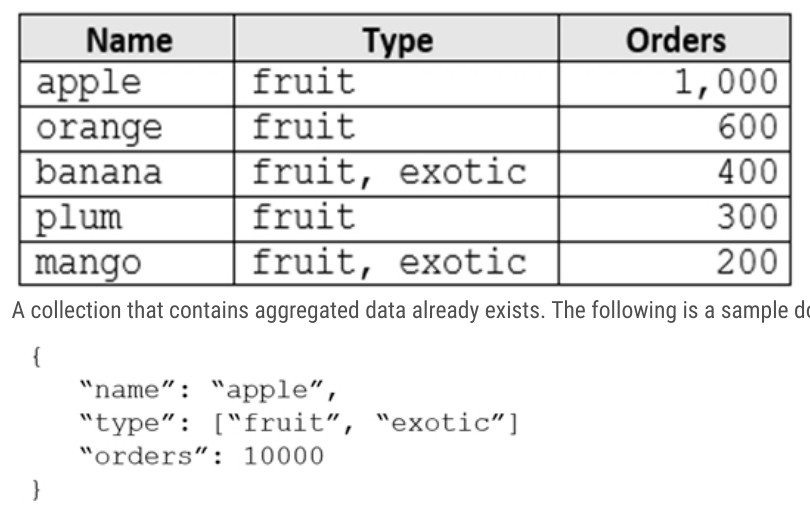
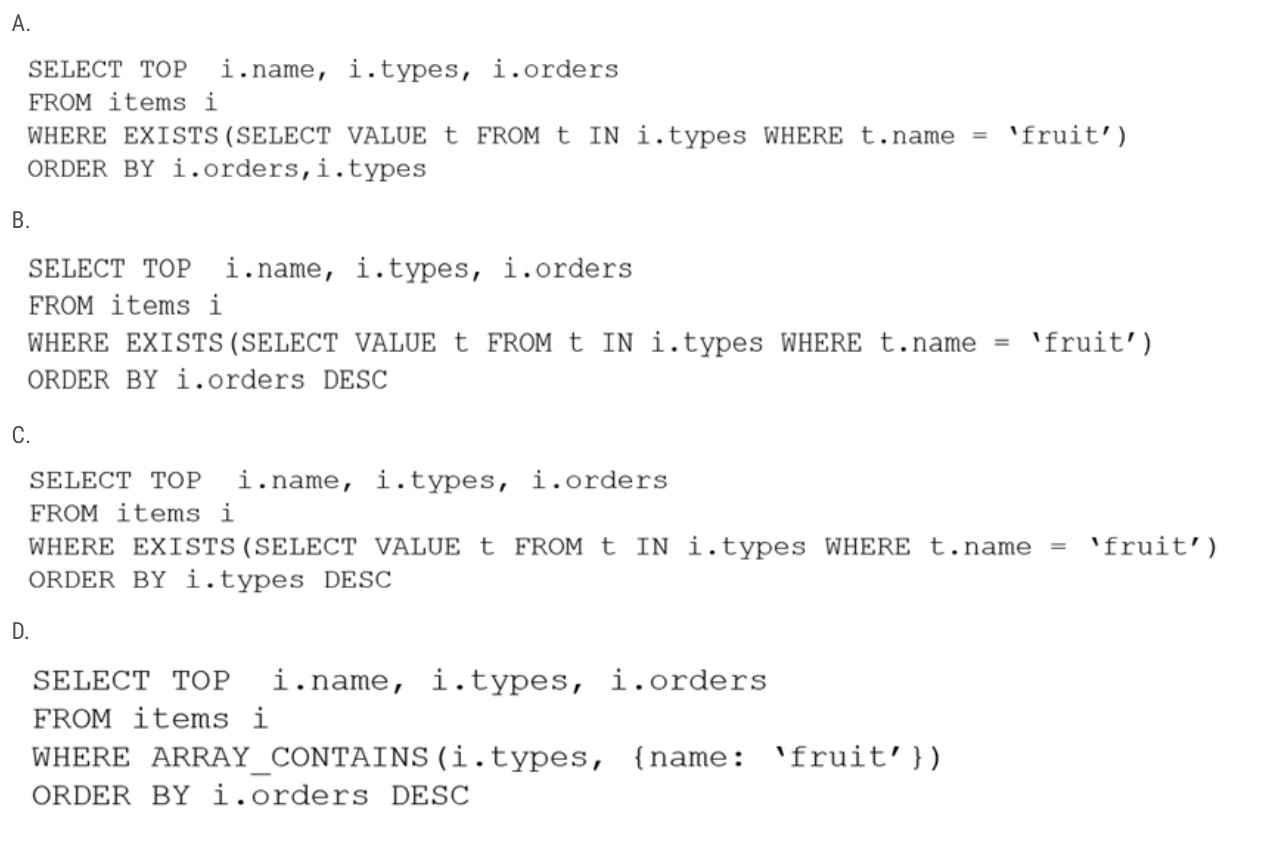
You are developing an application that will use an Azure Cosmos DB Core (SQL) API account as a data source. You need to create a report that displays the top five most ordered fruits as shown in the following table. A collection that contains aggregated data already exists. The following is a sample document: Which two queries can you use to retrieve data for the report? Each correct answer presents a complete solution. NOTE: Each correct selection is worth one point.

Exhibit for question 1

Exhibit for question 1

Show answer and explanation

Correct answer: B, D

B. SELECT TOP i.name, i.types, i.orders FROM items i WHERE EXISTS(SELECT VALUE t FROM t IN i.types WHERE t.name = 'fruit') ORDER BY i.orders DESC D. SELECT TOP i.name, i.types, i.orders FROM items i WHERE ARRAY_CONTAINS(i.types, {name: 'fruit'}) ORDER BY i.orders DESC Both options B and D correctly retrieve the top five most ordered fruits in descending order. Option B uses the EXISTS operator with a subquery on the types array, checking if any element has name = 'fruit', then ordering by orders in descending order. Option D uses the ARRAY_CONTAINS function, which is a more direct method to check if the types array contains an object with name = 'fruit', also ordering by orders descending. Both approaches properly filter for items where 'fruit' is in the types array and sort by order count from highest to lowest, which is required to identify the top ordered items.

Why the other options are wrong

  • A. This option orders by i.orders and then i.types, placing types as a secondary sort criterion, which does not produce the correct descending order by orders needed for the top fruits report.
  • C. This option orders by i.types DESC instead of i.orders DESC, sorting alphabetically by type rather than by order count, which fails to identify the most ordered fruits.

Question 2

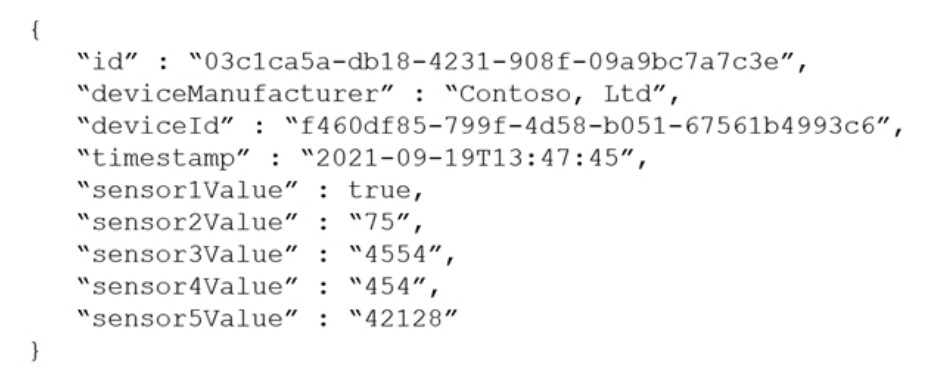
You are designing an Azure Cosmos DB Core (SQL) API solution to store data from IoT devices. Writes from the devices will be occur every second. The following is a sample of the data. You need to select a partition key that meets the following requirements for writes: • Minimizes the partition skew • Avoids capacity limits • Avoids hot partitions What should you do?

Exhibit for question 2

  1. Use timestamp as the partition key.
  2. Create a new synthetic key that contains deviceId and sensor1Value.
  3. Create a new synthetic key that contains deviceId and deviceManufacturer.
  4. Create a new synthetic key that contains deviceId and a random number.
Show answer and explanation

Correct answer: D. Create a new synthetic key that contains deviceId and a random number.

a random number. A partition key must distribute writes evenly across partitions to avoid hot partitions and skew. Using timestamp (A) would concentrate all writes to a single partition at any given moment, creating severe hot partitions. Using deviceManufacturer (C) would skew data toward devices from the most common manufacturer. Using only deviceId (B) would work better but still risks uneven distribution if some devices send data more frequently. Adding a random number to deviceId (D) ensures even distribution of writes across partitions regardless of device frequency patterns, device manufacturer distribution, or time-based clustering, which is essential for IoT scenarios with continuous writes every second.

Why the other options are wrong

  • A. Timestamp as partition key would route all simultaneous writes to the same partition, creating an immediate hot partition bottleneck.
  • B. Adding deviceManufacturer creates skew because writes would cluster by manufacturer; if one manufacturer produces most devices, that partition receives disproportionate load.
  • C. deviceManufacturer alone results in poor distribution since all writes from a manufacturer go to one partition, violating the requirement to minimize partition skew.

Question 3

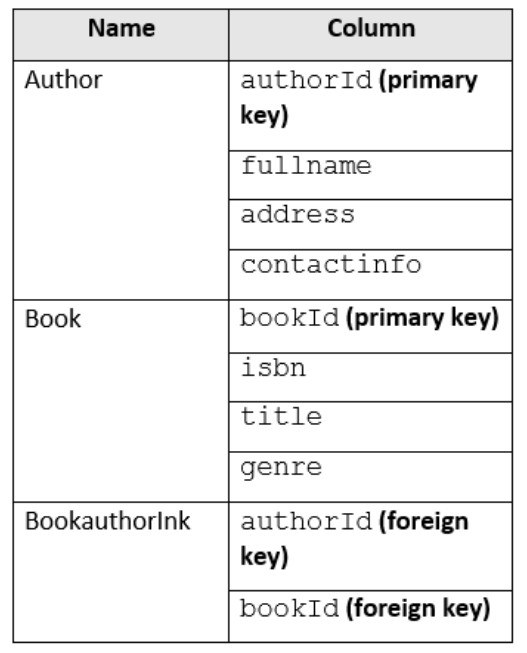
You maintain a relational database for a book publisher. The database contains the following tables. The most common query lists the books for a given authorId. You need to develop a non-relational data model for Azure Cosmos DB Core (SQL) API that will replace the relational database. The solution must minimize latency and read operation costs. What should you include in the solution?

Exhibit for question 3

  1. Create a container for Author and a container for Book. In each Author document, embed bookId for each book by the author. In each Book document embed authorId of each author.
  2. Create Author, Book, and Bookauthorlnk documents in the same container.
  3. Create a container that contains a document for each Author and a document for each Book. In each Book document, embed authorId.
  4. Create a container for Author and a container for Book. In each Author document and Book document embed the data from Bookauthorlnk.
Show answer and explanation

Correct answer: C. Create a container that contains a document for each Author and a document for each Book. In each Book document, embed authorId.

Author and a document for each Book. In each Book document, embed authorId. For the most common query that lists books for a given authorId, option C provides optimal latency and cost by storing Author and Book documents in a single container with authorId embedded in each Book document. This enables a single, efficient partition-key query to retrieve all books by an author without joins or cross-partition operations. Denormalizing authorId into Book documents eliminates the need for separate Bookauthorlnk lookups while keeping the container design simple and cost-effective, as queries execute within a single partition when properly keyed.

Why the other options are wrong

  • A. Embedding bookId in Author documents creates a one-to-many relationship stored on the parent, making it inefficient for querying books by author and causing large document sizes when authors have many books.
  • B. Storing Author, Book, and Bookauthorlnk as separate documents in the same container requires multiple queries or joins to retrieve books for an author, increasing latency and read costs.
  • D. Embedding Bookauthorlnk data into both Author and Book documents creates redundant denormalization without solving the core query problem and adds unnecessary complexity and storage overhead.

See all 10 free questions Get the full pack, US$39

271 practice questions for Microsoft Azure Cosmos DB Developer (DP-420), with full explanations.

Every question comes with the correct answer, the reasoning behind it, and a short note on why each wrong option is wrong. Work through it once with the answers, then again with the questions-only copy under exam conditions.

  • 271 questions mapped to the DP-420 exam objectives
  • Answers and explanations for every question, including the wrong options
  • A questions-only PDF for timed practice runs
  • Instant delivery by email the moment you check out
  • Free monthly updates for as long as the exam is live
  • Pass or your money back

A DP-420 attempt costs US$165 in the US. This pack is US$39, paid once.

Try 10 questions free before you buy.

Last updated September 2026 · 271 questions

What makes the DP-420 hard

DP-420 is a single-service exam, and that is what makes it hard. There is nowhere to hide behind general Azure knowledge: every domain is Azure Cosmos DB for NoSQL, and Microsoft expects candidates to read C# or Java, write the SQL dialect, interpret JSON and use PowerShell.

Over a third of the exam is data modelling and access: embedding versus referencing, synthetic and hierarchical partition keys, TTL, serverless versus provisioned throughput, gateway versus direct connectivity, transactional batch and bulk in the SDK, ETags for optimistic concurrency, session tokens, continuation tokens, handling 429s, and stored procedures, triggers and UDFs in JavaScript. Maintain is the second biggest domain: Normalized RU Consumption in Azure Monitor, periodic versus continuous backup and point in time restore, customer-managed keys, Entra ID data-plane RBAC, Always Encrypted, and moving data with Data Factory, Kafka, Stream Analytics and the Spark connector.

The July 2026 refresh added Cosmos DB Mirroring for Microsoft Fabric, time travel in Fabric Warehouse and Azure AI Search to the integration domain, so older prep material misses those. A bigger change follows: on 6 October 2026 Microsoft moves DP-420 to a new outline, Building AI Applications with Azure Cosmos DB, with three skill areas rather than five.

About the exam

DP-420 (Designing and Implementing Cloud-Native Applications Using Microsoft Azure Cosmos DB) leads to Microsoft Certified: Azure Cosmos DB Developer Specialty. It covers data modelling and partitioning, global distribution and consistency, integration with Fabric, Synapse, Functions and AI Search, query and index optimisation, change feed, and monitoring, backup, security and DevOps for Cosmos DB. Specialty level, no prerequisites. Skills measured as of 21 July 2026, current until Microsoft’s 6 October 2026 update moves the exam to Design and develop database solutions (40 to 45%), Secure, optimise, and deploy database solutions (30 to 35%), and Implement AI and analytics capabilities in database solutions (20 to 25%).

Exam domains

  • Design and implement data models: 35 to 40%
  • Design and implement data distribution: 5 to 10%
  • Integrate an Azure Cosmos DB solution: 5 to 10%
  • Optimise an Azure Cosmos DB solution: 15 to 20%
  • Maintain an Azure Cosmos DB solution: 25 to 30%

Passing score 700 out of 1000, US$165 in the US, priced by local currency elsewhere, online proctored or test centre, renews annually for free.

Reviews

There are no reviews yet.

Only logged in customers who have purchased this product may leave a review.

Questions before you buy

What do I get when I buy the Microsoft DP-420 pack?

271 practice questions as a PDF, each with the correct answer, a full explanation and a note on why the other options are wrong, plus a separate questions-only PDF for timed practice.

How quickly do I receive it?

Your PDF is prepared and sent to your email address after checkout, and you get a confirmation as soon as it is on its way.

Is there a free sample?

Yes. Ten questions from this pack, with answers and explanations, are free on this page and as a PDF, so you can judge the quality before you pay.

Are updates included?

Yes. The pack is updated every month for as long as the exam is live, and updates are free for everyone who has bought it.

What if I fail the exam?

We refund the pack. Sit the exam 7 to 30 days after buying, then send your official score report within 7 days of the exam date, as set out in the refund policy.

Can I share it with colleagues?

Each purchase is licensed to one person. For a team, school or training organisation, email support@certstash.com for a licence that fits.