MICROSOFT · AZ-140

Microsoft AZ-140 Exam Practice Questions

363 questionsPDF by emailUpdated September 2026

US$39

Try 10 questions free

Card, Apple Pay or Google Pay. Your PDF is sent by email as soon as you check out.

Pass or your money backFail the exam after using this pack and we refund it. How the guarantee works
Category:
TRY BEFORE YOU BUY

Three of the 363 questions in this pack

Question 1

You have an Azure Active Directory (Azure AD) tenant named contoso.com and an Azure virtual network named VNET1.

To VNET1, you deploy an Azure Active Directory Domain Services (Azure AD DS) managed domain named litwareinc.com.

To VNET1, you plan to deploy a Azure Virtual Desktop host pool named Pool1.

You need to ensure that you can deploy Windows 10 Enterprise session hosts to Pool1.

What should you do first?

  1. Modify the settings of the litwareinc.com DNS zone.
  2. Modify the DNS settings of VNET1.
  3. Add a custom domain name to contoso.com.
  4. Implement Azure AD Connect cloud sync.
Show answer and explanation

Correct answer: B. Modify the DNS settings of VNET1.

Before deploying Azure Virtual Desktop session hosts to a domain-joined environment with Azure AD DS, the virtual network's DNS settings must be configured to point to the Azure AD DS managed domain's DNS servers. This ensures that VMs in VNET1 can properly resolve the litwareinc.com domain and join the domain. Modifying VNET1's DNS settings is the prerequisite step that must be completed first.

Why the other options are wrong

  • A. Modifying the litwareinc.com DNS zone may be needed later but is not the first step; DNS resolution must be configured at the network level first.
  • C. Adding a custom domain to contoso.com is unnecessary since litwareinc.com is already the managed domain being used.
  • D. Azure AD Connect cloud sync is not required for Azure AD DS domain-joined deployments and is not a prerequisite for AVD host pool deployment.

Question 2

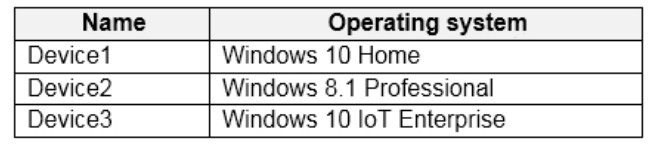
You have the devices shown in the following table.

You plan to deploy Azure Virtual Desktop for client access to remove virtualized apps.

Which devices support the Remote Desktop client?

Exhibit for question 2

  1. Device1 and Device2 only
  2. Device1 and Device3 only
  3. Device1, Device2, and Device3
  4. Device1 only
Show answer and explanation

Correct answer: B. Device1 and Device3 only

The Remote Desktop client for Azure Virtual Desktop is supported on Windows 10 and Windows 11, including Windows 10 IoT Enterprise, so Device1 (Windows 10 Home) and Device3 (Windows 10 IoT Enterprise) can connect. Windows 8.1 is not a supported operating system for the Windows Desktop client used with Azure Virtual Desktop, so Device2 is excluded. Device2 would need to be upgraded to a supported Windows client release before it could be used for access to the virtualized apps.

Why the other options are wrong

  • A. Device2 runs Windows 8.1 Professional, which is not a supported platform for the Azure Virtual Desktop Remote Desktop client.
  • C. Including Device2 is incorrect because Windows 8.1 is outside the supported client operating system list.
  • D. Device3 running Windows 10 IoT Enterprise is supported and must be included with Device1.

Question 3

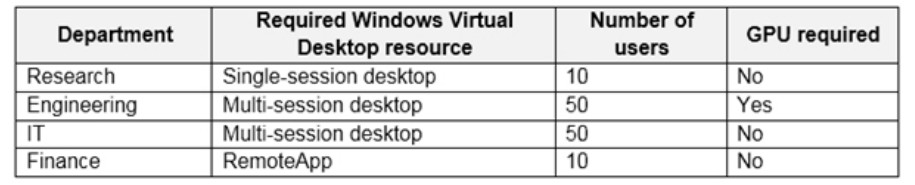
You plan to deploy Azure Virtual Desktop to meet the department requirements shown in the following table.

You plan to use Azure Virtual Desktop host pools with load balancing and autoscaling.

You need to recommend a host pool design that meets the requirements. The solution must minimize costs.

What is the minimum number of host pools you should recommend?

Exhibit for question 3

  1. 1
  2. 2
  3. 3
  4. 4
Show answer and explanation

Correct answer: C. 3

Research needs single-session desktops, which cannot be delivered from the same host pool as multi-session desktops, so that is one pool. Engineering needs GPU-backed multi- session hosts, and running the remaining non-GPU workloads on those more expensive GPU VMs would not minimize costs, so Engineering gets its own pool. IT and Finance both need non-GPU multi-session capacity, and Finance's RemoteApp requirement is met by publishing a RemoteApp application group from that same pool, giving a total of three host pools.

Why the other options are wrong

  • A. One host pool cannot deliver both the single-session desktops that Research needs and the multi-session desktops the other departments need.
  • B. Two host pools would force the non-GPU workloads onto the costly GPU hosts or mix session types, so it fails either the cost or the technical requirement.
  • D. A fourth pool is unnecessary because Finance's RemoteApp resources can be published as an application group from the same non-GPU multi-session pool used by IT.

See all 10 free questions Get the full pack, US$39

363 practice questions for Microsoft Certified: Azure Virtual Desktop Specialty (AZ-140), with full explanations.

Every question comes with the correct answer, the reasoning behind it, and a short note on why each wrong option is wrong. Work through it once with the answers, then again with the questions-only copy under exam conditions.

  • 363 questions mapped to the AZ-140 exam objectives
  • Answers and explanations for every question, including the wrong options
  • A questions-only PDF for timed practice runs
  • Instant delivery by email the moment you check out
  • Free monthly updates for as long as the exam is live
  • Pass or your money back

An AZ-140 attempt costs US$165 in the US. This pack is US$39, paid once.

Try 10 questions free before you buy.

Last updated September 2026 · 363 questions

What makes the AZ-140 hard

AZ-140 is a specialty exam with an implementer’s focus. It assumes AZ-104 level Azure knowledge and then goes deep on the one workload where users personally feel every mistake: their desktop.

The decisive material is the AVD-specific stack: host pool types and assignment, FSLogix profile containers and their storage backing, Azure Files versus NetApp Files and the permissions that break them, MSIX app attach, autoscaling plans, and the licensing question candidates get wrong at least once. Then session troubleshooting: why a user cannot connect, and which of several plausible causes fits the symptoms given.

Infrastructure is the exam. Planning and implementing the AVD infrastructure alone carries 40 to 45% of the marks, nearly half, so the host pool, networking, storage and session host material is where study time belongs. It survived Microsoft’s 2026 retirement wave untouched and remains the only AVD credential. This pack has 363 practice questions for the AZ-140.

About the exam

AZ-140 certifies planning, delivering and managing Azure Virtual Desktop: host pools, session hosts, FSLogix user environments, app delivery, security and monitoring. It assumes Azure administration experience. Skills measured as of 20 July 2026. Renews annually via a free online assessment.

Exam domains

  • Plan and implement an Azure Virtual Desktop infrastructure: 40 to 45%
  • Plan and implement identity and security: 15 to 20%
  • Plan and implement user environments and apps: 20 to 25%
  • Monitor and maintain an Azure Virtual Desktop infrastructure: 10 to 15%

Around 40 to 60 questions, 100 minutes, pass mark 700 out of 1000, US$165 in the US, priced by local currency elsewhere, online proctored or test centre, renews annually for free.
Reviews

There are no reviews yet.

Only logged in customers who have purchased this product may leave a review.

Questions before you buy

What do I get when I buy the Microsoft AZ-140 pack?

363 practice questions as a PDF, each with the correct answer, a full explanation and a note on why the other options are wrong, plus a separate questions-only PDF for timed practice.

How quickly do I receive it?

Your PDF is prepared and sent to your email address after checkout, and you get a confirmation as soon as it is on its way.

Is there a free sample?

Yes. Ten questions from this pack, with answers and explanations, are free on this page and as a PDF, so you can judge the quality before you pay.

Are updates included?

Yes. The pack is updated every month for as long as the exam is live, and updates are free for everyone who has bought it.

What if I fail the exam?

We refund the pack. Sit the exam 7 to 30 days after buying, then send your official score report within 7 days of the exam date, as set out in the refund policy.

Can I share it with colleagues?

Each purchase is licensed to one person. For a team, school or training organisation, email support@certstash.com for a licence that fits.