JUNIPER · JN0-664

Juniper JN0-664 JNCIP-SP Exam Practice Questions

96 questionsPDF by emailUpdated September 2026

US$39

Try 10 questions free

Card, Apple Pay or Google Pay. Your PDF is sent by email as soon as you check out.

Pass or your money backFail the exam after using this pack and we refund it. How the guarantee works
Category:
TRY BEFORE YOU BUY

Three of the 96 questions in this pack

Question 1

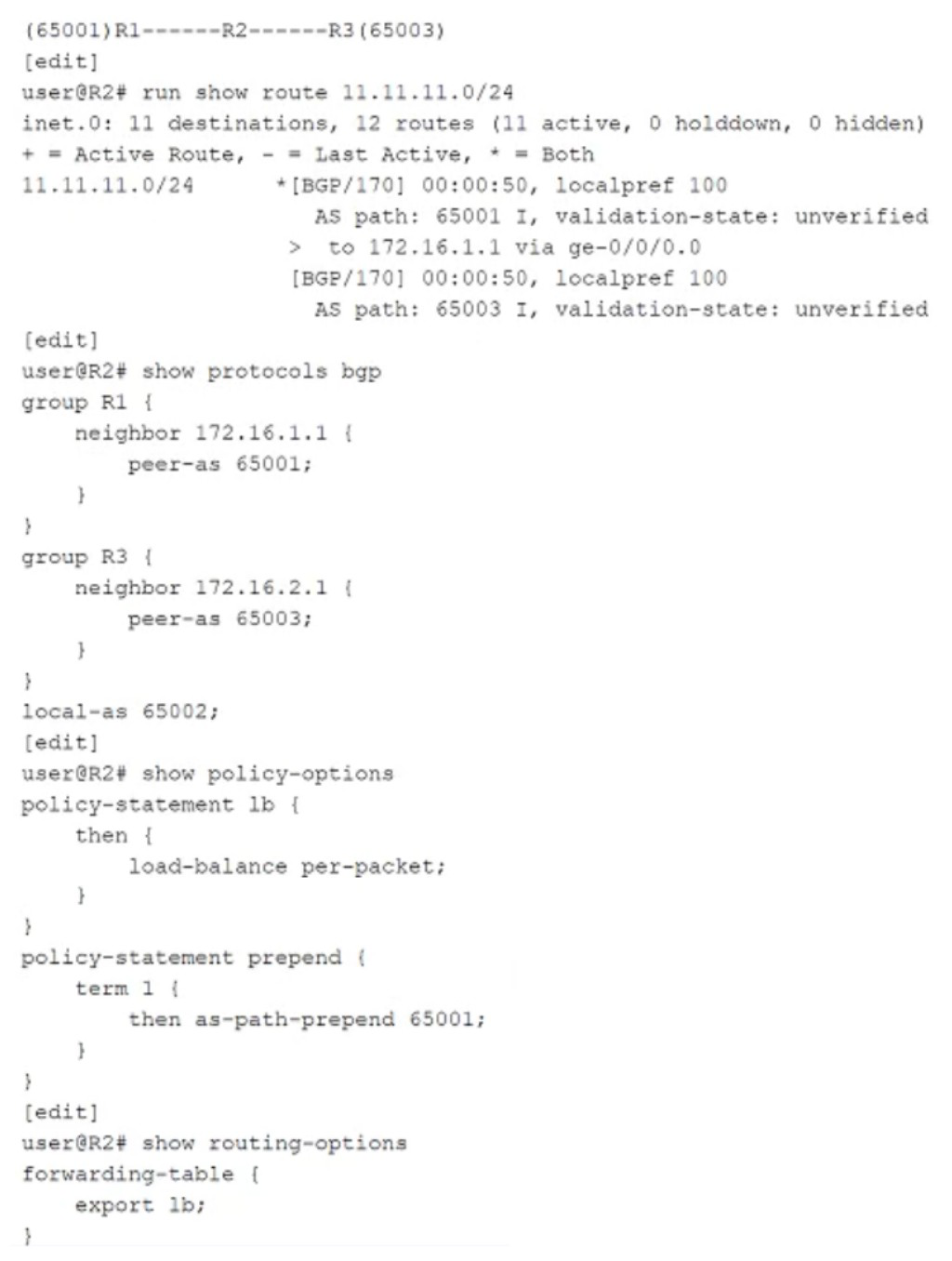
Click the Exhibit button.

R2 is receiving the same route from R1 and R3. You must ensure that you can load balance traffic for that route.

Referring to the exhibit, which configuration change will allow load balancing?

Exhibit for question 1

  1. Configure the multipath parameter under the global BGP configuration.
  2. Apply the prepend policy as an import policy under group R1.
  3. Configure the multipath multiple-as parameter under the global BGP configuration.
  4. Apply the prepend policy as an import policy under group R3.
Show answer and explanation

Correct answer: C. Configure the multipath multiple-as parameter under the global BGP configuration.

the global BGP configuration. R2 is receiving the route 11.11.11.0/24 from two different AS paths: AS 65001 (via R1) and AS 65003 (via R3). By default, BGP does not load balance across routes from different autonomous systems. The multipath multiple-as parameter enables BGP to install multiple routes in the routing table even when they come from different AS paths, allowing R2 to load balance traffic across both R1 and R3 for the destination 11.11.11.0/24.

Why the other options are wrong

  • A. The multipath parameter without multiple-as restriction only allows load balancing for routes received from the same AS, which does not apply here since the routes are from different ASes (65001 and 65003).
  • B. Applying the prepend policy as an import policy under R1 would increase the AS path length for routes from R1, making them less preferred and preventing load balancing rather than enabling it.
  • D. Applying the prepend policy as an import policy under R3 would increase the AS path length for routes from R3, making them less preferred and preventing load balancing rather than enabling it.

Question 2

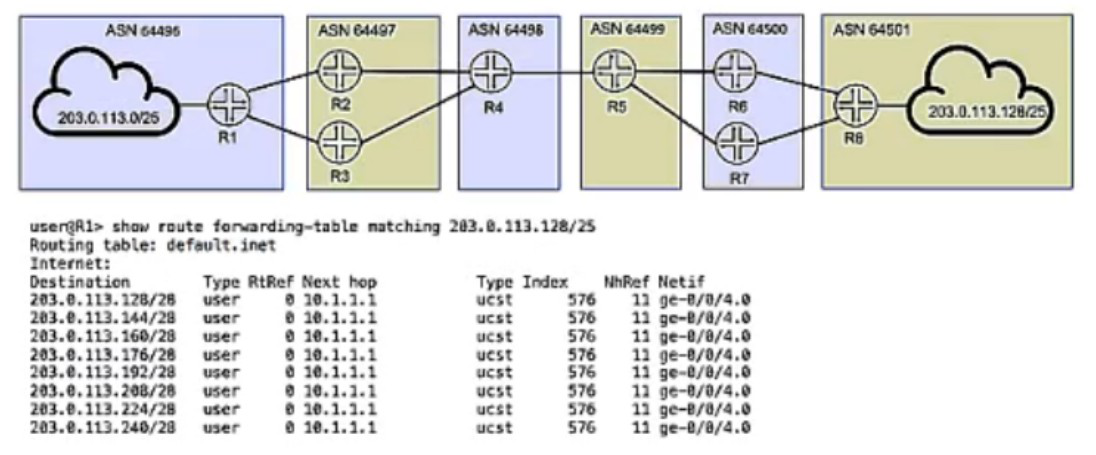
Click the Exhibit button.

You are troubleshooting the connection between AS 64496 and AS 64497 and notice that only one of the paths is being used for traffic forwarding.

Referring to the exhibit, which three actions will ensure that R1 is configured properly for load balancing BGP routes? (Choose three.)

Exhibit for question 2

  1. Verify that the routing table on R1 has BGP routes for 203.0.113.128/25 with multiple next hops.
  2. Verify that the multipath option is configured under protocols bgp on both R2 and R3.
  3. Verify that there is a load balancing export policy under routing-options for the received BGP routes on R1.
  4. Verify that the multipath option is configured under protocols bgp on R1.
  5. Verify that an import load balancing policy exists under protocols bgp for the received BGP routes on R1.
Show answer and explanation

Correct answer: A, C, D

A. Verify that the routing table on R1 has BGP routes for 203.0.113.128/25 with multiple next hops. C. Verify that there is a load balancing export policy under routing-options for the received BGP routes on R1. D. Verify that the multipath option is configured under protocols bgp on R1. To enable BGP load balancing across multiple paths from R1 to the destination 203.0.113.128/25, three configuration steps are necessary. First, the multipath option must be enabled under protocols bgp on R1 itself (option D) to allow the router to install and use multiple BGP routes with equal cost. Second, the routing table on R1 must be verified to contain BGP routes for 203.0.113.128/25 with multiple next hops (option A), confirming that multiple equal-cost paths are actually being installed. Third, a load balancing export policy under routing-options (option C) ensures that traffic is distributed across these multiple paths for outbound traffic forwarding. These three actions work together: multipath enables the feature on R1, the routing table verification confirms multiple paths exist, and the export policy ensures proper load distribution.

Why the other options are wrong

  • B. The multipath option on R2 and R3 is not required for R1 to perform load balancing; this option affects only those upstream routers, not R1's forwarding behavior.
  • E. An import policy under protocols bgp would filter or modify incoming routes but does not enable load balancing; the load balancing distribution is controlled by export policies and the multipath feature, not import policies.

Question 3

After a recent power outage, your manager asks you to investigate ways to automatically reduce the impact caused by suboptimal routing in your OSPF and OSPFv3 network after devices reboot.

Which three configuration statements accomplish this task? (Choose three.)

  1. set protocols ospf3 realm ipv4-unicast overload timeout 900
  2. set protocols ospf overload
  3. set protocols ospf overload timeout 900
  4. set protocols ospf3 overload
  5. set protocols ospf3 overload timeout 900
Show answer and explanation

Correct answer: A, C, E

A. set protocols ospf3 realm ipv4-unicast overload timeout 900 C. set protocols ospf overload timeout 900 E. set protocols ospf3 overload timeout 900 After a device reboots, the overload statement prevents the router from being used for transit traffic until it has fully converged, reducing suboptimal routing. Options A, C, and E configure overload with timeout values for both OSPFv3 realm ipv4-unicast and standard OSPF, allowing the router to gracefully exit overload mode after convergence completes. Option B enables overload without a timeout, which would persist indefinitely and is not the recommended approach for post-reboot scenarios where automatic recovery is desired.

Why the other options are wrong

  • B. Missing timeout value means overload persists indefinitely rather than automatically recovering after convergence.
  • D. OSPFv3 overload without timeout does not provide automatic timeout-based recovery like options A and E do.

See all 10 free questions Get the full pack, US$39

96 practice questions for Juniper Networks Certified Professional, Service Provider Routing and Switching (JNCIP-SP), exam JN0-664, with full explanations.

Every question comes with the correct answer, the reasoning behind it, and a short note on why each wrong option is wrong. Work through it once with the answers, then again with the questions-only copy under exam conditions.

  • 96 questions mapped to the JN0-664 exam objectives
  • Answers and explanations for every question, including the wrong options
  • A questions-only PDF for timed practice runs
  • Instant delivery by email the moment you check out
  • Free monthly updates for as long as the exam is live
  • Pass or your money back

A JN0-664 attempt costs US$400. This pack is US$39, paid once.

Try 10 questions free before you buy.

Last updated September 2026 · 96 questions

What makes the JNCIP-SP hard

JNCIP-SP is the professional exam on the Juniper service provider track, the one that separates candidates who can configure an MX from candidates who can explain what the routing table did. The current JN0-664 is written against Junos OS 22.3, requires an active JNCIS-SP, and runs 65 questions in 90 minutes. Juniper does not publish domain weightings, but the objectives make the emphasis clear: MPLS and the VPN services built on it are the centre of gravity, with IGP and BGP tuning underneath and multicast and class of service around the edges.

The VPN objectives dominate: Layer 3 VPNs cover VRF tables, route distinguishers and targets and PE-CE routing; Layer 2 VPNs cover BGP and LDP circuits, VPLS and EVPN with its route types and multihoming; MPLS covers LDP and RSVP-TE with fast reroute and segment routing. The IGP objectives cover OSPF and IS-IS at scale, and BGP covers route reflection, confederations and policy. Questions usually show a snippet of configuration or show output and ask what happens next.

This pack has 96 practice questions for the JN0-664 JNCIP-SP exam.

About the exam

JN0-664 earns the JNCIP-SP certification and is the prerequisite for JNCIE-SP. It covers OSPF, IS-IS, BGP, class of service, IP multicast, MPLS, Layer 3 VPNs and Layer 2 VPNs on Junos OS 22.3. The prerequisite is an active JNCIS-SP certification.

Exam domains

  • OSPF and IS-IS at scale
  • BGP route reflection, policy and troubleshooting
  • Class of service
  • IP multicast
  • MPLS with LDP, RSVP-TE and segment routing
  • Layer 3 VPNs
  • Layer 2 VPNs: Layer 2 circuits, VPLS and EVPN

Juniper does not publish weightings for these objectives.

65 multiple-choice questions, 90 minutes, US$400 per attempt, Pearson VUE test centre or online proctored, certification valid for three years. Juniper does not publish a fixed passing score.

Reviews

There are no reviews yet.

Only logged in customers who have purchased this product may leave a review.

Questions before you buy

What do I get when I buy the Juniper JN0-664 JNCIP-SP pack?

96 practice questions as a PDF, each with the correct answer, a full explanation and a note on why the other options are wrong, plus a separate questions-only PDF for timed practice.

How quickly do I receive it?

Your PDF is prepared and sent to your email address after checkout, and you get a confirmation as soon as it is on its way.

Is there a free sample?

Yes. Ten questions from this pack, with answers and explanations, are free on this page and as a PDF, so you can judge the quality before you pay.

Are updates included?

Yes. The pack is updated every month for as long as the exam is live, and updates are free for everyone who has bought it.

What if I fail the exam?

We refund the pack. Sit the exam 7 to 30 days after buying, then send your official score report within 7 days of the exam date, as set out in the refund policy.

Can I share it with colleagues?

Each purchase is licensed to one person. For a team, school or training organisation, email support@certstash.com for a licence that fits.