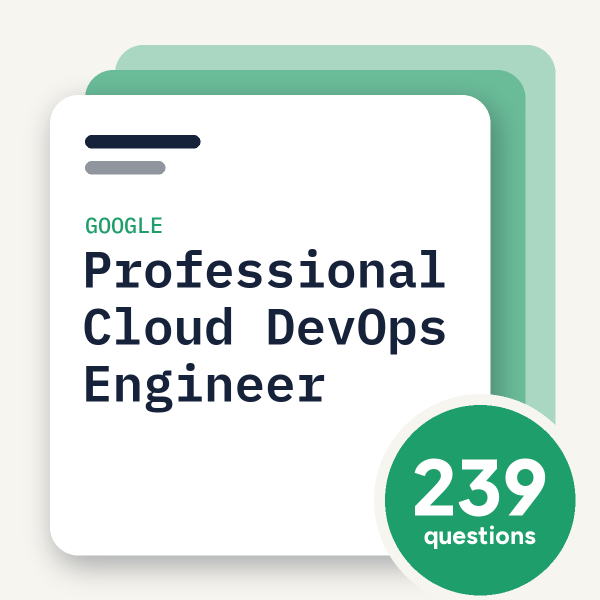
GOOGLE · Professional Cloud DevOps Engineer

Google Professional Cloud DevOps Engineer Exam Practice Questions

239 questionsPDF by emailUpdated September 2026

US$39

Try 10 questions free

Card, Apple Pay or Google Pay. Your PDF is sent by email as soon as you check out.

Pass or your money backFail the exam after using this pack and we refund it. How the guarantee works
Category:
TRY BEFORE YOU BUY

Three of the 239 questions in this pack

Question 1

You support a Node.js application running on Google Kubernetes Engine (GKE) in production. The application makes several HTTP requests to dependent applications. You want to anticipate which dependent applications might cause performance issues. What should you do?

  1. Instrument all applications with Stackdriver Profiler.
  2. Instrument all applications with Stackdriver Trace and review inter-service HTTP requests.
  3. Use Stackdriver Debugger to review the execution of logic within each application to instrument all applications.
  4. Modify the Node.js application to log HTTP request and response times to dependent applications. Use Stackdriver Logging to find dependent applications that are performing poorly.
Show answer and explanation

Correct answer: B. Instrument all applications with Stackdriver Trace and review inter-service HTTP requests.

review inter-service HTTP requests. Stackdriver Trace is specifically designed to track requests across distributed systems and visualize inter-service HTTP calls with latency data. This directly identifies which dependent applications are causing performance bottlenecks by showing request flow and timing between services. Profiler is for CPU/memory analysis within single applications, Debugger is for step-through debugging, and custom logging lacks the distributed context tracing provides.

Why the other options are wrong

  • A. Stackdriver Profiler analyzes CPU and memory usage within a single application, not inter-service request performance.
  • C. Stackdriver Debugger is for inspecting code execution at breakpoints, not for identifying performance issues across services.
  • D. Manual logging and Stackdriver Logging lack the automatic distributed tracing capabilities needed to efficiently identify cross-service bottlenecks.

Question 2

You created a Stackdriver chart for CPU utilization in a dashboard within your workspace project. You want to share the chart with your Site Reliability Engineering (SRE) team only. You want to ensure you follow the principle of least privilege. What should you do?

  1. Share the workspace Project ID with the SRE team. Assign the SRE team the Monitoring Viewer IAM role in the workspace project.
  2. Share the workspace Project ID with the SRE team. Assign the SRE team the Dashboard Viewer IAM role in the workspace project.
  3. Click "Share chart by URL" and provide the URL to the SRE team. Assign the SRE team the Monitoring Viewer IAM role in the workspace project.
  4. Click "Share chart by URL" and provide the URL to the SRE team. Assign the SRE team the Dashboard Viewer IAM role in the workspace project.
Show answer and explanation

Correct answer: A. Share the workspace Project ID with the SRE team. Assign the SRE team the Monitoring Viewer IAM role in the workspace project.

Assign the SRE team the Monitoring Viewer IAM role in the workspace project. Access to Cloud Monitoring charts and dashboards is controlled by IAM on the workspace (scoping) project, so the correct approach is to tell the SRE team which project holds the dashboard and grant them a read-only Monitoring role. roles/monitoring.viewer is the least privileged predefined role that includes both reading dashboards and listing the time series data that the CPU chart renders. Restricting the grant to the SRE team keeps the chart visible only to them while avoiding any write or admin permissions.

Why the other options are wrong

  • B. The Monitoring Dashboard Viewer role only allows reading dashboard configurations and does not include permission to read the metric data, so the team would not see the CPU utilization values.
  • C. A chart shared by URL can be opened by anyone who obtains the link, so it is not an access control mechanism and does not limit visibility to the SRE team.
  • D. This combines a link that anyone can open with a role that cannot read metric data, so it is both less secure and functionally insufficient.

Question 3

Your organization wants to implement Site Reliability Engineering (SRE) culture and principles. Recently, a service that you support had a limited outage. A manager on another team asks you to provide a formal explanation of what happened so they can action remediations. What should you do?

  1. Develop a postmortem that includes the root causes, resolution, lessons learned, and a prioritized list of action items. Share it with the manager only.
  2. Develop a postmortem that includes the root causes, resolution, lessons learned, and a prioritized list of action items. Share it on the engineering organization's document portal.
  3. Develop a postmortem that includes the root causes, resolution, lessons learned, the list of people responsible, and a list of action items for each person. Share it with the manager only.
  4. Develop a postmortem that includes the root causes, resolution, lessons learned, the list of people responsible, and a list of action items for each person. Share it on the engineering organization's document portal.
Show answer and explanation

Correct answer: B. Develop a postmortem that includes the root causes, resolution, lessons learned, and a prioritized list of action items. Share it on the engineering organization's document portal.

resolution, lessons learned, and a prioritized list of action items. Share it on the engineering organization's document portal. SRE culture emphasizes blameless postmortems shared across the engineering organization to drive organizational learning and prevent future incidents. Publishing to the document portal ensures all engineers can learn from the incident and understand action items. Postmortems should not name individuals responsible (blameless culture) and should be shared widely rather than limited to one manager to maximize organizational benefit.

Why the other options are wrong

  • A. Limiting postmortem sharing to a manager only prevents organizational learning and contradicts SRE principles of transparency and collaboration.
  • C. Naming individuals responsible contradicts blameless postmortem principles and creates a blame culture rather than learning culture.
  • D. While sharing widely is correct, naming individuals responsible contradicts blameless postmortem principles central to SRE culture.

See all 10 free questions Get the full pack, US$39

239 practice questions for Google Cloud Professional Cloud DevOps Engineer, with full explanations.

Every question comes with the correct answer, the reasoning behind it, and a short note on why each wrong option is wrong. Work through it once with the answers, then again with the questions-only copy under exam conditions.

  • 239 questions mapped to the Professional Cloud DevOps Engineer exam objectives
  • Answers and explanations for every question, including the wrong options
  • A questions-only PDF for timed practice runs
  • Instant delivery by email the moment you check out
  • Free monthly updates for as long as the exam is live
  • Pass or your money back

A Professional Cloud DevOps Engineer attempt costs US$200. This pack is US$39, paid once.

Try 10 questions free before you buy.

Last updated September 2026 · 239 questions

What makes the Professional Cloud DevOps Engineer exam hard

The Professional Cloud DevOps Engineer is the SRE-aligned credential for anyone balancing service reliability with delivery speed on Google Cloud. It is the badge for engineers who own CI/CD, automation and observability in production.

What decides it is DevOps and SRE on Google Cloud end to end: bootstrapping and maintaining the organisation, applying SRE practices like SLIs, SLOs and error budgets, building CI/CD pipelines including continuous testing for application, infrastructure and machine learning workloads, implementing observability and troubleshooting, and optimising both performance and cost. The exam rewards real operational judgement, not just tool knowledge.

It is 50 to 60 questions in two hours. This pack will have 239 practice questions mapped to the Professional Cloud DevOps Engineer exam objectives.

About the exam

The Google Cloud Professional Cloud DevOps Engineer certification validates the ability to build software delivery pipelines, deploy and monitor services, and manage incidents using SRE practices on Google Cloud. Google recommends three or more years of industry experience including one or more year designing and managing production systems on Google Cloud. It is valid for two years.

Exam sections

  • Bootstrap and maintain a Google Cloud organization
  • Apply site reliability engineering practices
  • Build and implement CI/CD pipelines
  • Implement observability practices and troubleshoot issues
  • Optimize performance and cost

Google does not publish percentage weightings for these sections. 50 to 60 questions, 2 hours, multiple choice and multiple select, US$200 per attempt, available in English and Japanese, online proctored or test centre, valid 2 years.

Reviews

There are no reviews yet.

Only logged in customers who have purchased this product may leave a review.

Questions before you buy

What do I get when I buy the Google Professional Cloud DevOps Engineer pack?

239 practice questions as a PDF, each with the correct answer, a full explanation and a note on why the other options are wrong, plus a separate questions-only PDF for timed practice.

How quickly do I receive it?

Your PDF is prepared and sent to your email address after checkout, and you get a confirmation as soon as it is on its way.

Is there a free sample?

Yes. Ten questions from this pack, with answers and explanations, are free on this page and as a PDF, so you can judge the quality before you pay.

Are updates included?

Yes. The pack is updated every month for as long as the exam is live, and updates are free for everyone who has bought it.

What if I fail the exam?

We refund the pack. Sit the exam 7 to 30 days after buying, then send your official score report within 7 days of the exam date, as set out in the refund policy.

Can I share it with colleagues?

Each purchase is licensed to one person. For a team, school or training organisation, email support@certstash.com for a licence that fits.