
10 free VMware 2V0-21.23 practice questions with the correct answer and a full explanation for each, taken from the CertStash pack of 110 questions. Work through them, then open each answer to check your reasoning.
Get all 110 questions (US$39) · Download these 10 as a PDF
Question 1
An administrator needs to consolidate a number of physical servers by migrating the workloads to a software-defined data center solution.
Which VMware solution should the administrator recommend?
Show answer and explanation
Correct answer: C. VMware vSphere
VMware vSphere is the foundational virtualization platform that enables physical-to-virtual server migration and consolidation. It provides the hypervisor, resource management, and virtual machine infrastructure necessary to migrate workloads from physical servers to a software-defined data center. vSAN (storage), NSX (networking), and Horizon (desktop virtualization) are complementary solutions but vSphere is the core enabling technology for workload consolidation.
Why the other options are wrong
- A. Horizon is a desktop and application virtualization solution, not a server consolidation platform.
- B. vSAN is a storage solution that complements but does not enable the primary consolidation of physical server workloads.
- D. NSX is a network virtualization solution that supports but is not the primary solution for physical server consolidation.
Question 2
An administrator has a host profile named Standard-Config. The administrator wants to change the other host profiles to use only the storage configuration settings that are defined in the Standard-Config host profile.
What should the administrator do to make this change?
Show answer and explanation
Correct answer: B. Copy the storage settings from Standard-Config to all other host profiles.
To apply only the storage configuration settings from the Standard-Config host profile to other host profiles, the administrator should copy the storage settings directly from Standard-Config to all other host profiles. This targeted approach allows selective replication of specific configuration sections without affecting other settings in the destination profiles. Exporting and importing customizations would affect all settings, not just storage. Duplicating or attaching the entire profile would override all configurations, not just storage settings.
Why the other options are wrong
- A. Exporting customizations would transfer all customization settings, not only storage configuration.
- C. Duplicating the entire profile creates a new profile with all settings, not a selective storage-only update.
- D. Attaching a host profile applies all its settings, not selectively just the storage configuration.
Question 3
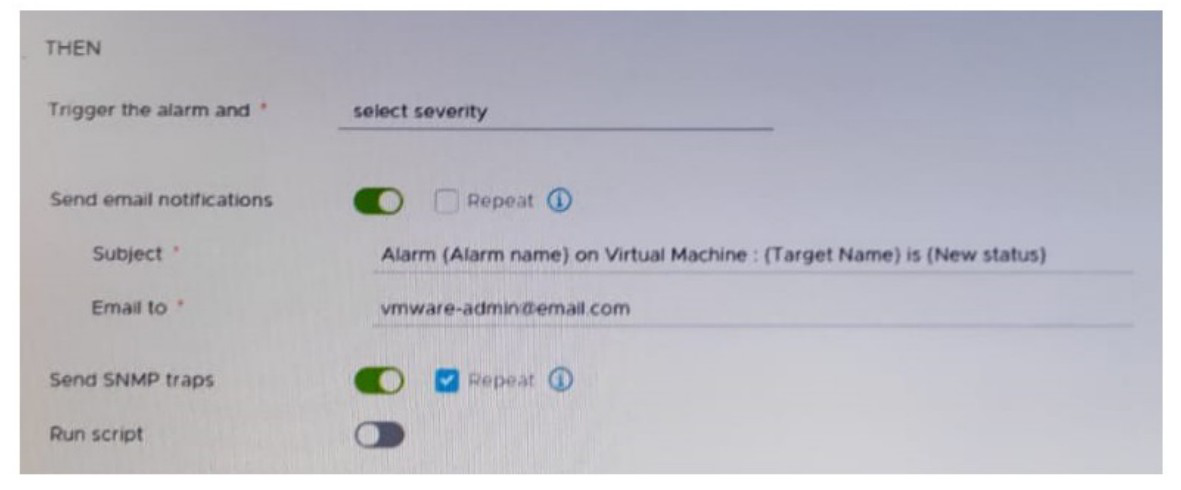
Refer to the exhibit.
After updating a predefined alarm on VMware vCenter, an administrator enables email notifications as shown in the attached alarm; however, notifications are NOT being sent.
Where must the mail server settings be configured by the administrator to resolve this issue?
Show answer and explanation
Correct answer: C. In the vCenter settings in the vSphere Client
To enable email notifications in vCenter alarms, the SMTP mail server settings must be configured at the vCenter level through the vSphere Client settings. While the alarm rule itself shows where to enable and configure the email notification action (as seen in the exhibit), the underlying mail server configuration that actually allows vCenter to send those emails must be established in vCenter's global settings. This is a prerequisite configuration that exists outside of individual alarm definitions.
Why the other options are wrong
- A. ESXi host system configuration does not contain mail server settings for vCenter alarm notifications; SMTP configuration is a vCenter-level function, not an ESXi function.
- B. The alarm rule definition enables the email notification feature and specifies recipients and subject, but cannot configure the actual SMTP mail server that vCenter needs to send the emails.
- D. The vCenter Management Interface provides direct server access but is not the standard location where administrators configure mail server settings within the vSphere Client management interface.
Question 4
During the staging of a patch on a vCenter Server Appliance, an error was encountered and the process stopped. An administrator resolved the root cause and is ready to continue with the staging of the patch.
From the vCenter Management Interface, which action should the administrator take to continue the process from the point at which the error occurred?
Show answer and explanation
Correct answer: B. Use the Resume option to resume the staging.
When a patch staging process encounters an error and stops on vCenter Server Appliance, the Resume option allows the administrator to continue from the exact point where the failure occurred, without losing progress or requiring the entire staging process to restart.
Why the other options are wrong
- A. Stage and Install will restart the entire process from the beginning rather than resuming from the failure point.
- C. Unstage removes patches that have been staged and would require restarting the staging process completely.
- D. Stage Only will restart the staging process from the beginning, not resume from where it failed.
Question 5
An administrator is adding a new ESXi host to an existing vSphere cluster.
When selecting the cluster, the administrator is unable to use the Cluster Quickstart workflow to add and configure the additional host.
What could be the root cause of this issue?
Show answer and explanation
Correct answer: A. The administrator has previously dismissed the Cluster Quickstart workflow.
Cluster Quickstart workflow. The Cluster Quickstart workflow can be dismissed or hidden in vSphere Client. When an administrator has previously dismissed this workflow, it becomes unavailable for use and must be re-enabled or the workflow must be accessed through alternative methods to add and configure hosts to the cluster.
Why the other options are wrong
- B. The Cluster Quickstart workflow is designed specifically to add hosts to clusters; hosts do not need to be manually added first.
- C. Permissions control access to features, but dismissing the workflow is a UI preference separate from permissions-based access control.
- D. The Cluster Quickstart workflow is a built-in vCenter feature that does not require manual enabling; dismissing it is the cause of unavailability.
Question 6
A company has two sites: Site A and Site B. The administrator would like to manage the VMware vCenter inventories in both sites from a single vSphere Client session.
Which vCenter feature must be configured?
Show answer and explanation
Correct answer: D. Enhanced Linked Mode
Enhanced Linked Mode is the vCenter feature that enables management of multiple vCenter Server instances across different sites from a single vSphere Client session, allowing centralized inventory and management of distributed infrastructure.
Why the other options are wrong
- A. VMware Certificate Authority is for certificate management and does not provide multi-site vCenter management capabilities.
- B. Site Recovery Manager handles disaster recovery and site failover but does not provide unified vCenter management from a single session.
- C. vCenter Single Sign-On provides authentication and identity management but does not enable managing multiple vCenter inventories from one session.
Question 7
An administrator plans to update the Supervisor cluster and has noticed some of the Tanzu Kubernetes Grid clusters are running an incompatible version.
Which action must the administrator take before proceeding with the Supervisor cluster update?
Show answer and explanation
Correct answer: D. Update incompatible Tanzu Kubernetes Grid clusters prior to the Supervisor cluster update.
Before updating a Supervisor cluster, any Tanzu Kubernetes Grid clusters running incompatible versions must be updated first. This ensures compatibility and prevents upgrade failures or undefined behavior during the Supervisor cluster update process.
Why the other options are wrong
- A. Only incompatible clusters need updating before the Supervisor update, not necessarily all clusters to the latest version.
- B. Tanzu Kubernetes Grid clusters are not automatically updated as part of the Supervisor cluster update and must be manually addressed beforehand.
- C. Incompatible clusters cannot be safely updated after the Supervisor update; they must be updated before to maintain compatibility.
Question 8
An administrator wants to create virtual machine (VM) templates and store them in a content library. The administrator would like to use the content library to manage different versions of these templates so that reverting to an earlier version is an option.
How should the administrator create these templates?
Show answer and explanation
Correct answer: A. Select a VM in the vCenter inventory. Clone the VM to the content library as a VM template type.
To create VM templates in a content library with version management capabilities, an administrator should select a VM from the vCenter inventory and clone it directly to the content library as a VM template type. This method enables the content library to track and manage multiple template versions for easy rollback.
Why the other options are wrong
- B. Cloning a template rather than a VM does not provide the same versioning benefits and may not capture all necessary configuration states.
- C. Exporting to OVF and importing does not leverage the content library's native version management capabilities for templates.
- D. Converting a VM to a template in inventory first, then cloning it, adds unnecessary steps and doesn't align with content library's version tracking design.
Question 9
An administrator is tasked with moving an application and guest operating system (OS) running on top of a physical server to a software-defined data center (SDDC) in a remote secure location.
The following constraints apply:
The remote secure location has no network connectivity to the outside world.
The business owner is not concerned if all changes in the application make it to the SDDC in the secure location.
The application’s data is hosted in a database with a high number of transactions.
What could the administrator do to create an image of the guest OS and application that can be moved to this remote data center?
Show answer and explanation
Correct answer: B. Create a cold clone of the physical server using VMware vCenter Converter.
VMware vCenter Converter. A cold clone of the physical server using VMware vCenter Converter is the appropriate solution when migrating to a remote secure location with no external network connectivity and when data loss during migration is acceptable. Cold clone ensures a complete, consistent image capture without the complexity of network-dependent hot cloning.
Why the other options are wrong
- A. Hot cloning requires network connectivity and ongoing synchronization, which is problematic for an isolated remote location and where data changes are not critical to preserve.
- C. Restoring from backup does not create a complete VM image and may not capture the current state of the application and OS.
- D. Storage replication requires continuous network connectivity between locations, which contradicts the constraint that the remote location has no outside network connectivity.
Question 10
An administrator is tasked with configuring an appropriate Single Sign-On (SSO) solution for VMware vCenter based on the following criteria:
The solution should support the creation of Enhanced Link Mode groups.
All user accounts are stored within a single Active Directory domain and the solution must support only this Active Directory domain as the identity source.
All user account password and account lockout policies must be managed within the Active Directory domain.
The solution should support token-based authentication.
Which SSO solution should the administrator choose based on the criteria?
Show answer and explanation
That was 10 of 110.
The full VMware 2V0-21.23 pack has all 110 questions, each with the answer, the explanation and why the other options are wrong, plus a questions-only copy for timed runs. US$39, paid once, with free monthly updates and a pass-or-your-money-back guarantee.