
10 free ServiceNow CIS-ITSM practice questions with the correct answer and a full explanation for each, taken from the CertStash pack of 242 questions. Work through them, then open each answer to check your reasoning.
Get all 242 questions (US$39) · Download these 10 as a PDF
Question 1
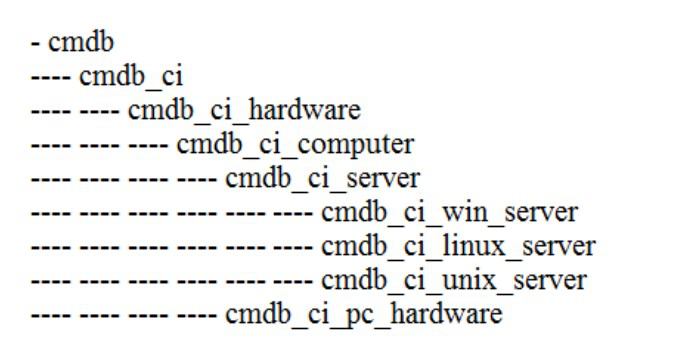
Given the class structure shown below, which types of CIs will be included in a report run against the cmdb_ci_computer table?
Show answer and explanation
Correct answer: C. CIs defined directly in cmdb_ci_computer and all child classes
In ServiceNow's CMDB, when you run a report against a table like cmdb_ci_computer, the query returns not only records defined directly in that table but also all records from child classes that extend it. The class hierarchy shown demonstrates inheritance, with cmdb_ci_computer as a parent class and cmdb_ci_win_server, cmdb_ci_linux_server, and cmdb_ci_unix_server as child classes. ServiceNow's table inheritance model includes child table records when querying a parent table, allowing you to retrieve all computer CI instances regardless of their specific type. Parent classes are not included because cmdb_ci_computer is the table being queried, not a filter looking upward in the hierarchy.
Why the other options are wrong
- A. Excluding child classes would miss all Windows, Linux, and Unix server CIs that inherit from cmdb_ci_computer.
- B. Parent classes should not be included in a query against cmdb_ci_computer; the query starts from this table and looks downward to children, not upward to parents.
Question 2
Which field from the configuration item will automatically populate in the Assignment group field of an incident record?
Show answer and explanation
Correct answer: B. Support group
In ServiceNow ITSM, the Support group field on a configuration item automatically populates the Assignment group field when an incident is created or linked to that CI. This establishes the default support team responsible for incidents related to that configuration item.
Why the other options are wrong
- A. Managed by is a field that tracks ownership of the CI itself, not incident assignment.
- C. Approval group is used for change approvals and does not automatically populate incident assignment groups.
- D. Change group is used in change management workflows and does not affect incident assignment group population.
Question 3
Which of the following are defined for a given change model? (Choose three.)
Show answer and explanation
Correct answer: B, C, E
B. State model C. State transition conditions E. State transitions A change model is built from its state model, the state transitions that define which moves between states are allowed, and the state transition conditions that control when each transition can occur. Together these define the lifecycle any change request following that model must follow. Everything else about the change, such as approvals or tasks, is driven by those state definitions.
Why the other options are wrong
- A. Change models do not define phase transitions, movement is defined between states, not phases.
- D. There is no phase model defined on a change model, the lifecycle is described by the state model.
Question 4
When is a change task for Post Implementation Review created for an unauthorized change?
Show answer and explanation
Correct answer: C. When the change request moves to a state of Review
For an unauthorized change, the Post Implementation Review change task is generated when the change request moves into the Review state. The Review state exists specifically to capture what happened after implementation, so the PIR task is created there and must be completed before the change can be closed. This ensures unauthorized work is examined before the record is finalized.
Why the other options are wrong
- A. Close comes after the review activity has already been performed, so the PIR task is not created at that point.
- B. A change manager accepting the change relates to authorization for execution, not to post implementation activity.
- D. Assess is an early evaluation state in the change lifecycle and generates no post implementation tasks.
Question 5
Which should be used to explore the entire hierarchy and table definitions of the Configuration Management Database Classes?
Show answer and explanation
Correct answer: B. CI Class Manager
The CI Class Manager is the tool designed to explore and manage the entire hierarchy and table definitions of Configuration Management Database classes in ServiceNow. It provides a comprehensive view of all CI classes, their relationships, and the database tables they extend.
Why the other options are wrong
- A. Reports are used to display data but do not provide the structural exploration of CI class hierarchies.
- C. Application Menus provide navigation to modules but do not allow exploration of CMDB class definitions.
- D. Dependency View shows relationships between CIs but does not explore the class hierarchy structure itself.
Question 6
Which of the following cannot be defined or set through a Catalog UI Policy?
Show answer and explanation
Correct answer: C. Setting a catalog category to visible
Catalog UI Policies act on variables and variable sets on catalog items, so they can make a variable mandatory, read-only, or visible. They have no control over catalog categories, which are governed by category records, user criteria, and catalog definitions. Setting a catalog category to visible is therefore outside the scope of a Catalog UI Policy.
Why the other options are wrong
- A. A Catalog UI Policy action can set a variable to mandatory.
- B. A Catalog UI Policy can be applied across the places the item is rendered, including the Catalog Item, Requested Item, and Catalog Task forms.
- D. A Catalog UI Policy action can set a variable to read-only.
Question 7
Which type of catalog item should be used to create an incident record from the portal?
Show answer and explanation
Correct answer: D. Record Producer
A Record Producer is the catalog item type that creates a record on a specified table, including Incident, directly from the Service Portal. It presents a simple, variable driven form and maps the submitted values into the target record. This gives users a catalog style experience while producing an incident rather than a request.
Why the other options are wrong
- A. An incident template prefills fields on an existing incident form, it is not a catalog item users order from the portal.
- B. A Requested Item is generated by ordering a catalog item and tracks fulfillment of a service request, not an incident.
- C. An Order Guide bundles multiple related catalog items into one ordering flow and does not create incidents.
Question 8
Which incident management roles are activated by installing the ITSM Roles plugin (com.snc.itsm.roles)? (Choose two.)
Show answer and explanation
Correct answer: A, D
A. sn_incident_read D. sn_incident_write Installing the ITSM Roles plugin activates the sn_incident_read and sn_incident_write roles for incident management. These roles follow ServiceNow's naming convention for module-specific roles and provide granular access control for incident read and write operations.
Why the other options are wrong
- B. itsm_incident_read uses an older naming convention and is not activated by the com.snc.itsm.roles plugin.
- C. incident_manager is a broader administrative role that may exist but is not specifically activated by this plugin.
- E. itsm_incident_write uses an older naming convention and is not activated by the com.snc.itsm.roles plugin.
Question 9
A customer requests that when the Service Desk agent clicks on the information icon for the Caller's name, the quick view frame shows only the following fields:
• User name
• Manager name
• Email Address
• Employee ID
How would you modify the quick view frame?
Show answer and explanation
Correct answer: A. Update the sys_popup view for the user table
To customize the quick view frame that appears when clicking the information icon on the Caller's name field, you update the sys_popup view for the user table. The Caller field references the user table, and sys_popup is the view used for popup/quick view displays in ServiceNow forms.
Why the other options are wrong
- B. There is no caller table; the Caller field references the user table, making this option incorrect.
- C. The sys_popup view is correct, but it must be applied to the user table, not a caller table.
- D. While the user table is correct, sys_quick is not the standard view name for popup displays; sys_popup is the correct view.
Question 10
Your customer has built a mature knowledge base, with articles targeted to internal audiences -which are technical. Other articles are written for end users, with simple instructions. From the Incident form, the agents would like to be able to identify which articles are visible to the callers
What feature would you use, to satisfy this requirement?
Show answer and explanation
Correct answer: B. Search as User
Search as User is the feature that allows agents to preview knowledge base articles exactly as end users would see them from the Incident form. This feature simulates the caller's perspective, showing which articles are actually visible to external users versus internal-only articles, directly addressing the requirement to identify article visibility from the agent's workflow.
Why the other options are wrong
- A. Internal/External Highlighting marks content within articles but does not filter which articles are visible to callers.
- C. Show User Viewable is not a standard ServiceNow feature for this purpose.
- D. User Only View is not a recognized ServiceNow knowledge base visibility control.
That was 10 of 242.
The full ServiceNow CIS-ITSM pack has all 242 questions, each with the answer, the explanation and why the other options are wrong, plus a questions-only copy for timed runs. US$39, paid once, with free monthly updates and a pass-or-your-money-back guarantee.