
10 free Palo Alto Networks XSIAM Engineer practice questions with the correct answer and a full explanation for each, taken from the CertStash pack of 95 questions. Work through them, then open each answer to check your reasoning.
Get all 95 questions (US$39) · Download these 10 as a PDF
Question 1
How will Cortex XSIAM help with raw log ingestion from third-party sources in an existing infrastructure?
Show answer and explanation
Correct answer: B. For structured logs, like CEF, LEEF, and JSON, it decouples the key-value pairs and saves them in table format.
Cortex XSIAM processes structured logs (CEF, LEEF, JSON) by parsing and normalizing them into a table format with decoupled key-value pairs. This structured approach enables efficient querying and correlation. Unstructured logs are handled differently and do not undergo this key-value decoupling. Metadata is added to enhance context and enable better analytics regardless of log type.
Why the other options are wrong
- A. Structured logs are not left unchanged; they are actively parsed and normalized into table format.
- C. Unstructured logs do have metadata added to provide additional context for analysis.
- D. Unstructured logs do not have key-value pairs decoupled into table format; only structured logs undergo this transformation.
Question 2
In which two locations can correlation rules be monitored for errors? (Choose two.)
Show answer and explanation
Correct answer: B, C
B. correlations_auditing dataset through XQL C. Management audit logs (type = Rules, subtype = Error) Correlation rule errors can be monitored in two locations: the correlations_auditing dataset through XQL queries for detailed audit information, and the Management audit logs which track rule-related errors with type = Rules and subtype = Error. These provide comprehensive visibility into correlation rule execution and troubleshooting.
Why the other options are wrong
- A. XDR Collector audit logs are used for collector-level events, not correlation rule monitoring.
- D. The Alerts table functions for displaying security alerts, not for health monitoring of correlation rules.
Question 3
Which option should be used when customizing a dashboard in Cortex XSIAM to include a widget that will display data filtered by more than one dynamic value?
Show answer and explanation
Correct answer: B. Multi-select
Multi-select is the appropriate widget option for filtering dashboard data by multiple dynamic values simultaneously. This allows users to apply compound filters from a defined set of options. Fixed filters and single-select options only allow one value or static configurations, while free text/number fields are not designed for multi-value categorical filtering.
Why the other options are wrong
- A. Free text/number allows arbitrary input but is not structured for multi-value filtering.
- C. Fixed filters do not support dynamic values or multiple selections.
- D. Single-select restricts users to choosing only one value at a time.
Question 4
How must Cloud Identity Engine be deployed and activated on Cortex XSIAM?
Show answer and explanation
Correct answer: C. In the same region as Cortex XSIAM; logs can be verified using pan_dss_raw dataset
Cloud Identity Engine must be deployed in the same region as Cortex XSIAM to ensure proper synchronization and low-latency communication. Log verification for Cloud Identity Engine operations is performed using the pan_dss_raw dataset, which contains the detailed identity and authentication-related telemetry.
Why the other options are wrong
- A. Cloud Identity Engine must be in the same region, not a different region, for proper integration.
- B. Cloud Identity Engine must be in the same region, and verification uses pan_dss_raw, not endpoints dataset.
- D. The endpoints dataset is used for endpoint-related data, not for Cloud Identity Engine log verification.
Question 5
Which common issue can result in sudden data ingestion loss for a data source that was previously successful?
Show answer and explanation
Correct answer: D. API key used for the integration has expired.
An expired API key is the most common cause of sudden data ingestion loss for previously functioning data sources. When credentials expire, the data source loses authorization to push or pull data, immediately halting ingestion. Unsupported data formats would cause issues from the start, storage capacity limitations are rare, and end-of-life support typically involves gradual deprecation rather than sudden loss.
Why the other options are wrong
- A. Unsupported data formats would prevent initial successful ingestion, not cause sudden loss.
- B. Data sources do not typically have individual storage capacity limits that cause ingestion to fail suddenly.
- C. End-of-life support is usually communicated in advance and managed gradually, not causing sudden loss.
Question 6
While using the remote repository on a Development XSIAM tenant, which two objects can be pushed or pulled to the remote repository? (Choose two.)
Show answer and explanation
Correct answer: A, C
A. Scripts C. Lists Scripts and Lists are the objects that can be pushed and pulled to/from the remote repository in a Development XSIAM tenant. These represent portable automations and data collections that benefit from version control. Parsing rules and Layouts are managed through different mechanisms and are not included in the remote repository push/pull functionality.
Why the other options are wrong
- B. Parsing rules are managed through separate content management processes, not remote repository synchronization.
- D. Layouts are managed as UI configurations and are not transferred through remote repository operations.
Question 7
When a Cortex XSIAM playbook execution reaches a breakpoint on a non-manual task, which two actions will allow the playbook to continue? (Choose two.)
Show answer and explanation
Correct answer: B, D
B. Skip the task with the breakpoint to let the playbook proceed automatically. D. Click Run Script Now or Complete Manually. When a playbook reaches a breakpoint on a non-manual task, execution can resume by either skipping the task to allow automatic continuation or by using the Run Script Now or Complete Manually options to manually advance. These actions provide immediate control over breakpoint handling. Disabling the breakpoint requires a rerun from the start, and parallel task completion does not directly resume a breakpoint task.
Why the other options are wrong
- A. Disabling the breakpoint and rerunning from start is inefficient; direct resume actions are available.
- C. Parallel task completion does not automatically resume a breakpoint task; manual action is required.
Question 8
What is the purpose of using rolling tokens to manage Cortex XDR agents?
Show answer and explanation
Correct answer: B. To perform administration on agents without requiring static credentials
Rolling tokens enable administration and management of Cortex XDR agents without requiring static credentials that pose security risks. These tokens periodically rotate, reducing exposure if compromised. Static tokens are replaced by rolling tokens to maintain security posture. While tokens may be used for updates and other functions, the primary purpose is to eliminate the need for persistent static credentials in agent management.
Why the other options are wrong
- A. Encryption key rotation is a separate security function not directly associated with rolling tokens.
- C. Content updates use agent communication channels, but rolling tokens' primary purpose is credential rotation, not update authorization.
- D. Rolling tokens do not disable agents; they provide authentication for active agent management.
Question 9
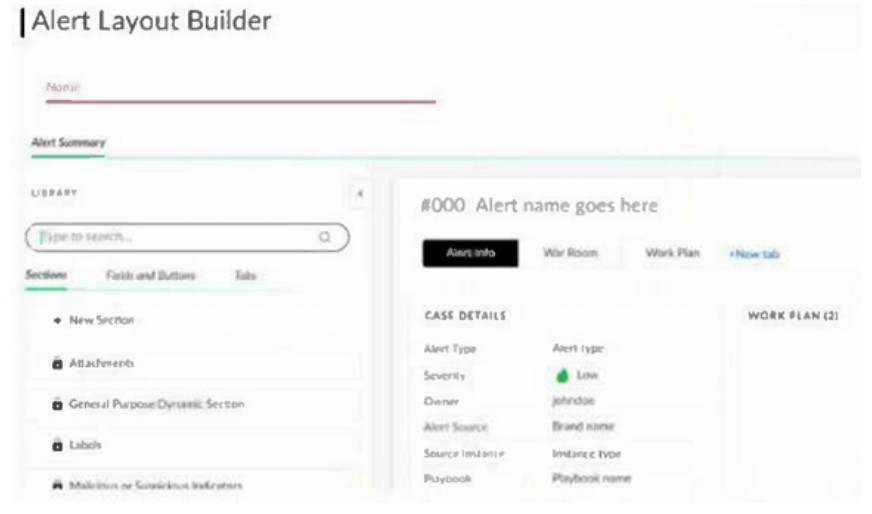
Based on the image below, which statement applies to the ability to remove tabs when creating a new alert layout?
Show answer and explanation
Correct answer: A. Only "Alert Info" tab can be removed.
In the Alert Layout Builder interface shown, the tabs displayed are 'Alert Info', 'War Room', 'Work Plan', and '+New Lab'. The 'Alert Info' tab appears in a solid black button style, indicating it is the primary or protected tab that cannot be removed. The other tabs ('War Room', 'Work Plan', and '+New Lab') are shown in lighter styling, suggesting they are removable or optional. However, only the 'Alert Info' tab has the visual distinction and locked appearance characteristic of a mandatory, non-removable core tab in this type of builder interface.
Why the other options are wrong
- B. While 'Alert Info' can be removed according to this option, 'War Room' is also removable, but the question asks which tabs CAN be removed, not must both be.
- C. 'War Room' and 'Work Plan' are not the exclusive removable tabs; 'Alert Info' demonstrates the removable capability through its standard tab presentation.
- D. Only 'Work Plan' being removable ignores the removability of other tabs in the interface and contradicts the visual hierarchy shown.
Question 10
A Cortex XSIAM engineer is developing a playbook that uses reputation commands such as '!ip' to enrich and analyze indicators.
Which statement applies to the use of reputation commands in this scenario?
Show answer and explanation
Correct answer: B. Reputation commands such as '!ip' will fail if the required reputation integration instance is not configured and enabled.
Reputation commands such as '!ip' require a properly configured and enabled reputation integration instance to function. If the required integration is not configured and enabled, the command will fail rather than execute silently or return empty results. This is a hard dependency in Cortex XSIAM's enrichment architecture.
Why the other options are wrong
- A. Reputation commands do not execute at all without the required integration; they fail rather than return no results.
- C. The mapping flow is not disabled by extraction being set to 'None'; extraction settings control what data is saved, not whether the flow executes.
- D. Enrichment data can be saved to indicators through default extraction behavior; manual configuration is not always required.
That was 10 of 95.
The full Palo Alto Networks XSIAM Engineer pack has all 95 questions, each with the answer, the explanation and why the other options are wrong, plus a questions-only copy for timed runs. US$39, paid once, with free monthly updates and a pass-or-your-money-back guarantee.