
10 free Microsoft DP-750 practice questions with the correct answer and a full explanation for each, taken from the CertStash pack of 108 questions. Work through them, then open each answer to check your reasoning.
Get all 108 questions (US$39) · Download these 10 as a PDF
Question 1
Show the case study this question is based on
This is a case study. Case studies are not timed separately from other exam sections. You can use as much exam time as you would like to complete each case study. However, there might be additional case studies or other exam sections. Manage your time to ensure that you can complete all the exam sections in the time provided. Pay attention to the Exam Progress at the top of the screen so you have sufficient time to complete any exam sections that follow this case study. To answer the case study questions, you will need to reference information that is provided in the case. Case studies and associated questions might contain exhibits or other resources that provide more information about the scenario described in the case. Information provided in an individual question does not apply to the other questions in the case study.A Review Screen will appear at the end of this case study. From the Review Screen, you can review and change your answers before you move to the next exam section. After you leave this case study, you will NOT be able to return to it. To start the case study -To display the first question in this case study, select the “Next” button. To the left of the question, a menu provides links to information such as business requirements, the existing environment, and problem statements. Please read through all this information before answering any questions.
When you are ready to answer a question, select the “Question” button to return to the question. Overview -Company Information -Contoso, Inc. is a renewable energy provider that operates solar and wind farms across North America.Existing Environment -Azure Environment -Contoso has a single Azure Databricks workspace named Workspace1 in the West US Azure region. Workspace1 is enabled for Unity Catalog.Workspace1 contains all-purpose clusters for both development and production workloads. The company's Azure environment contains:In the West US, Central US, and East US Azure regions, Azure event hubs that stream telemetry data and an Azure Data Lake Storage Gen2 account in each region for each hubA single Azure SQL database in the West US region that hosts enterprise resource planning (ERP) dataAn Azure Database for PostgreSQL server in the West US region that stores operational maintenance dataData Environment -Contoso ingests the following operational and business data:Telemetry data: More than 40,000 IoT sensors across 28 sites emit JSON telemetry events every few seconds. Each site sends the events to the nearest event hub, which writes the data into the corresponding Data Lake Storage Gen2 account. These files frequently experience schema drift. Maintenance logs: Maintenance systems generate historical repair logs, daily incremental updates, technician notes, and unstructured attachments that are stored in the Data Lake Storage Gen2 accounts. Operational maintenance data: Structured operational maintenance data is stored on the Azure Database for PostgreSQL server. External weather data: Hourly weather forecasts are retrieved from a REST API and written to the Data Lake Storage Gen2 accounts.ERP data: Daily CSV extracts of 50 to 100 GB contain equipment metadata, work orders, and purchase order information. Problem Statements -The company’s existing analytics environment has several issues:Ingestion -Telemetry pipelines fall behind during peak loads. Telemetry ingestion fails when schema drift occurs. Streaming pipelines reprocess events after a
pipeline restarts. Compute -Production and development workloads run on the same all- purpose clusters. Production and development workloads do NOT support autoscaling or workload isolation. Governance -The ERP data is duplicated across systems and development teams. Naming conventions are inconsistent across development teams, regions, and products. Ownership of the IoT sensors changes over time, and analysts must track the full history of the ownership. Occasionally, equipment manufacturers must correct data-entry mistakes in equipment names. Historical values are NOT required. Pipeline operations -Pipelines lack resiliency, alerting, and centralized scheduling. Requirements -Planned Changes -Contoso plans to implement the following changes:Implement scalable data pipeline orchestration. Create a managed analytics catalog in Unity Catalog.Implement a consistent approach to creating curated datasets. Establish a centralized governance model across ingestion, cleansed, and curated layers. Grant data engineers access to the ERP tables by using minimal development effort. Adopt a compute strategy that isolates production workloads and supports autoscaling. Adopt a slowly changing dimension (SCD) approach to address current data modeling issues. Technical Requirements -Contoso identifies the following environment and compute requirements:Ensure that production ingestion workloads run on compute clusters that can scale automatically during telemetry spikes. Provide fast and consistent performance for business intelligence (BI) workloads. Prevent development activity from affecting production pipelines. Production ingestion workloads must run as scheduled, non-interactive pipelines rather than on shared interactive development clusters. Contoso identifies the following data ingestion and processing requirements:Auto-scale ingestion pipelines to handle bursty workloads. Handle schema drift for the maintenance and telemetry data. Ingest file-based telemetry data by using minimal operational effort. Store all the ingested data in a format that supports incremental processing. Support the continuous ingestion of telemetry data from the event hubs by using exactly-once semantics. Support the ingestion of the structured maintenance data from the Azure Database for PostgreSQL server. Build a new telemetry pipeline that ingests raw events from the event hubs, cleanses the data, and publishes curated tables to Unity Catalog.Ensure that the Apache Spark Structured Streaming pipelines reading from the event hubs write the data into a managed Delta table named telemetry.raw_events. The pipelines must support schema drift and resume processing after failures without reprocessing the data. Contoso identifies the following data modeling and optimization requirements:Build curated tables that standardize business logic. Overwrite equipment metadata attributes, such as name, manufacturer, model, and commissioning date, when the attributes change. Historical values are NOT required. Contoso identifies the following pipeline deployment and operation requirements:Orchestrate multistep ingestion and transformation workflows. Define a clear execution order and dependencies. Automatically retry failed steps and notify operators. Schedule ingestion and transformation workloads consistently. Governance Requirements -Contoso identifies the following governance requirements:Centralize the metadata catalog. Provide isolated development areas that follow standard naming conventions. Establish a consistent structure for organizing raw, cleansed, and curated data. Provide a read-only mechanism to reference the ERP data through a foreign
catalog. Business Requirements -Contoso identifies the following business requirements:Improve ingestion reliability and reduce operational effort. Standardize data definitions across development teams. You need to configure compute for the ingestion of telemetry data. The solution must meet the data ingestion and processing requirements. What should you do?
Show answer and explanation
Correct answer: B. Enable Photon acceleration for a job compute cluster.
For production ingestion workloads that must handle telemetry spikes with auto-scaling capabilities, Photon acceleration on a job compute cluster provides the performance optimization needed. Job clusters are designed for scheduled, non-interactive pipelines and support autoscaling during bursty workloads. Photon accelerates Spark SQL operations, improving throughput during peak loads when schema drift handling and data processing demands are highest.
Why the other options are wrong
- A. Shared compute prevents production workloads from being isolated and doesn't address the requirement for scheduled, non-interactive pipeline execution.
- C. Increasing an all-purpose cluster to a larger fixed node type wastes resources during off-peak periods and doesn't provide the autoscaling needed for bursty telemetry spikes.
- D. Disabling autoscaling removes the ability to handle automatic scaling during peak telemetry loads, directly contradicting the scalable ingestion requirement.
Question 2
You have an Azure Databricks workspace. You are creating a Lakeflow Spark Declarative Pipelines (SDP) pipeline that scales automatically. You need to configure compute for the pipeline. The solution must minimize operational costs and effort. What should you use?
Show answer and explanation
Correct answer: C. a job cluster that uses autoscaling
A job cluster with autoscaling is the optimal choice for Lakehouse Spark Declarative Pipelines. Job clusters are created on-demand for scheduled pipelines, incurring costs only during execution, and autoscaling ensures efficient resource utilization during variable workloads. This minimizes both operational costs and administrative effort compared to maintaining persistent clusters.
Why the other options are wrong
- A. SQL warehouses are designed for BI queries, not Spark-based transformation pipelines.
- B. An all-purpose cluster with autoscaling requires persistent maintenance and incurs continuous costs even when idle, increasing operational overhead.
- D. A single-node all-purpose cluster cannot scale and will become a bottleneck for pipeline workloads, also requiring persistent management.
Question 3
You have an Azure Databricks workspace that is attached to a Unity Catalog metastore named metastore1, metastore1 contains a catalog named catalog1.You need to create a new schema named schema2 that meets the following requirements:Is contained in catalog1 -Uses abfss://[email protected]/data as the managed locationWhich SQL statement should you execute?
Show answer and explanation
Correct answer: B. CREATE SCHEMA catalog1.schema2 -MANAGED LOCATION ‘abfss://[email protected]/data’;
LOCATION ‘abfss://[email protected]/data’; The CREATE SCHEMA statement with the MANAGED LOCATION clause is the correct syntax for creating a schema in Unity Catalog with a specified managed location. The MANAGED LOCATION parameter defines where Delta tables created in this schema will be stored by default, allowing external storage configuration within the catalog structure.
Why the other options are wrong
- A. The LOCATION clause without MANAGED is not valid syntax for setting a managed location in Unity Catalog schema creation.
- C. CREATE CATALOG creates a new catalog, not a schema; schemas must be created with CREATE SCHEMA within an existing catalog.
- D. DBPROPERTIES uses hyphens in invalid syntax and does not support location configuration; the MANAGED LOCATION clause is the correct approach.
Question 4
You have an Azure Databricks workspace named Workspace1.You create a compute cluster named Cluster1 that will be used to ingest data. You need to install the required libraries on Cluster1. The solution must use Unity Catalog for access control. What should you do?
Show answer and explanation
Correct answer: C. Upload the libraries to Workspace1 and install the libraries on Cluster1.
libraries on Cluster1. Uploading libraries to Workspace1 and installing them on Cluster1 ensures libraries are managed through Unity Catalog's access control mechanisms. This approach provides centralized governance, audit trails, and consistent access control across the workspace while maintaining compatibility with Unity Catalog security policies.
Why the other options are wrong
- A. Using pip3 directly bypasses Unity Catalog access control and governance mechanisms, not aligning with the requirement to use Unity Catalog for access control.
- B. Custom dependency management scripts don't leverage Unity Catalog's built-in access control and governance features.
- D. Installing libraries directly on the cluster and restarting circumvents Unity Catalog governance and doesn't provide centralized management or audit trails.
Question 5
You have an Azure Databricks workspace that contains an all-purpose cluster named Cluster1.You need to configure Cluster1 to meet the following requirements:Scale up automatically when workloads increaseScale down automatically when workloads decreaseMinimize costs -Which two actions should you perform? Each correct answer presents part of the solution.NOTE: Each correct selection is worth one point.
Show answer and explanation
Correct answer: B, E
B. Enable autoscaling for Cluster1. E. Configure Cluster1 to terminate after 30 minutes of inactivity. Enabling autoscaling (B) allows Cluster1 to automatically scale up and down based on workload demands, reducing idle resource waste. Configuring autotermination (E) causes the cluster to shut down after 30 minutes of inactivity, eliminating costs during idle periods. Together, these settings minimize costs while maintaining performance during workload increases.
Why the other options are wrong
- A. Disabling Photon acceleration reduces performance and is not necessary for autoscaling cost optimization.
- C. A compute policy manages what settings users can modify; it doesn't directly enable autoscaling functionality.
- D. Specifying a fixed number of workers prevents autoscaling, contradicting the requirement to scale automatically based on workload changes.
Question 6
You have an Azure Databricks workspace that is enabled for Unity Catalog.You have an Apache Spark Structured Streaming job that writes data to a Delta table. After the cluster restarts, the streaming job reprocesses previously ingested data. You need to prevent the streaming job from reprocessing the data after the cluster restarts. What should you do?
Show answer and explanation
Correct answer: A. Configure a checkpoint location for the streaming query.
query. Configuring a checkpoint location for the streaming query enables Apache Spark Structured Streaming to track its progress. When the cluster restarts, the streaming job reads from the checkpoint to resume processing from where it left off, preventing reprocessing of previously ingested data. This is the standard mechanism for exactly-once semantics in Spark Structured Streaming.
Why the other options are wrong
- B. Increasing the trigger interval only affects how frequently the query processes batches, not whether it reprocesses data after restarts.
- C. Change data feed enables tracking of row-level changes but does not prevent reprocessing after cluster restarts.
- D. A watermark manages late-arriving data in windowed aggregations and does not prevent data reprocessing after cluster restarts.
Question 7
You have an Azure Databricks workspace that contains a cluster named Cluster1.Performance monitoring shows that Cluster1 is consistently overprovisioned for its batch workload:CPU utilization remains below 20 percent, including peak processing periods. The workload is highly predictable and does not spike. The current node type already meets the workload requirements. You need to reduce compute costs without increasing job duration. What should you do?
Show answer and explanation
Correct answer: D. Disable autoscaling and reduce the number of worker nodes.
nodes. Disabling autoscaling and reducing the number of worker nodes directly addresses the overprovisioning issue. Since CPU utilization remains below 20 percent even during peak periods and the workload is predictable with no spikes, fewer fixed workers will suffice. This eliminates the cost of excess idle capacity without increasing job duration for a non- bursty workload.
Why the other options are wrong
- A. Photon acceleration increases performance but doesn't reduce costs; it may even increase per-node expenses.
- B. Using a larger node type increases costs rather than reducing them for an already overprovisioned cluster.
- C. Decreasing autotermination timeout helps only if the cluster is idle between jobs; it doesn't address the core overprovisioning of worker nodes.
Question 8
You have an Azure Databricks workspace. You are creating a Lakeflow Spark Declarative Pipelines (SDP) pipeline that scales automatically. You need to configure compute for the pipeline. The solution must minimize operational costs and administrative effort. What should you use?
Show answer and explanation
Correct answer: A. serverless compute
Serverless compute is the optimal solution for Lakehouse Spark Declarative Pipelines when minimizing both operational costs and administrative effort. Serverless compute automatically scales infrastructure, eliminates cluster management overhead, and charges only for actual compute consumption, providing the lowest operational burden and cost efficiency for scheduled pipeline workloads.
Why the other options are wrong
- B. A single-node all-purpose cluster cannot scale and requires ongoing cluster management, increasing administrative effort.
- C. An all-purpose cluster with autoscaling still requires manual provisioning, monitoring, and ongoing administration compared to serverless options.
- D. SQL warehouses are designed for BI workloads, not Spark transformation pipelines, and do not provide cost-effective compute for SDP workloads.
- E. While job clusters with autoscaling are cost-effective, serverless compute eliminates the operational overhead of cluster management entirely.
Question 9
You have an Azure Databricks solution that was developed by multiple engineers and deployed to development, test, and production environments. You need to implement an application lifecycle management (ALM) process that meets the following requirements:Deploys and provides source control for Databricks notebooks, workflows, and jobs in a consistent and repeatable wayParameterizes the target deployment environmentWhat should you include in the solution?
Show answer and explanation
Correct answer: D. Declarative Automation Bundles in Git
Declarative Automation Bundles (DAB) in Git provide a comprehensive ALM solution that meets all requirements: they enable source control for notebooks, workflows, and jobs; support parameterization through bundle configuration files for different environments; and ensure consistent and repeatable deployments through Infrastructure as Code principles. DAB is the modern, recommended approach for managing Databricks resources across multiple environments.
Why the other options are wrong
- A. Export/import workspace approach is manual and not repeatable, lacks source control integration, and doesn't support parameterization.
- B. While Terraform can manage Databricks resources, it's not the primary ALM tool and doesn't provide the integrated source control and parameterization specifically designed for Databricks workflows.
- C. Git folders with manual promotion is inconsistent, error-prone, and doesn't meet the requirement for a repeatable and automated deployment process.
Question 10
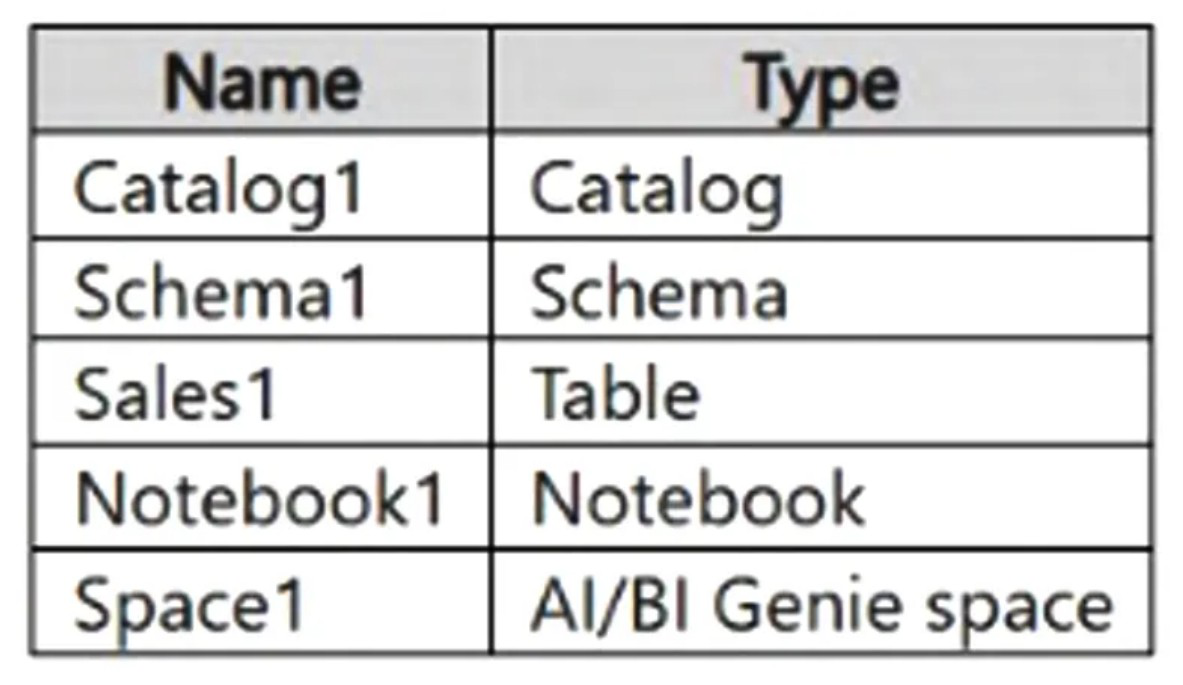
You have an Azure Databricks workspace that contains the objects shown in the following table. Users often use the following words to refer to a sale: transaction, event, order, and invoice. You need to create a knowledge store. The solution must ensure that when the users use any of the words in Space1, Genie queries the Sales1 table. Any other Genie spaces must remain unaffected. To which object should you add the instructions?
Show answer and explanation
Correct answer: C. Space1
In Azure Databricks, a Genie space is where you configure knowledge store instructions and synonyms that guide how Genie interprets natural language queries. To ensure that when users refer to sales using the words 'transaction', 'event', 'order', and 'invoice', Genie queries the Sales1 table specifically within Space1, you must add these synonym instructions directly to Space1. This configuration is scoped to that particular space and will not affect other Genie spaces, meeting the requirement that any other Genie spaces remain unaffected.
Why the other options are wrong
- A. Sales1 is a Table object where data resides, not where Genie query instructions and synonyms are configured.
- B. Schema1 is a Schema object that organizes database objects, not the location for Genie space-specific instructions.
- D. Catalog1 is a Catalog object at a higher organizational level and is not where space- scoped Genie instructions are added.
- E. Notebook1 is a notebook object used for interactive development, not the location for configuring Genie space knowledge store instructions.
That was 10 of 108.
The full Microsoft DP-750 pack has all 108 questions, each with the answer, the explanation and why the other options are wrong, plus a questions-only copy for timed runs. US$39, paid once, with free monthly updates and a pass-or-your-money-back guarantee.