
10 free Microsoft DP-600 practice questions with the correct answer and a full explanation for each, taken from the CertStash pack of 222 questions. Work through them, then open each answer to check your reasoning.
Get all 222 questions (US$39) · Download these 10 as a PDF
Question 1
Show the case study this question is based on
CASE STUDY
This is a case study. Case studies are not timed separately. You can use as much exam time as you would like to complete each case. However, there may be additional case studies and sections on this exam. You must manage your time to ensure that you are able to complete all questions included on this exam in the time provided.
To answer the questions included in a case study, you will need to reference information that is provided in the case study. Case studies might contain exhibits and other resources that provide more information about the scenario that is described in the case study. Each question is independent of the other questions in this case study.
At the end of this case study, a review screen will appear. This screen allows you to review your answers and to make changes before you move to the next section of the exam. After you begin a new section, you cannot return to this section.
To start the case study -To display the first question in this case study, click the Next button. Use the buttons in the left pane to explore the content of the case study before you answer the questions. Clicking these buttons displays information such as business requirements, existing environment, and problem statements. If the case study has an All Information tab, note that the information displayed is identical to the information displayed on the subsequent tabs.
When you are ready to answer a question, click the Question button to return to the question.
Overview
Contoso, Ltd. is a US-based health supplements company. Contoso has two divisions named Sales and Research. The Sales division contains two departments named Online Sales and Retail Sales. The Research division assigns internally developed product lines to individual teams of researchers and analysts.
Existing Environment
Identity Environment
Contoso has a Microsoft Entra tenant named contoso.com. The tenant contains two groups named ResearchReviewersGroup1 and ResearchReviewersGroup2.
Data Environment
Contoso has the following data environment:
The Sales division uses a Microsoft Power BI Premium capacity.
The semantic model of the Online Sales department includes a fact table named Orders that uses Import made. In the system of origin, the OrderID value represents the sequence in which orders are created.
The Research department uses an on-premises, third-party data warehousing product.
Fabric is enabled for contoso.com.
An Azure Data Lake Storage Gen2 storage account named storage1 contains Research division data for a product line named Productline1. The data is in the delta format.
A Data Lake Storage Gen2 storage account named storage2 contains Research division data for a product line named Productline2. The data is in the CSV format.
Requirements
Planned Changes
Contoso plans to make the following changes:
Enable support for Fabric in the Power BI Premium capacity used by the Sales division.
Make all the data for the Sales division and the Research division available in Fabric.
For the Research division, create two Fabric workspaces named Productline1ws and Productine2ws.
In Productline1ws, create a lakehouse named Lakehouse1.
In Lakehouse1, create a shortcut to storage1 named ResearchProduct.
Data Analytics Requirements
Contoso identifies the following data analytics requirements:
All the workspaces for the Sales division and the Research division must support all Fabric experiences.
The Research division workspaces must use a dedicated, on-demand capacity that has per-minute billing.
The Research division workspaces must be grouped together logically to support OneLake data hub filtering based on the department name.
For the Research division workspaces, the members of ResearchReviewersGroup1 must be able to read lakehouse and warehouse data and shortcuts by using SQL endpoints.
For the Research division workspaces, the members of ResearchReviewersGroup2 must be able to read lakehouse data by using Lakehouse explorer.
All the semantic models and reports for the Research division must use version control that supports branching.
Data Preparation Requirements
Contoso identifies the following data preparation requirements:
The Research division data for Productline1 must be retrieved from Lakehouse1 by using Fabric notebooks.
All the Research division data in the lakehouses must be presented as managed tables in Lakehouse explorer.
Semantic Model Requirements
Contoso identifies the following requirements for implementing and managing semantic models:
The number of rows added to the Orders table during refreshes must be minimized.
The semantic models in the Research division workspaces must use Direct Lake mode.
General Requirements
Contoso identifies the following high-level requirements that must be considered for all solutions:
Follow the principle of least privilege when applicable.
Minimize implementation and maintenance effort when possible.
You need to ensure that Contoso can use version control to meet the data analytics requirements and the general requirements.
What should you do?
Show answer and explanation
Correct answer: C. Modify the settings of the Research division workspaces to use an Azure Repos repository.
workspaces to use an Azure Repos repository. For Fabric workspaces, Azure Repos is the native version control solution that integrates directly with Fabric for managing semantic models and reports with branching support. Azure Repos provides enterprise-grade version control within the Microsoft ecosystem, minimizing implementation effort and maintaining security compliance. This satisfies the requirement for version control supporting branching while following least privilege principles through role-based access control in Azure Repos.
Why the other options are wrong
- A. Storing files in Data Lake Gen2 storage does not provide version control capabilities or branching support.
- B. While GitHub supports branching, Azure Repos is the Microsoft-native solution designed for Fabric integration and reduces maintenance overhead.
- D. OneDrive does not provide version control with branching capabilities required for semantic model management.
Question 2
Show the case study this question is based on
CASE STUDY
This is a case study. Case studies are not timed separately. You can use as much exam time as you would like to complete each case. However, there may be additional case studies and sections on this exam. You must manage your time to ensure that you are able to complete all questions included on this exam in the time provided.
To answer the questions included in a case study, you will need to reference information that is provided in the case study. Case studies might contain exhibits and other resources that provide more information about the scenario that is described in the case study. Each question is independent of the other questions in this case study.
At the end of this case study, a review screen will appear. This screen allows you to review your answers and to make changes before you move to the next section of the exam. After you begin a new section, you cannot return to this section.
To start the case study -To display the first question in this case study, click the Next button. Use the buttons in the left pane to explore the content of the case study before you answer the questions. Clicking these buttons displays information such as business requirements, existing environment, and problem statements. If the case study has an All Information tab, note that the information displayed is identical to the information displayed on the subsequent tabs.
When you are ready to answer a question, click the Question button to return to the question.
Overview
Contoso, Ltd. is a US-based health supplements company. Contoso has two divisions named Sales and Research. The Sales division contains two departments named Online Sales and Retail Sales. The Research division assigns internally developed product lines to individual teams of researchers and analysts.
Existing Environment
Identity Environment
Contoso has a Microsoft Entra tenant named contoso.com. The tenant contains two groups named ResearchReviewersGroup1 and ResearchReviewersGroup2.
Data Environment
Contoso has the following data environment:
The Sales division uses a Microsoft Power BI Premium capacity.
The semantic model of the Online Sales department includes a fact table named Orders that uses Import made. In the system of origin, the OrderID value represents the sequence in which orders are created.
The Research department uses an on-premises, third-party data warehousing product.
Fabric is enabled for contoso.com.
An Azure Data Lake Storage Gen2 storage account named storage1 contains Research division data for a product line named Productline1. The data is in the delta format.
A Data Lake Storage Gen2 storage account named storage2 contains Research division data for a product line named Productline2. The data is in the CSV format.
Requirements
Planned Changes
Contoso plans to make the following changes:
Enable support for Fabric in the Power BI Premium capacity used by the Sales division.
Make all the data for the Sales division and the Research division available in Fabric.
For the Research division, create two Fabric workspaces named Productline1ws and Productine2ws.
In Productline1ws, create a lakehouse named Lakehouse1.
In Lakehouse1, create a shortcut to storage1 named ResearchProduct.
Data Analytics Requirements
Contoso identifies the following data analytics requirements:
All the workspaces for the Sales division and the Research division must support all Fabric experiences.
The Research division workspaces must use a dedicated, on-demand capacity that has per-minute billing.
The Research division workspaces must be grouped together logically to support OneLake data hub filtering based on the department name.
For the Research division workspaces, the members of ResearchReviewersGroup1 must be able to read lakehouse and warehouse data and shortcuts by using SQL endpoints.
For the Research division workspaces, the members of ResearchReviewersGroup2 must be able to read lakehouse data by using Lakehouse explorer.
All the semantic models and reports for the Research division must use version control that supports branching.
Data Preparation Requirements
Contoso identifies the following data preparation requirements:
The Research division data for Productline1 must be retrieved from Lakehouse1 by using Fabric notebooks.
All the Research division data in the lakehouses must be presented as managed tables in Lakehouse explorer.
Semantic Model Requirements
Contoso identifies the following requirements for implementing and managing semantic models:
The number of rows added to the Orders table during refreshes must be minimized.
The semantic models in the Research division workspaces must use Direct Lake mode.
General Requirements
Contoso identifies the following high-level requirements that must be considered for all solutions:
Follow the principle of least privilege when applicable.
Minimize implementation and maintenance effort when possible.
You need to refresh the Orders table of the Online Sales department. The solution must meet the semantic model requirements.
What should you include in the solution?
Show answer and explanation
Correct answer: A. an Azure Data Factory pipeline that executes a Stored procedure activity to retrieve the maximum value of the OrderID column in the destination lakehouse
procedure activity to retrieve the maximum value of the OrderID column in the destination lakehouse The Orders table uses Import mode and OrderID reflects the sequence in which orders are created, so the refresh should load only the orders created after the last load. The pipeline first retrieves the maximum OrderID already present in the destination, then copies only rows with a higher OrderID, which minimizes the number of rows added during each refresh. A Stored procedure activity is the component that returns that watermark value to the pipeline so the copy can be filtered.
Why the other options are wrong
- B. Starting from the minimum OrderID would reload rows that are already in the destination instead of adding only the new orders.
- C. Retrieving the minimum OrderID reloads history that is already loaded, so the number of rows added is not minimized.
- D. A dataflow is designed to move and transform data, not to return the watermark value that the pipeline needs to drive the incremental load.
Question 3
Show the case study this question is based on
CASE STUDY
This is a case study. Case studies are not timed separately. You can use as much exam time as you would like to complete each case. However, there may be additional case studies and sections on this exam. You must manage your time to ensure that you are able to complete all questions included on this exam in the time provided.
To answer the questions included in a case study, you will need to reference information that is provided in the case study. Case studies might contain exhibits and other resources that provide more information about the scenario that is described in the case study. Each question is independent of the other questions in this case study.
At the end of this case study, a review screen will appear. This screen allows you to review your answers and to make changes before you move to the next section of the exam. After you begin a new section, you cannot return to this section.
To start the case study -To display the first question in this case study, click the Next button. Use the buttons in the left pane to explore the content of the case study before you answer the questions. Clicking these buttons displays information such as business requirements, existing environment, and problem statements. If the case study has an All Information tab, note that the information displayed is identical to the information displayed on the subsequent tabs.
When you are ready to answer a question, click the Question button to return to the question.
Overview
Contoso, Ltd. is a US-based health supplements company. Contoso has two divisions named Sales and Research. The Sales division contains two departments named Online Sales and Retail Sales. The Research division assigns internally developed product lines to individual teams of researchers and analysts.
Existing Environment
Identity Environment
Contoso has a Microsoft Entra tenant named contoso.com. The tenant contains two groups named ResearchReviewersGroup1 and ResearchReviewersGroup2.
Data Environment
Contoso has the following data environment:
The Sales division uses a Microsoft Power BI Premium capacity.
The semantic model of the Online Sales department includes a fact table named Orders that uses Import made. In the system of origin, the OrderID value represents the sequence in which orders are created.
The Research department uses an on-premises, third-party data warehousing product.
Fabric is enabled for contoso.com.
An Azure Data Lake Storage Gen2 storage account named storage1 contains Research division data for a product line named Productline1. The data is in the delta format.
A Data Lake Storage Gen2 storage account named storage2 contains Research division data for a product line named Productline2. The data is in the CSV format.
Requirements
Planned Changes
Contoso plans to make the following changes:
Enable support for Fabric in the Power BI Premium capacity used by the Sales division.
Make all the data for the Sales division and the Research division available in Fabric.
For the Research division, create two Fabric workspaces named Productline1ws and Productine2ws.
In Productline1ws, create a lakehouse named Lakehouse1.
In Lakehouse1, create a shortcut to storage1 named ResearchProduct.
Data Analytics Requirements
Contoso identifies the following data analytics requirements:
All the workspaces for the Sales division and the Research division must support all Fabric experiences.
The Research division workspaces must use a dedicated, on-demand capacity that has per-minute billing.
The Research division workspaces must be grouped together logically to support OneLake data hub filtering based on the department name.
For the Research division workspaces, the members of ResearchReviewersGroup1 must be able to read lakehouse and warehouse data and shortcuts by using SQL endpoints.
For the Research division workspaces, the members of ResearchReviewersGroup2 must be able to read lakehouse data by using Lakehouse explorer.
All the semantic models and reports for the Research division must use version control that supports branching.
Data Preparation Requirements
Contoso identifies the following data preparation requirements:
The Research division data for Productline1 must be retrieved from Lakehouse1 by using Fabric notebooks.
All the Research division data in the lakehouses must be presented as managed tables in Lakehouse explorer.
Semantic Model Requirements
Contoso identifies the following requirements for implementing and managing semantic models:
The number of rows added to the Orders table during refreshes must be minimized.
The semantic models in the Research division workspaces must use Direct Lake mode.
General Requirements
Contoso identifies the following high-level requirements that must be considered for all solutions:
Follow the principle of least privilege when applicable.
Minimize implementation and maintenance effort when possible.
Which syntax should you use in a notebook to access the Research division data for Productline1?
Show answer and explanation
Correct answer: B. spark.sql(“SELECT * FROM Lakehouse1.ResearchProduct ”)
Lakehouse1.ResearchProduct ”) To access data from Lakehouse1 using a shortcut named ResearchProduct in a Fabric notebook, the correct syntax is `spark.sql("SELECT * FROM Lakehouse1.ResearchProduct")`. This uses Spark SQL to query the lakehouse object directly by referencing the lakehouse name and the shortcut alias, which is the standard approach for notebook data retrieval in Fabric.
Why the other options are wrong
- A. This syntax references an internal Tables folder path structure that is not the correct method for accessing shortcut data in notebooks.
- C. The external_table function with this syntax is not valid Fabric notebook syntax for accessing lakehouse shortcuts.
- D. This external_table syntax lacks the required string quotes and is not a valid Fabric function for data access.
Question 4
Show the case study this question is based on
CASE STUDY
This is a case study. Case studies are not timed separately. You can use as much exam time as you would like to complete each case. However, there may be additional case studies and sections on this exam. You must manage your time to ensure that you are able to complete all questions included on this exam in the time provided.
To answer the questions included in a case study, you will need to reference information that is provided in the case study. Case studies might contain exhibits and other resources that provide more information about the scenario that is described in the case study. Each question is independent of the other questions in this case study.
At the end of this case study, a review screen will appear. This screen allows you to review your answers and to make changes before you move to the next section of the exam. After you begin a new section, you cannot return to this section.
To start the case study -To display the first question in this case study, click the Next button. Use the buttons in the left pane to explore the content of the case study before you answer the questions. Clicking these buttons displays information such as business requirements, existing environment, and problem statements. If the case study has an All Information tab, note that the information displayed is identical to the information displayed on the subsequent tabs.
When you are ready to answer a question, click the Question button to return to the question.
Overview
Litware, Inc. is a manufacturing company that has offices throughout North America. The analytics team at Litware contains data engineers, analytics engineers, data analysts, and data scientists.
Existing Environment
Fabric Environment
Litware has been using a Microsoft Power BI tenant for three years. Litware has NOT enabled any Fabric capacities and features.
Available Data
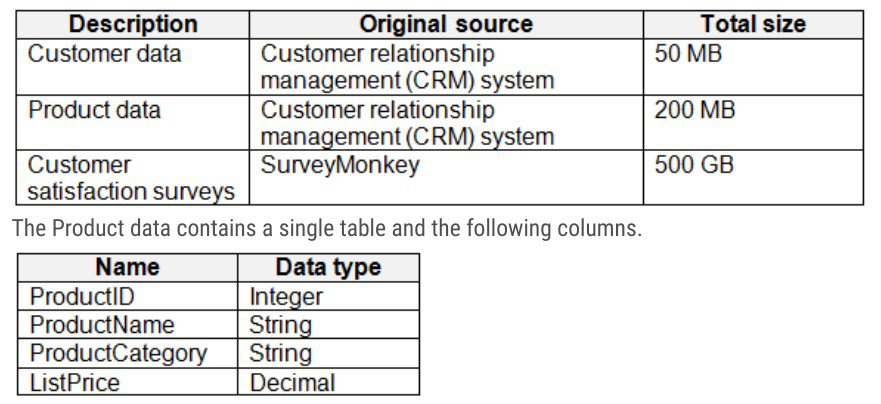
Litware has data that must be analyzed as shown in the following table.
The Product data contains a single table and the following columns.
The customer satisfaction data contains the following tables:
• Survey
• Question
• Response
For each survey submitted, the following occurs:
One row is added to the Survey table.
One row is added to the Response table for each question in the survey.
The Question table contains the text of each survey question. The third question in each survey response is an overall satisfaction score.
Customers can submit a survey after each purchase.
User Problems
The analytics team has large volumes of data, some of which is semi-structured. The team wants to use Fabric to create a new data store.
Product data is often classified into three pricing groups: high, medium, and low. This logic is implemented in several databases and semantic models, but the logic does NOT always match across implementations.
Requirements
Planned Changes
Litware plans to enable Fabric features in the existing tenant. The analytics team will create a new data store as a proof of concept (PoC). The remaining Liware users will only get access to the Fabric features once the PoC is complete. The PoC will be completed by using a Fabric trial capacity The following three workspaces will be created:
AnalyticsPOC: Will contain the data store, semantic models, reports pipelines, dataflow, and notebooks used to populate the data store DataEngPOC: Will contain all the pipelines, dataflows, and notebooks used to populate OneLake DataSciPOC: Will contain all the notebooks and reports created by the data scientists The following will be created in the AnalyticsPOC workspace:
• A data store (type to be decided)
• A custom semantic model
• A default semantic model
• Interactive reports
The data engineers will create data pipelines to load data to OneLake either hourly or daily depending on the data source. The analytics engineers will create processes to ingest, transform, and load the data to the data store in the AnalyticsPOC workspace daily. Whenever possible, the data engineers will use low-code tools for data ingestion. The choice of which data cleansing and transformation tools to use will be at the data engineers’ discretion.
All the semantic models and reports in the Analytics POC workspace will use the data store as the sole data source.
Technical Requirements
The data store must support the following:
• Read access by using T-SQL or Python
• Semi-structured and unstructured data
• Row-level security (RLS) for users executing T-SQL queries
Files loaded by the data engineers to OneLake will be stored in the Parquet format and will meet Delta Lake specifications.
Data will be loaded without transformation in one area of the AnalyticsPOC data store. The data will then be cleansed, merged, and transformed into a dimensional model The data load process must ensure that the raw and cleansed data is updated completely before populating the dimensional model The dimensional model must contain a date dimension. There is no existing data source for the date dimension. The Litware fiscal year matches the calendar year. The date dimension must always contain dates from 2010 through the end of the current year.
The product pricing group logic must be maintained by the analytics engineers in a single location. The pricing group data must be made available in the data store for T- SOL. queries and in the default semantic model. The following logic must be used:
List prices that are less than or equal to 50 are in the low pricing group.
List prices that are greater than 50 and less than or equal to 1,000 are in the medium pricing group.
List prices that are greater than 1,000 are in the high pricing group.
Security Requirements
Only Fabric administrators and the analytics team must be able to see the Fabric items created as part of the PoC.
Litware identifies the following security requirements for the Fabric items in the AnalyticsPOC workspace:
Fabric administrators will be the workspace administrators.
The data engineers must be able to read from and write to the data store. No access must be granted to datasets or reports.
The analytics engineers must be able to read from, write to, and create schemas in the data store. They also must be able to create and share semantic models with the data analysts and view and modify all reports in the workspace.
The data scientists must be able to read from the data store, but not write to it. They will access the data by using a Spark notebook The data analysts must have read access to only the dimensional model objects in the data store. They also must have access to create Power BI reports by using the semantic models created by the analytics engineers.
The date dimension must be available to all users of the data store.
The principle of least privilege must be followed.
Both the default and custom semantic models must include only tables or views from the dimensional model in the data store. Litware already has the following Microsoft Entra security groups:
• FabricAdmins: Fabric administrators
• AnalyticsTeam: All the members of the analytics team
DataAnalysts: The data analysts on the analytics team DataScientists: The data scientists on the analytics team DataEngineers: The data engineers on the analytics team AnalyticsEngineers: The analytics engineers on the analytics team
Report Requirements
The data analysts must create a customer satisfaction report that meets the following requirements:
Enables a user to select a product to filter customer survey responses to only those who have purchased that product.
Displays the average overall satisfaction score of all the surveys submitted during the last 12 months up to a selected dat.
Shows data as soon as the data is updated in the data store.
Ensures that the report and the semantic model only contain data from the current and previous year.
Ensures that the report respects any table-level security specified in the source data store.
Minimizes the execution time of report queries.
What should you recommend using to ingest the customer data into the data store in the AnalyticsPOC workspace?
Show answer and explanation
Correct answer: D. a dataflow
The requirements explicitly state that data engineers should use low-code tools for data ingestion whenever possible, and that the choice of data cleansing and transformation tools is at their discretion. Customer data from the CRM system (50 MB) needs to be loaded to OneLake in Parquet format meeting Delta Lake specifications. A dataflow is the low-code tool within Fabric designed for this purpose, allowing data engineers to ingest structured data from source systems without writing code. Dataflows integrate seamlessly with OneLake and support transformation to Parquet format, making it the optimal choice for meeting the "whenever possible, use low-code tools" requirement.
Why the other options are wrong
- A. Stored procedures are database-level objects that execute within a database, not data ingestion tools for loading data into a Fabric data store from external sources.
- B. KQL (Kusto Query Language) activities are used for querying and processing data in Kusto databases, not for ingesting CRM data into OneLake as Parquet files.
- C. While a Spark notebook could perform ingestion, it requires code and contradicts the stated preference to use low-code tools whenever possible for data ingestion.
Question 5
Show the case study this question is based on
CASE STUDY
This is a case study. Case studies are not timed separately. You can use as much exam time as you would like to complete each case. However, there may be additional case studies and sections on this exam. You must manage your time to ensure that you are able to complete all questions included on this exam in the time provided.
To answer the questions included in a case study, you will need to reference information that is provided in the case study. Case studies might contain exhibits and other resources that provide more information about the scenario that is described in the case study. Each question is independent of the other questions in this case study.
At the end of this case study, a review screen will appear. This screen allows you to review your answers and to make changes before you move to the next section of the exam. After you begin a new section, you cannot return to this section.
To start the case study -To display the first question in this case study, click the Next button. Use the buttons in the left pane to explore the content of the case study before you answer the questions. Clicking these buttons displays information such as business requirements, existing environment, and problem statements. If the case study has an All Information tab, note that the information displayed is identical to the information displayed on the subsequent tabs.
When you are ready to answer a question, click the Question button to return to the question.
Overview
Litware, Inc. is a manufacturing company that has offices throughout North America. The analytics team at Litware contains data engineers, analytics engineers, data analysts, and data scientists.
Existing Environment
Fabric Environment
Litware has been using a Microsoft Power BI tenant for three years. Litware has NOT enabled any Fabric capacities and features.
Available Data
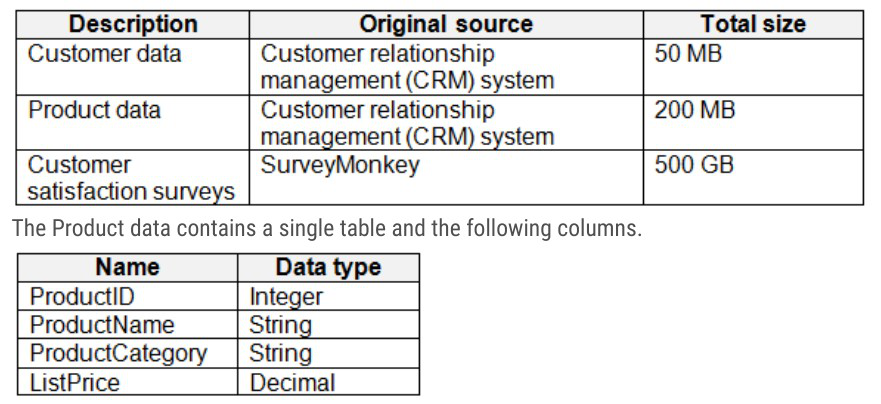
Litware has data that must be analyzed as shown in the following table.
The Product data contains a single table and the following columns.
The customer satisfaction data contains the following tables:
• Survey
• Question
• Response
For each survey submitted, the following occurs:
One row is added to the Survey table.
One row is added to the Response table for each question in the survey.
The Question table contains the text of each survey question. The third question in each survey response is an overall satisfaction score.
Customers can submit a survey after each purchase.
User Problems
The analytics team has large volumes of data, some of which is semi-structured. The team wants to use Fabric to create a new data store.
Product data is often classified into three pricing groups: high, medium, and low. This logic is implemented in several databases and semantic models, but the logic does NOT always match across implementations.
Requirements
Planned Changes
Litware plans to enable Fabric features in the existing tenant. The analytics team will create a new data store as a proof of concept (PoC). The remaining Liware users will only get access to the Fabric features once the PoC is complete. The PoC will be completed by using a Fabric trial capacity The following three workspaces will be created:
AnalyticsPOC: Will contain the data store, semantic models, reports pipelines, dataflow, and notebooks used to populate the data store DataEngPOC: Will contain all the pipelines, dataflows, and notebooks used to populate OneLake DataSciPOC: Will contain all the notebooks and reports created by the data scientists The following will be created in the AnalyticsPOC workspace:
• A data store (type to be decided)
• A custom semantic model
• A default semantic model
• Interactive reports
The data engineers will create data pipelines to load data to OneLake either hourly or daily depending on the data source. The analytics engineers will create processes to ingest, transform, and load the data to the data store in the AnalyticsPOC workspace daily. Whenever possible, the data engineers will use low-code tools for data ingestion. The choice of which data cleansing and transformation tools to use will be at the data engineers’ discretion.
All the semantic models and reports in the Analytics POC workspace will use the data store as the sole data source.
Technical Requirements
The data store must support the following:
• Read access by using T-SQL or Python
• Semi-structured and unstructured data
• Row-level security (RLS) for users executing T-SQL queries
Files loaded by the data engineers to OneLake will be stored in the Parquet format and will meet Delta Lake specifications.
Data will be loaded without transformation in one area of the AnalyticsPOC data store. The data will then be cleansed, merged, and transformed into a dimensional model The data load process must ensure that the raw and cleansed data is updated completely before populating the dimensional model The dimensional model must contain a date dimension. There is no existing data source for the date dimension. The Litware fiscal year matches the calendar year. The date dimension must always contain dates from 2010 through the end of the current year.
The product pricing group logic must be maintained by the analytics engineers in a single location. The pricing group data must be made available in the data store for T- SOL. queries and in the default semantic model. The following logic must be used:
List prices that are less than or equal to 50 are in the low pricing group.
List prices that are greater than 50 and less than or equal to 1,000 are in the medium pricing group.
List prices that are greater than 1,000 are in the high pricing group.
Security Requirements
Only Fabric administrators and the analytics team must be able to see the Fabric items created as part of the PoC.
Litware identifies the following security requirements for the Fabric items in the AnalyticsPOC workspace:
Fabric administrators will be the workspace administrators.
The data engineers must be able to read from and write to the data store. No access must be granted to datasets or reports.
The analytics engineers must be able to read from, write to, and create schemas in the data store. They also must be able to create and share semantic models with the data analysts and view and modify all reports in the workspace.
The data scientists must be able to read from the data store, but not write to it. They will access the data by using a Spark notebook The data analysts must have read access to only the dimensional model objects in the data store. They also must have access to create Power BI reports by using the semantic models created by the analytics engineers.
The date dimension must be available to all users of the data store.
The principle of least privilege must be followed.
Both the default and custom semantic models must include only tables or views from the dimensional model in the data store. Litware already has the following Microsoft Entra security groups:
• FabricAdmins: Fabric administrators
• AnalyticsTeam: All the members of the analytics team
DataAnalysts: The data analysts on the analytics team DataScientists: The data scientists on the analytics team DataEngineers: The data engineers on the analytics team AnalyticsEngineers: The analytics engineers on the analytics team
Report Requirements
The data analysts must create a customer satisfaction report that meets the following requirements:
Enables a user to select a product to filter customer survey responses to only those who have purchased that product.
Displays the average overall satisfaction score of all the surveys submitted during the last 12 months up to a selected dat.
Shows data as soon as the data is updated in the data store.
Ensures that the report and the semantic model only contain data from the current and previous year.
Ensures that the report respects any table-level security specified in the source data store.
Minimizes the execution time of report queries.
Which type of data store should you recommend in the AnalyticsPOC workspace?
Show answer and explanation
Correct answer: C. a lakehouse
The data store must hold semi-structured and unstructured data, allow read access with T- SQL or Python, and enforce row-level security for T-SQL queries. A lakehouse meets all three: files land in OneLake as Delta Parquet, data scientists read them with Spark notebooks in Python, and the SQL analytics endpoint serves T-SQL queries with row-level security. It also supports the raw, cleansed, and dimensional layers plus the default and custom semantic models built on those tables.
Why the other options are wrong
- A. A plain data lake offers no T-SQL query surface, no row-level security, and no semantic model layer.
- B. A warehouse stores only relational tables, so it cannot hold the semi-structured and unstructured data the analytics team must analyze.
- D. An external Hive metastore is a catalog service, not a Fabric data store that can be created in the AnalyticsPOC workspace.
Question 6
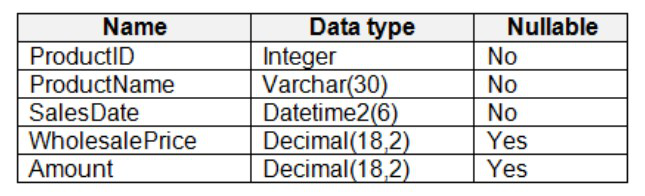
You have a Fabric warehouse that contains a table named Staging.Sales. Staging.Sales contains the following columns.
You need to write a T-SQL query that will return data for the year 2023 that displays ProductID and ProductName and has a summarized Amount that is higher than 10,000.
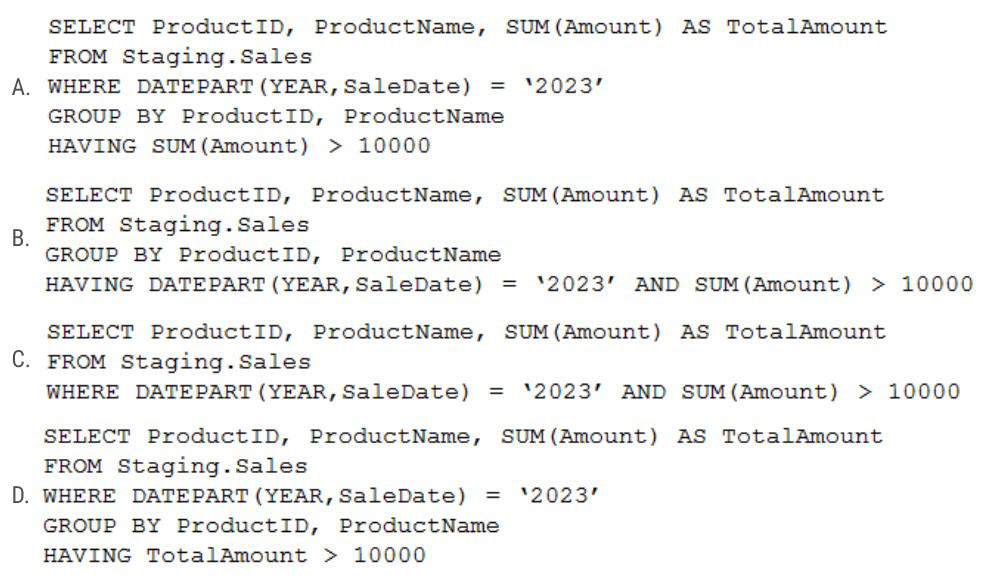
Which query should you use?
Show answer and explanation
Correct answer: A. SELECT ProductID, ProductName, SUM(Amount) AS
TotalAmount FROM Staging.Sales WHERE DATEPART(YEAR,SaleDate) = '2023' GROUP BY ProductID, ProductName HAVING SUM(Amount) > 10000 Option A filters rows to 2023 in the WHERE clause, groups by ProductID and ProductName, and then applies HAVING SUM(Amount) > 10000 to keep only products whose summarized amount exceeds the threshold. That is the required order of operations in T-SQL: filter rows, aggregate, then filter the aggregates.
Why the other options are wrong
- B. SaleDate in the HAVING clause is neither aggregated nor listed in the GROUP BY, so the query fails, and the year restriction would be applied after aggregation rather than before it.
- C. An aggregate function cannot appear in the WHERE clause, and the query has no GROUP BY to produce a summarized amount per product.
- D. T-SQL does not allow a SELECT list alias such as TotalAmount to be referenced in the HAVING clause; the aggregate expression must be repeated.
Question 7
You are the administrator of a Fabric workspace that contains a lakehouse named Lakehouse1. Lakehouse1 contains the following tables:
Table1: A Delta table created by using a shortcut Table2: An external table created by using Spark Table3: A managed table -You plan to connect to Lakehouse1 by using its SQL endpoint.
What will you be able to do after connecting to Lakehouse1?
Show answer and explanation
Correct answer: A. Read Table3.
The SQL analytics endpoint of a lakehouse is read-only, so any option that writes data is out. The endpoint exposes the Delta tables in the lakehouse Tables area, which includes managed tables and tables created from shortcuts, so the managed Table3 can be queried. Data changes must be made against the lakehouse itself with Spark, pipelines, or dataflows.
Why the other options are wrong
- B. The SQL analytics endpoint does not support INSERT, UPDATE, DELETE, or MERGE against lakehouse tables.
- C. An external table created in Spark is not registered as a queryable Delta table in the SQL analytics endpoint.
- D. A shortcut-based Delta table can be read through the endpoint but cannot be modified there, because the endpoint provides read-only access.
Question 8
You have a Fabric tenant that contains a warehouse.
You use a dataflow to load a new dataset from OneLake to the warehouse.
You need to add a PowerQuery step to identify the maximum values for the numeric columns.
Which function should you include in the step?
Show answer and explanation
Correct answer: D. Table.Profile
The Table.Profile function in Power Query is designed to provide statistical summaries of data columns, including maximum values for numeric columns. This function generates profile information that identifies data characteristics without requiring custom logic to find maximum values.
Why the other options are wrong
- A. Table.MaxN returns the top N rows with maximum values but is not the primary profiling function.
- B. Table.Max returns a single maximum value but does not provide comprehensive profiling across all numeric columns simultaneously.
- C. Table.Range is used to extract a contiguous subset of rows, not for identifying maximum values.
Question 9
You have a Fabric tenant that contains a machine learning model registered in a Fabric workspace.
You need to use the model to generate predictions by using the PREDICT function in a Fabric notebook.
Which two languages can you use to perform model scoring? Each correct answer presents a complete solution.
NOTE: Each correct answer is worth one point.
Show answer and explanation
Correct answer: C, D
C. Spark SQL D. PySpark The PREDICT function in Fabric notebooks for model scoring is supported in Spark SQL and PySpark. These are the two languages available within Fabric notebooks for executing machine learning model predictions. Spark SQL provides SQL-based prediction syntax while PySpark provides Python-based model scoring capabilities.
Why the other options are wrong
- A. T-SQL is not supported in Fabric notebooks for PREDICT function execution.
- B. DAX is used in Power BI reports and semantic models, not in Fabric notebooks for model scoring.
Question 10
You are analyzing the data in a Fabric notebook.
You have a Spark DataFrame assigned to a variable named df.
You need to use the Chart view in the notebook to explore the data manually.
Which function should you run to make the data available in the Chart view?
Show answer and explanation
Correct answer: D. display
The `display()` function in Fabric notebooks makes a Spark DataFrame available in the Chart view, allowing for manual data exploration and visualization. This function renders the DataFrame in a tabular format that can be converted to various chart types for interactive analysis.
Why the other options are wrong
- A. displayHTML is used for rendering HTML content, not for making DataFrames available in Chart view.
- B. show is not the standard function for making DataFrames available in Fabric notebook Chart views.
- C. write is used for writing data to storage, not for displaying data in the notebook interface.
That was 10 of 222.
The full Microsoft DP-600 pack has all 222 questions, each with the answer, the explanation and why the other options are wrong, plus a questions-only copy for timed runs. US$39, paid once, with free monthly updates and a pass-or-your-money-back guarantee.