
10 free Microsoft AZ-700 practice questions with the correct answer and a full explanation for each, taken from the CertStash pack of 387 questions. Work through them, then open each answer to check your reasoning.
Get all 387 questions (US$39) · Download these 10 as a PDF
Question 1
Your company has a single on-premises datacenter in Washington DC. The East US Azure region has a peering location in Washington DC.
The company only has Azure resources in the East US region.
You need to implement ExpressRoute to support up to 1 Gbps. You must use only ExpressRoute Unlimited data plans. The solution must minimize costs.
Which type of ExpressRoute circuits should you create?
Show answer and explanation
Correct answer: A. ExpressRoute Local
ExpressRoute Local circuits are offered at peering locations that are co-located with a specific Azure region, and Washington DC is the local peering location for East US. Local circuits are sold only with the Unlimited data plan and include data transfer at no additional charge, which meets the requirement and gives the lowest price for up to 1 Gbps. Because all workloads live only in East US, the reach limitation of Local is not a problem.
Why the other options are wrong
- B. ExpressRoute Direct provisions dedicated 10 Gbps or 100 Gbps port pairs and is far more expensive than needed for a single 1 Gbps connection.
- C. ExpressRoute Premium is a paid add-on that extends connectivity beyond the geopolitical boundary and raises route and VNet limits, capabilities this single-region deployment does not need.
- D. ExpressRoute Standard supports an Unlimited data plan but costs more than a Local circuit for the same bandwidth when the datacenter sits at the region's local peering location.
Question 2
You are planning an Azure Point-to-Site (P2S) VPN that will use OpenVPN.
Users will authenticate by an on-premises Active Directory domain.
Which additional service should you deploy to support the VPN authentication?
Show answer and explanation
Correct answer: B. a RADIUS server
RADIUS (Remote Authentication Dial-In User Service) is the required service to authenticate Point-to-Site VPN users against an on-premises Active Directory domain. Azure VPN Gateway with OpenVPN and RADIUS integration enables this authentication flow by forwarding user credentials to the RADIUS server, which validates them against Active Directory.
Why the other options are wrong
- A. Azure Key Vault stores cryptographic keys and secrets but does not provide authentication services for VPN users.
- C. A certification authority handles digital certificates and PKI infrastructure, not user authentication against Active Directory.
- D. Azure AD Application Proxy manages application access through Azure Active Directory, not on-premises AD authentication for VPN.
Question 3
You plan to configure BGP for a Site-to-Site VPN connection between a datacenter and Azure.
Which two Azure resources should you configure? Each correct answer presents a part of the solution. (Choose two.)
NOTE: Each correct selection is worth one point.
Show answer and explanation
Correct answer: A, D
A. a virtual network gateway D. a local network gateway The virtual network gateway (A) is the Azure-side VPN termination point that establishes the IPsec tunnel and runs BGP routing. The local network gateway (D) represents the on- premises network and defines the remote BGP peer configuration. Together, these two resources enable dynamic BGP routing between the datacenter and Azure.
Why the other options are wrong
- B. Azure Application Gateway is a Layer 7 load balancer for web traffic, not involved in BGP or VPN configuration.
- C. Azure Firewall provides network filtering and threat protection but does not configure or run BGP routing protocols.
- E. Azure Front Door is a global load balancing service unrelated to Site-to-Site VPN or BGP configuration.
Question 4
You fail to establish a Site-to-Site VPN connection between your company's main office and an Azure virtual network.
You need to troubleshoot what prevents you from establishing the IPsec tunnel.
Which diagnostic log should you review?
Show answer and explanation
Correct answer: A. IKEDiagnosticLog
IKEDiagnosticLog captures the Internet Key Exchange negotiation between the on- premises VPN device and the Azure VPN gateway. When a tunnel never comes up, this log shows the Phase 1 and Phase 2 details such as mismatched IPsec/IKE policies, wrong pre-shared keys, and unsupported proposals. That is exactly the evidence needed to find what blocks the IPsec tunnel.
Why the other options are wrong
- B. RouteDiagnosticLog records static route and BGP route changes learned or advertised by the gateway, which is routing information rather than tunnel negotiation.
- C. GatewayDiagnosticLog reports gateway-level operations such as configuration changes and health events, without the IKE negotiation detail.
- D. TunnelDiagnosticLog records tunnel connect and disconnect state-change events, so it shows that the tunnel is down but not why the negotiation failed.
Question 5
You have an Azure virtual network and an on-premises datacenter.
You are planning a Site-to-Site VPN connection between the datacenter and the virtual network.
Which two resources should you include in your plan? Each correct answer presents part of the solution.
NOTE: Each correct selection is worth one point.
Show answer and explanation
Correct answer: B, G
B. a virtual network gateway G. a local network gateway The virtual network gateway (B) serves as the Azure-side VPN endpoint that terminates the IPsec tunnel and manages the VPN connection. The local network gateway (G) represents the on-premises datacenter, defining its network address space and VPN device details. These two resources are essential for establishing Site-to-Site VPN connectivity.
Why the other options are wrong
- A. User-defined routes manage traffic within Azure networks but are not required for establishing the VPN connection itself.
- C. Azure Firewall provides network security filtering but is optional and not part of the core Site-to-Site VPN setup.
- D. Azure Web Application Firewall protects web applications and is unrelated to VPN infrastructure.
- E. On-premises data gateway is used for hybrid cloud data integration, not for VPN connections.
- F. Azure Application Gateway is a Layer 7 load balancer unrelated to VPN connectivity.
Question 6
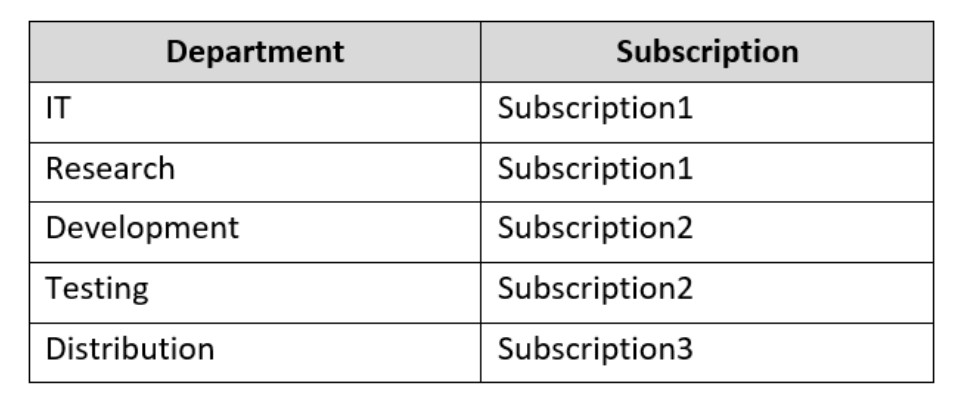
Your company has an on-premises network and three Azure subscriptions named Subscription1, Subscription2, and Subscription3.
The departments at the company use the Azure subscriptions as shown in the following table.
All the resources in the subscriptions are in either the West US Azure region or the West US 2 Azure region.
You plan to connect all the subscriptions to the on-premises network by using ExpressRoute.
What is the minimum number of ExpressRoute circuits required?
Show answer and explanation
Correct answer: A. 1
One ExpressRoute circuit is enough. A circuit is created in a single subscription, but its owner can generate circuit authorizations and hand the authorization keys to the other subscriptions so their virtual network gateways can link to the same circuit. West US and West US 2 are both in the same geopolitical region, so a single Standard circuit reaches all resources in all three subscriptions.
Why the other options are wrong
- B. A second circuit would only add redundancy, which the question does not require, so it is not the minimum.
- C. Circuits do not map one to one with subscriptions because authorization keys let several subscriptions connect to one circuit.
- D. Four circuits far exceed what is needed when a single circuit can be shared across every subscription and both regions.
- E. Five circuits is heavy over-provisioning for three subscriptions whose regions fall inside one geopolitical region.
Question 7
Your company has offices in New York and Amsterdam. The company has an Azure subscription. Both offices connect to Azure by using a Site-to-Site VPN connection.
The office in Amsterdam uses resources in the North Europe Azure region. The office in New York uses resources in the East US Azure region.
You need to implement ExpressRoute circuits to connect each office to the nearest Azure region. Once the ExpressRoute circuits are connected, the on-premises computers in the Amsterdam office must be able to connect to the on-premises servers in the New York office by using the ExpressRoute circuits.
Which ExpressRoute option should you use?
Show answer and explanation
Correct answer: B. ExpressRoute Global Reach
ExpressRoute Global Reach links the private peerings of two ExpressRoute circuits so the on-premises networks behind them can exchange traffic directly across the Microsoft backbone. Connecting the Amsterdam circuit in North Europe to the New York circuit in East US lets the two offices reach each other's servers without traversing the internet or a hub virtual network. This is the only ExpressRoute feature designed for site-to-site connectivity between circuits.
Why the other options are wrong
- A. ExpressRoute FastPath sends data plane traffic straight to virtual machines by bypassing the ExpressRoute virtual network gateway, and it does nothing to connect two on-premises sites.
- C. ExpressRoute Direct supplies dedicated 10 Gbps or 100 Gbps ports into Microsoft's network but provides no circuit-to-circuit routing.
- D. ExpressRoute Local limits a circuit to the Azure region co-located with its peering location and cannot be used with Global Reach.
Question 8
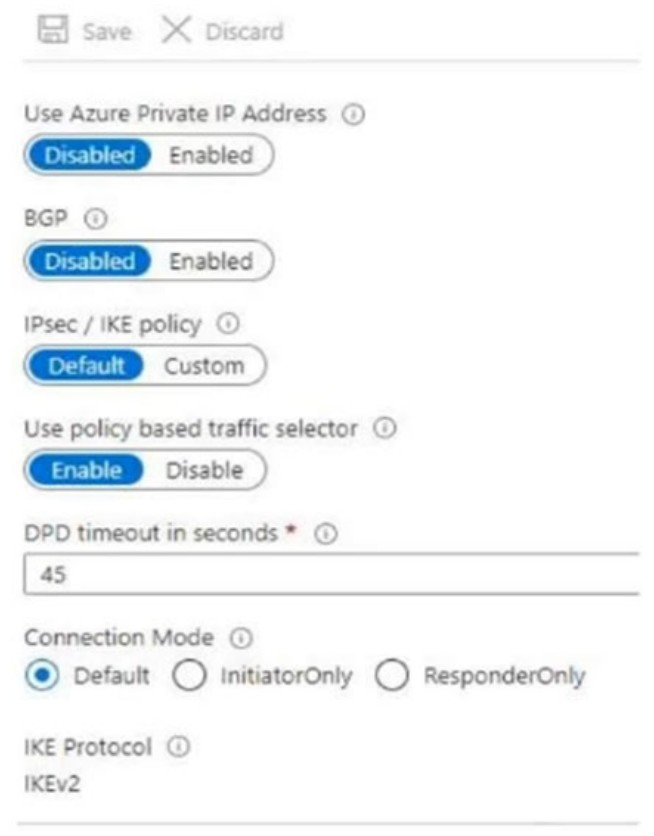
You have an Azure virtual network named Vnet1 and an on-premises network. The on- premises network has policy-based VPN devices.
In Vnet1, you deploy a virtual network gateway named GW1 that uses a SKU of VpnGw1 and is route-based.
You have a Site-to-Site VPN connection for GW1 as shown in the following exhibit.
You need to ensure that the on-premises network can connect to the route-based GW1.
What should you do before you create the connection?
Show answer and explanation
Correct answer: D. Set IPsec / IKE policy to Custom.
When connecting a policy-based VPN device (on-premises) to a route-based VPN gateway (Azure), you must configure a custom IPsec/IKE policy to enable compatibility. Policy-based and route-based VPN devices have different encryption and authentication requirements. Setting IPsec/IKE policy to Custom allows you to manually configure the specific algorithms and parameters that match the policy-based device's requirements, enabling the connection to succeed. This is a prerequisite configuration before creating the connection.
Why the other options are wrong
- A. Connection Mode set to ResponderOnly would prevent the initiator from establishing connections; the default mode is appropriate for this scenario.
- B. BGP is used for dynamic routing and is not required for basic policy-based to route- based VPN compatibility.
- C. Using Azure Private IP Address is not necessary to establish connectivity between policy-based and route-based VPN devices.
Question 9
You are planning an Azure deployment that will contain three virtual networks in the East US Azure region as shown in the following table.
A Site-to-Site VPN will connect Vnet1 to your company’s on-premises network.
You need to recommend a solution that ensures that the virtual machines on all the virtual networks can communicate with the on-premises network. The solution must minimize costs.
What should you recommend for Vnet2 and Vnet3?

Show answer and explanation
Correct answer: B. peering
Peer Vnet2 and Vnet3 with the hub, Vnet1, and enable gateway transit on the Vnet1 peerings while selecting use remote gateways on the Vnet2 and Vnet3 peerings. That lets both spokes use the Site-to-Site VPN gateway already deployed in Vnet1 instead of paying for additional gateways. Since all three virtual networks are in East US, peering delivers this connectivity at the lowest cost.
Why the other options are wrong
- A. VNet-to-VNet VPN connections would require a virtual network gateway in each spoke, adding gateway and connection charges that peering avoids.
- C. Service endpoints extend a virtual network identity to Azure PaaS services and provide no path to an on-premises network.
- D. Route tables only steer traffic along paths that already exist, so on their own they create no connectivity between the virtual networks or to on-premises.
Question 10
Your company has an office in New York.
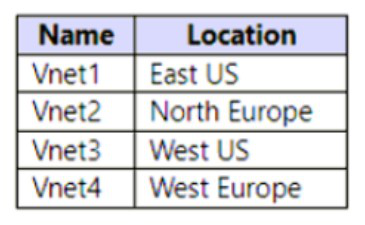
The company has an Azure subscription that contains the virtual networks shown in the following table.
You need to connect the virtual networks to the office by using ExpressRoute. The solution must meet the following requirements:
• The connection must have up to 1 Gbps of bandwidth.
• The office must have access to all the virtual networks.
• Costs must be minimized.
How many ExpressRoute circuits should be provisioned, and which ExpressRoute SKU should you enable?
Show answer and explanation
Correct answer: A. one ExpressRoute Premium circuit
To connect the New York office to all four virtual networks (Vnet1, Vnet2, Vnet3, Vnet4) across different regions with up to 1 Gbps bandwidth while minimizing costs, you need one ExpressRoute Premium circuit. A single Premium circuit provides the necessary bandwidth capacity and can connect to multiple virtual networks across different regions through virtual network peering and routing. The Premium SKU is required because it allows connectivity across geopolitical regions (the VNets span East US, North Europe, West US, and West Europe), whereas Standard circuits are limited to connections within the same geopolitical region. One circuit is sufficient because all VNets can be connected to it through appropriate routing and peering configurations.
Why the other options are wrong
- B. Two circuits are unnecessary; a single Premium circuit can connect to all four virtual networks across regions.
- C. Standard circuits cannot span multiple geopolitical regions, so four Standard circuits would not meet the requirement of connecting all networks, and this approach increases costs unnecessarily.
- D. A Standard circuit lacks the capability to connect across multiple geopolitical regions required by this topology (East US, North Europe, West US, West Europe).
That was 10 of 387.
The full Microsoft AZ-700 pack has all 387 questions, each with the answer, the explanation and why the other options are wrong, plus a questions-only copy for timed runs. US$39, paid once, with free monthly updates and a pass-or-your-money-back guarantee.