
10 free Juniper JN0-683 JNCIP-DC practice questions with the correct answer and a full explanation for each, taken from the CertStash pack of 94 questions. Work through them, then open each answer to check your reasoning.
Get all 94 questions (US$39) · Download these 10 as a PDF
Question 1
You are asked to automatically provision new Juniper Networks devices in your network with minimal manual intervention.
Before you begin, which two statements are correct? (Choose two.)
Show answer and explanation
Correct answer: B, C
B. You must have a DHCP server that provides the location of the software image and configuration files. C. You must have a file server that stores software image and configuration files. Zero-touch provisioning requires two core components: a DHCP server to deliver the locations of software images and configuration files (option B), and a file server to store and serve those software images and configuration files (option C). While syslog and NTP servers are useful for network operations, they are not mandatory for the ZTP provisioning process itself to function.
Why the other options are wrong
- A. Syslog servers manage log messages but are not required for the ZTP provisioning process to operate.
- D. NTP synchronization is beneficial for network operations but is not a mandatory component for ZTP to provision devices.
Question 2
You are asked for TX and RX traffic statistics for each interface to which an application server is attached. The statistics need to be reported every five seconds.
Using the Junos default settings, which telemetry method would accomplish this request?
Show answer and explanation
Correct answer: A. Native Sensors
Native Sensors (option A) in Junos provide streaming telemetry data at regular intervals with minimal latency and CPU overhead. They natively support pushing statistics like TX and RX traffic data every five seconds by default. This is the method designed to meet the specific requirement of reporting interface statistics at a five-second interval using Junos default settings.
Why the other options are wrong
- B. OpenConfig is a model-driven approach but requires additional configuration beyond defaults and may not provide the exact five-second interval natively.
- C. SNMP typically uses polling rather than push-based streaming and is not optimized for five-second interval reporting.
- D. gNMI is a newer protocol but requires explicit configuration and is not the Junos native default method for this use case.
Question 3
You are asked to deploy 100 QFX Series devices using ZTP. Each QFX5120 requires a different configuration.
In this scenario, what are two components that you would configure on the DHCP server? (Choose two.)
Show answer and explanation
Correct answer: B, C
B. the MAC address for each QFX5120 C. the management IP address for each QFX5120 When deploying multiple QFX5120 devices via ZTP with different configurations, the DHCP server must be configured with the MAC address of each QFX5120 (option B) to identify individual devices and provide device-specific settings, and the management IP address for each QFX5120 (option C) so that unique IP addresses are assigned for management purposes. The FTP server address is typically provided in DHCP options but is not configured on the DHCP server itself, and the FTP server has its own separate address.
Why the other options are wrong
- A. The IP address of the FTP server is configured in DHCP options but not as a DHCP server configuration element.
- D. The MAC address of the FTP server is not relevant to DHCP server configuration; only device MAC addresses and their assigned addresses matter.
Question 4
A Junos switch boots with a factory-default or zeroized configuration and the ZTP process takes over.
Which three statements are correct about this ZTP process? (Choose three.)
Show answer and explanation
Correct answer: A, B, C
A. The switch verifies the software version listed in DHCP options. B. The switch discovers a DHCP server and obtains an IP address. C. The switch downloads and applies assigned configuration. The ZTP process follows a specific sequence: first, the switch discovers a DHCP server and obtains an IP address (option B), then it verifies the software version listed in DHCP options (option A), and subsequently downloads and applies the assigned configuration (option C). Options D and E describe functions that are not part of the core ZTP process; archiving old software is not automatic, and discovering management elements through ZTP is not a standard verification step.
Why the other options are wrong
- D. The ZTP process does not automatically archive old software versions to a storage network.
- E. The ZTP process does not include verification of management element addresses; it focuses on obtaining IP, verifying software, and applying configuration.
Question 5
You are deploying a solution to monitor your data center devices’ interface RX statistics. The solution should be a push-based model.
Which solution will accomplish this behavior?
Show answer and explanation
Correct answer: A. JTI
JTI (Juniper Telemetry Interface, option A) is Juniper's native push-based telemetry solution that continuously streams data from devices to collectors without requiring polling. This matches the requirement for a push-based model to monitor interface RX statistics. CLI is an interactive tool, SNMP is pull-based by default, and NETCONF is request- response based, none of which provide true push-based monitoring.
Why the other options are wrong
- B. CLI is an interactive command-line interface, not a monitoring solution or push-based model.
- C. SNMP operates on a pull-based polling model, not push-based streaming.
- D. NETCONF is a request-response protocol that pulls data rather than pushing it from the device.
Question 6
You are preparing an sFlow monitoring system configuration.
In this scenario, what information will be included in the datagram sent to the sFlow collector? (Choose two.)
Show answer and explanation
Correct answer: A, D
A. the interface through which the packets entered the agent D. the source and destination VLAN for sampled packets sFlow datagrams sent to collectors include the interface through which packets entered the agent (option A), allowing collectors to identify the ingress port, and the source and destination VLAN information for sampled packets (option D), enabling VLAN-level traffic analysis. The device serial number and packet CRC are not included in standard sFlow datagrams.
Why the other options are wrong
- B. The sending device's serial number is not included in sFlow datagram information.
- C. The CRC from the sampled packet is not part of the standard sFlow datagram content.
Question 7
You are asked to configure active probes to track and monitor reachability across the network and investigate network issues.
In this scenario, which feature would accomplish this task?
Show answer and explanation
Correct answer: D. RPM
RPM (Real-time Performance Monitoring, option D) is Juniper's active probing feature that sends test packets to track and monitor reachability across the network and investigate network performance issues. IPFIX is a flow export standard, RMON is passive statistics collection, and sFlow is packet sampling, none of these provide active probing capabilities.
Why the other options are wrong
- A. IPFIX is an export format for flow information, not an active probing tool.
- B. RMON provides passive monitoring of statistics and events, not active reachability probes.
- C. sFlow is a passive packet sampling method, not an active probing mechanism.
Question 8
You need to deploy a new data center. As part of the switch onboarding process, you want to use Juniper Networks’ zero-touch provisioning (ZTP) process.
Which statement is correct about this scenario?
Show answer and explanation
Correct answer: A. Scripts that require execution must end with .sh or .py.
or .py. Scripts executed during the ZTP process must end with recognized file extensions such as .sh for shell scripts or .py for Python scripts (option A) to indicate the script type and allow the ZTP process to determine how to execute them. While DHCP provides initial connectivity, the ZTP process can continue beyond just obtaining an IP address, device hostnames are typically not the MAC address by default, and Junos images can be both upgraded and downgraded.
Why the other options are wrong
- B. A DHCP IP address is necessary but not sufficient; the ZTP process continues beyond initial IP assignment to download and apply configurations.
- C. The switch's default hostname is typically derived from device configuration or model, not set to the MAC address.
- D. Junos images can be both upgraded and downgraded, allowing flexibility in version management.
Question 9
Which two statements are true about IP fabrics using unnumbered BGP? (Choose two.)
Show answer and explanation
Correct answer: B, C
B. Unnumbered BGP requires that family inet6 is configured on each interface. C. Unnumbered BGP peering automatically provisions IPv6 peering. Unnumbered BGP peering in IP fabrics automatically provisions IPv6 peering using link- local addresses, eliminating the need for manual IPv6 address assignment. The family inet6 must be configured on each interface to enable this functionality. While unnumbered BGP can support IPv4 through special configurations, it is primarily designed for and automatically provisions IPv6 peering, making IPv6 the native protocol for this deployment model.
Why the other options are wrong
- A. Unnumbered BGP does not automatically provision IPv4 peering; it is designed for IPv6 link-local addressing.
- D. Family inet (IPv4) is not required for unnumbered BGP operation, as it uses IPv6 link- local addresses.
Question 10
Click the Exhibit button.
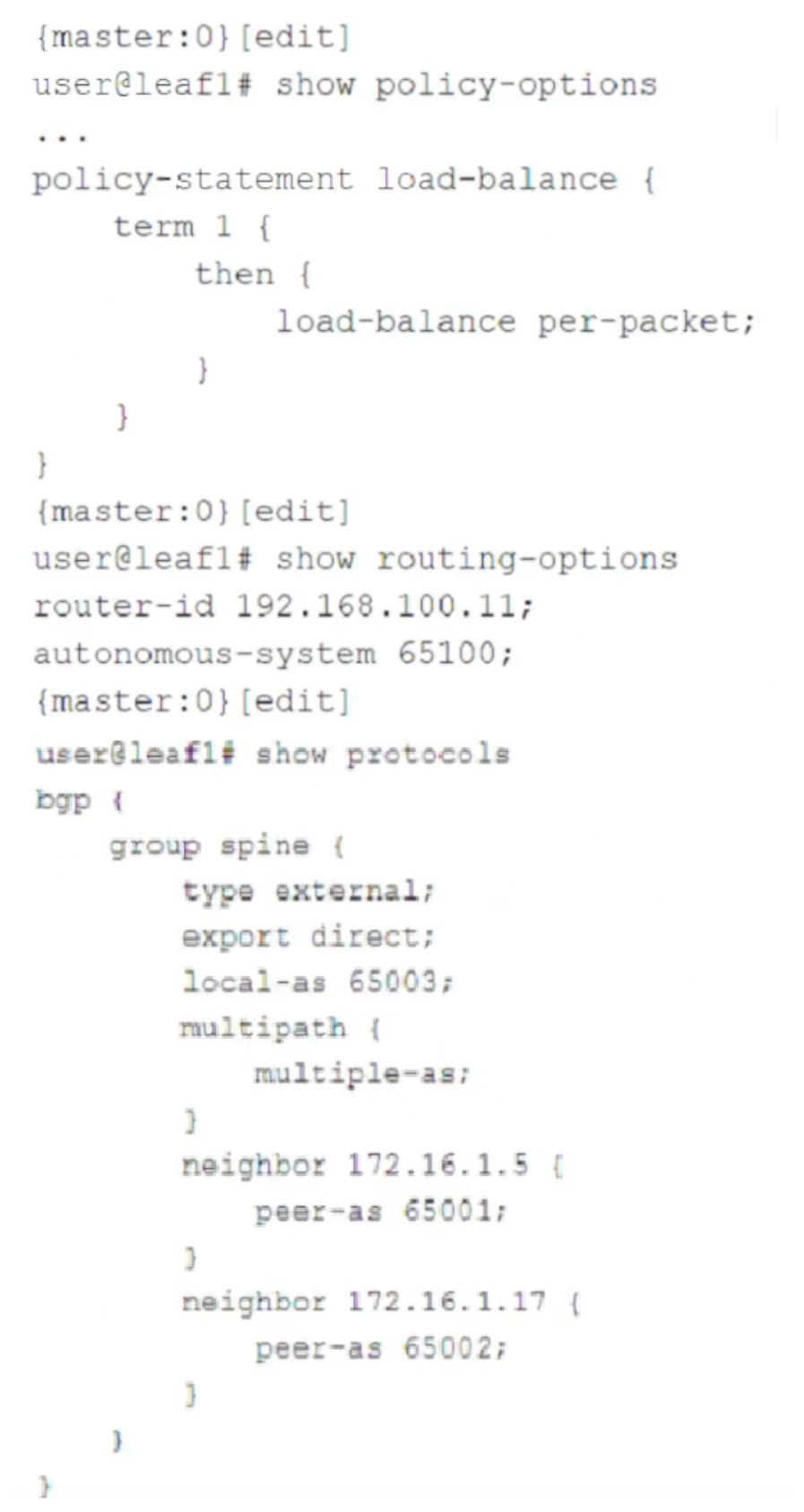
You are troubleshooting an IP fabric for your data center. You notice that your traffic is not being load balancing to your spine devices from leaf devices.
Referring to the configuration shown in the exhibit, what must be configured to solve this issue?
Show answer and explanation
Correct answer: D. The load-balance policy must be applied to the forwarding table under the routing- options hierarchy.
forwarding table under the routing-options hierarchy. The load-balance policy shown in the exhibit defines per-packet load balancing but is never actually applied to any forwarding mechanism. To enable load balancing across multiple spine devices in an IP fabric, the policy must be applied to the forwarding table under the routing-options hierarchy. This tells the router to use the policy when making forwarding decisions for traffic destined to the spines. Without this application, the policy exists as a definition but has no effect on actual packet forwarding behavior.
Why the other options are wrong
- A. The policy already specifies load balancing logic (per-packet); BGP matching is not required for the policy itself to function for load balancing purposes.
- B. The multipath multiple-as configuration is already present in the BGP spine group configuration and is unrelated to why the load-balance policy is not being applied.
- C. Applying the policy as an export policy to the BGP group would affect route advertisement, not the forwarding of traffic across multiple spine paths at the ingress leaf device.
That was 10 of 94.
The full Juniper JN0-683 JNCIP-DC pack has all 94 questions, each with the answer, the explanation and why the other options are wrong, plus a questions-only copy for timed runs. US$39, paid once, with free monthly updates and a pass-or-your-money-back guarantee.