
10 free CompTIA Data+ DA0-002 practice questions with the correct answer and a full explanation for each, taken from the CertStash pack of 148 questions. Work through them, then open each answer to check your reasoning.
Get all 148 questions (US$39) · Download these 10 as a PDF
Question 1
Which of the following makes data unreadable without a required key?
Show answer and explanation
Correct answer: C. Encryption
Encryption is the process of converting readable data into an unreadable format using a cryptographic key, making it inaccessible without the correct decryption key. Anonymization removes identifying information but doesn't make data unreadable. Role- based access control restricts who can access data but doesn't render it unreadable. Masking obscures data for display purposes but doesn't fundamentally make it unreadable to those with access.
Why the other options are wrong
- A. Anonymization removes identifiers but leaves data in a readable format.
- B. RBAC controls access permissions but doesn't make data unreadable.
- D. Masking hides data visually but doesn't prevent reading by authorized users.
Question 2
An analyst is building a reporting deck. The deck must include tracking and visualizing metrics and row-level security.
Which of the following actions should the analyst take after meeting the initial requirements?
Show answer and explanation
Correct answer: A. Show a mock-up to the team.
After identifying initial requirements like tracking metrics and row-level security, the next logical step is to validate assumptions and gather feedback by showing a mock-up to the team. This allows stakeholders to visualize the solution, provide feedback, and ensure the analyst's understanding of requirements is correct before investing significant effort in full development.
Why the other options are wrong
- B. Explaining reporting detail should happen during initial requirements gathering, not after.
- C. Presenting analysis is a later deliverable, not a follow-up to initial requirements.
- D. Finding the due date should be established before or during initial requirements, not after.
Question 3
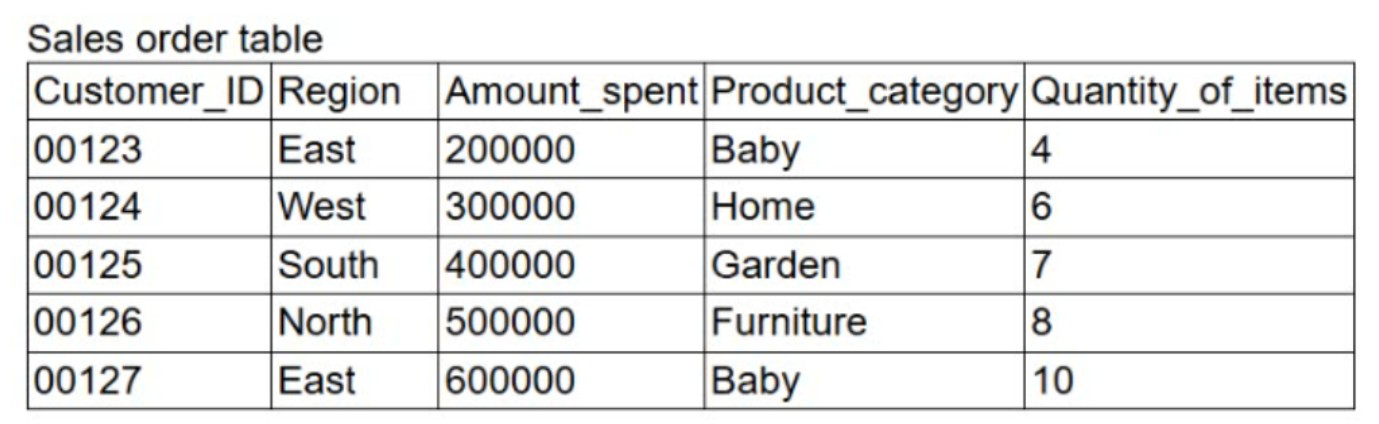
A data analysis team needs to segment customers based on customer spending behavior. Given one million rows of data like the information in the following sales order table:
Which of the following techniques should the team use for this task?
Show answer and explanation
The answer and explanation for this question are in the free sample PDF.
Question 4
Which of the following pieces of information, if made public, results in a data privacy violation?
Show answer and explanation
Correct answer: B. Driver’s license
A driver's license number is personally identifiable information (PII) that directly identifies an individual and is regulated under privacy laws. Public disclosure would constitute a clear data privacy violation. Gender, age, and employment status, while sensitive, are demographic attributes that alone do not uniquely identify individuals and may be disclosed in aggregate or anonymized form without necessarily violating privacy regulations.
Why the other options are wrong
- A. Gender alone is not sufficient to identify an individual and may be disclosed in aggregate.
- C. Age alone is demographic information that doesn't uniquely identify someone.
- D. Employment status is general information that may be publicly disclosed without privacy violation.
Question 5
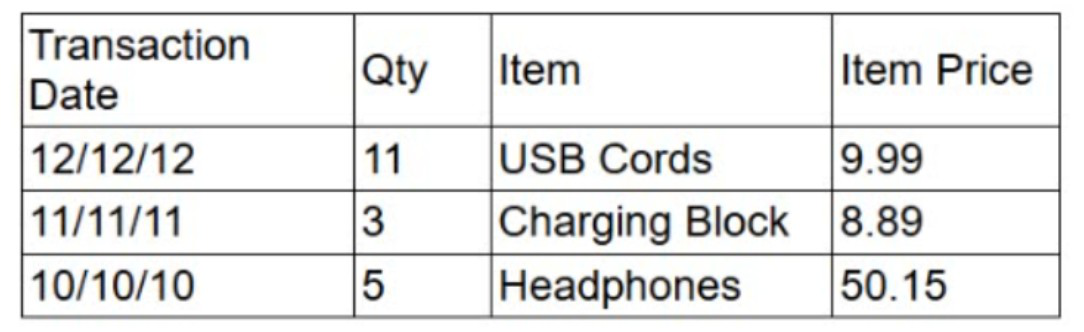
A data analyst is analyzing the following data set:
Which of the following methods should the analyst use to determine the total cost for each transaction?
Show answer and explanation
Correct answer: D. Deriving
To determine the total cost for each transaction, the analyst must create a new calculated field by multiplying Qty × Item Price for each row. This is a derivation operation, creating new data by computing values from existing columns. For example, the first transaction would derive a total cost of 11 × 9.99 = 109.89. Derivation is the process of creating new data attributes through mathematical or logical operations on existing data.
Why the other options are wrong
- A. Parsing is the process of breaking down unstructured data into structured components, not calculating totals from existing numerical fields.
- B. Scaling adjusts data to fit within a specific range or normalize values, which is not needed to calculate transaction totals.
- C. Compressing reduces file size or data volume, not relevant to computing total costs from quantity and price columns.
Question 6
A data analyst needs to use one table's data to refine data selection from a second table.
Which of the following is the most efficient way?
Show answer and explanation
Correct answer: A. Subquery
A subquery is the most efficient way to use one table's data to refine data selection from a second table, as it allows filtering based on conditions derived from another table in a single query operation. Joins combine tables but require matching on keys. Aggregates summarize data rather than refine selection. Unions combine results from multiple tables rather than use one to filter another.
Why the other options are wrong
- B. Aggregates summarize data; they don't refine selection based on another table.
- C. Unions combine result sets vertically; they don't filter one table by another.
- D. Joins combine tables horizontally but may not be more efficient than a subquery for this specific task.
Question 7
Which of the following is found in metadata?
Show answer and explanation
Correct answer: B. Data lineage
Data lineage is metadata, not data itself. It records where data originated, which systems it passed through, and how it changed, supporting traceability, impact analysis, and audit in data catalogs and governance tools.
Why the other options are wrong
- A. Transformations are the processing steps applied to data, the work done rather than the documented history.
- C. Syntax is the rule set for writing code or queries, not information about a data asset.
- D. Variable types describe individual fields, not data origin or how it moved and changed.
Question 8
Which of the following allows the transfer of isolated applications to multiple environments?
Show answer and explanation
Correct answer: D. Containerization
Containerization packages applications with their dependencies into isolated containers that can run consistently across multiple environments, enabling seamless transfer and deployment. Virtualization creates virtual machines but is heavier-weight than containers. Version control tracks code changes but doesn't directly enable application transfer. Continuous integration automates testing and merging but doesn't isolate applications for multi-environment deployment.
Why the other options are wrong
- A. Virtualization creates VMs but is less efficient than containerization for this purpose.
- B. Version control manages code versions but doesn't package applications for deployment.
- C. Continuous integration automates builds and testing, not application environment transfer.
Question 9
A data breach occurs at a company.
Which of the following actions should be taken?
Show answer and explanation
Correct answer: B. Tell the company management team and then tell regulatory agencies.
regulatory agencies. The proper incident response procedure is to first notify management and then inform regulatory agencies as required by law. This follows the appropriate chain of command and legal obligations. Social media announcements bypass proper notification channels. Keeping breaches secret violates disclosure laws. Informing the IT sector broadly is not standard protocol and spreads sensitive information unnecessarily.
Why the other options are wrong
- A. Announcing on social media bypasses proper internal and regulatory notification.
- C. Hiding breaches violates privacy laws and regulatory requirements.
- D. Informing the IT sector at large is not protocol and spreads sensitive information unnecessarily.
Question 10
A data analyst is modeling a new data warehouse to analyze sales. One of the requirements is to analyze sales by region.
Which of the following best describes the region table?
Show answer and explanation
Correct answer: B. Dimensional
A region table is a dimensional table in a data warehouse schema. Dimensional tables contain descriptive attributes used to analyze facts and support filtering and grouping operations, such as analyzing sales by region. Fact tables contain quantitative measures and foreign keys. Bridge tables resolve many-to-many relationships. Snowflake refers to a schema design pattern, not a table type.
Why the other options are wrong
- A. Fact tables contain measures and metrics, not descriptive attributes like region.
- C. Bridge tables resolve many-to-many relationships, not dimensional analysis.
- D. Snowflake is a schema design pattern, not a classification for this specific table.
That was 10 of 148.
The full CompTIA Data+ DA0-002 pack has all 148 questions, each with the answer, the explanation and why the other options are wrong, plus a questions-only copy for timed runs. US$39, paid once, with free monthly updates and a pass-or-your-money-back guarantee.