
10 free Cisco 300-620 DCACI practice questions with the correct answer and a full explanation for each, taken from the CertStash pack of 404 questions. Work through them, then open each answer to check your reasoning.
Get all 404 questions (US$39) · Download these 10 as a PDF
Question 1
An engineer is implementing a Cisco ACI data center network that includes Cisco Nexus 2000 Series 10G fabric extenders.
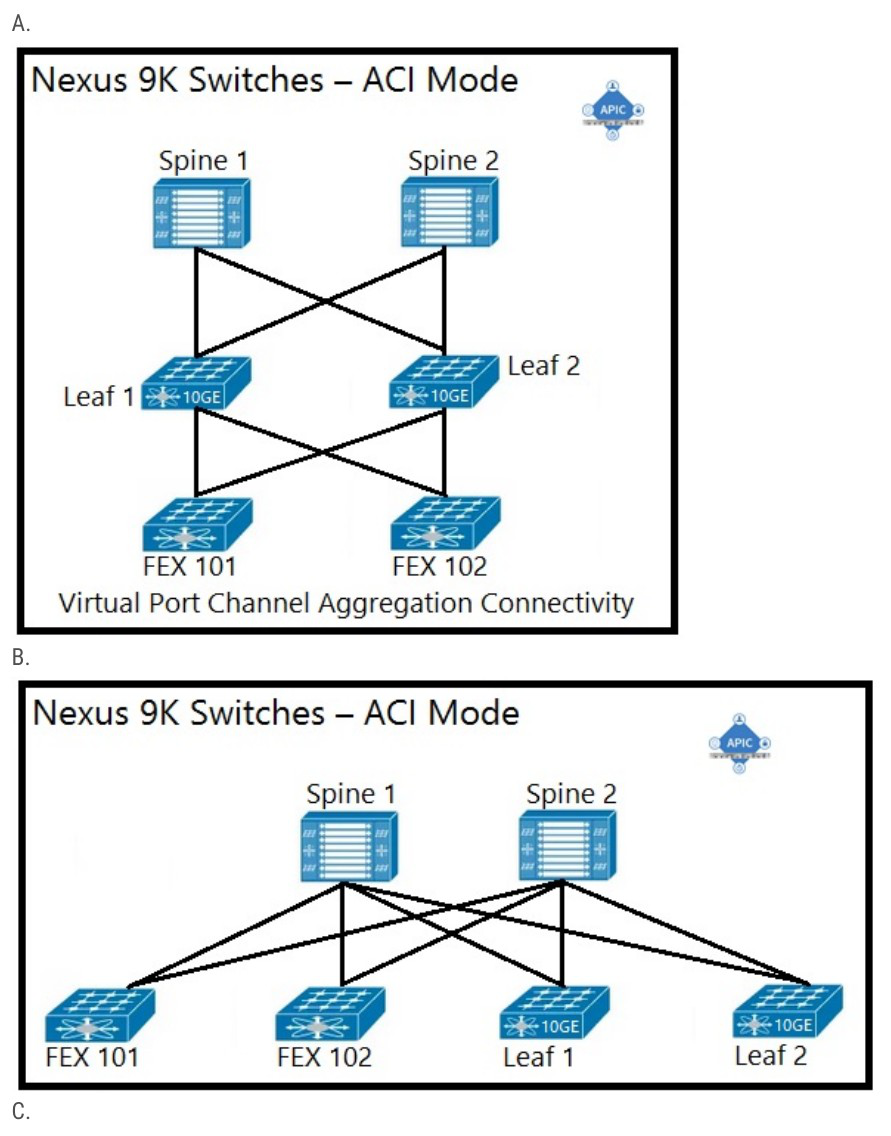
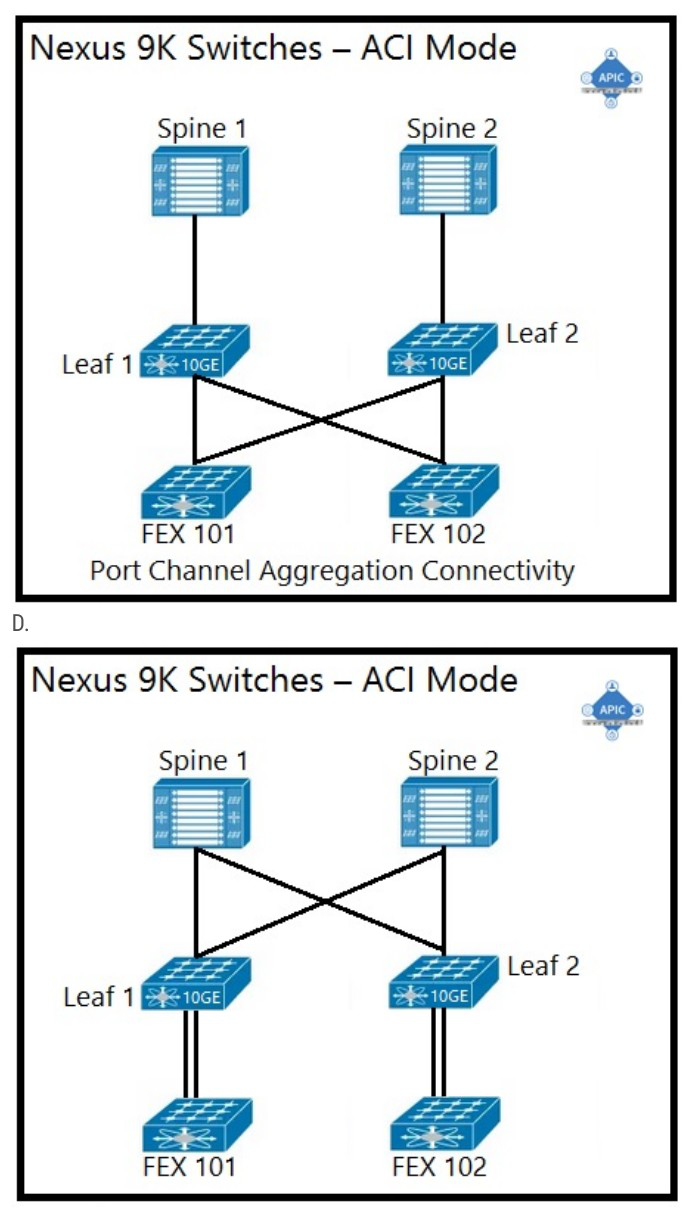
Which physical topology is supported?
Show answer and explanation
Correct answer: C. Nexus 9K Switches – ACI Mode with Spine 1 and
Spine 2 connected to Leaf 1 and Leaf 2 (10GE) in a full mesh, which then connect to FEX 101 and FEX 102 in a full mesh. Labeled 'Port Channel Aggregation Connectivity' In Cisco ACI, Nexus 2000 Series fabric extenders (FEX) are supported in a two-tier leaf architecture where the FEX devices connect to Leaf switches, not directly to Spine switches. Option C shows the correct supported topology with Spines connecting to Leaves in a full mesh, and Leaves connecting to FEX devices in a full mesh using Port Channel Aggregation (PCA) for redundancy. The FEX devices do not connect directly to the Spine layer in ACI mode. Option A shows Virtual Port Channel Aggregation which is a different concept, option B incorrectly shows FEX devices connecting directly to Spines, and option D shows a non-redundant direct connection topology.
Why the other options are wrong
- A. Shows Virtual Port Channel Aggregation rather than Port Channel Aggregation, which is not the standard ACI fabric extender topology
- B. Incorrectly shows FEX devices connecting directly to both Spine switches, bypassing the Leaf layer, which is not supported in ACI mode
Question 2
An ACI administrator notices a change in the behavior of the fabric.
Which action must be taken to determine if a human intervention introduced the change?
Show answer and explanation
Correct answer: C. Inspect audit logs in the APIC UI to see all user events.
events. Audit logs in the APIC UI provide a comprehensive record of all user events and actions performed on the fabric, including configuration changes made through human intervention. This is the primary method to track administrative actions and determine if a change was introduced manually.
Why the other options are wrong
- A. Event records show fabric events but not specifically user actions performed.
- B. While audit_messages exists on the APIC, the UI audit logs interface is the proper and supported method for viewing user actions.
- D. Command history is not a standard APIC CLI feature for tracking user actions across the fabric.
Question 3
An engineer is creating a configuration import policy that must terminate if the imported configuration is incompatible with the existing system.
Which import mode achieves this result?
Show answer and explanation
Correct answer: B. atomic
Atomic import mode ensures that the entire import operation is treated as a single transaction; if any part of the configuration is incompatible with the existing system, the entire import is rejected and the fabric state remains unchanged. This prevents partial or incompatible configurations from being applied.
Why the other options are wrong
- A. Merge mode combines imported configuration with existing configuration and would not terminate on incompatibility.
- C. Best effort mode attempts to apply what it can and ignores incompatible elements rather than terminating.
- D. Replace mode overwrites existing configuration without checking compatibility with the current system state.
Question 4
Which components must be configured for the BGP Route Reflector policy to take effect?
Show answer and explanation
Correct answer: C. pod policy groups and profiles
Pod policy groups and profiles must be configured for the BGP Route Reflector policy to take effect. These policies operate at the pod level in ACI and define how route reflection is handled across the fabric infrastructure.
Why the other options are wrong
- A. Spine fabric interface overrides configure individual spine interfaces but are not the required component for BGP Route Reflector policy.
- B. Access policies configure leaf access ports and are not related to BGP Route Reflector functionality.
- D. Leaf fabric interface overrides configure leaf-to-spine connections but are not the primary component for BGP Route Reflector policy configuration.
Question 5
Which type of policy configures the suppression of faults that are generated from a port being down?
Show answer and explanation
Correct answer: C. fault severity assignment
Fault severity assignment policies configure the suppression and severity level of faults generated by specific conditions, including port-down events. This policy type allows administrators to suppress unwanted faults by assigning them a severity level that prevents them from being displayed.
Why the other options are wrong
- A. Fault lifecycle assignment manages the lifecycle states of faults, not their suppression based on severity.
- B. Event lifecycle assignment manages event lifecycle states and is not used for fault suppression.
- D. Event severity assignment handles event severity levels, not fault suppression from port-down conditions.
Question 6
Which type of profile needs to be created to deploy an access port policy group?
Show answer and explanation
Correct answer: D. leaf interface
A leaf interface profile must be created to deploy an access port policy group. The leaf interface profile defines which physical ports on leaf switches will use the associated port policy group configuration.
Why the other options are wrong
- A. Attachable entity profiles are used for EPG associations, not for deploying port policy groups.
- B. Pod profiles configure pod-level settings and are not used to deploy access port policy groups.
- C. Module profiles configure module-level settings, not port policy group deployments.
Question 7
A situation causes a fault to be raised on the APIC. The ACI administrator does not want that fault to be raised because it is not directly relevant to the environment.
Which action should the administrator take to prevent the fault from appearing?
Show answer and explanation
Correct answer: C. Under System -> Faults, right-click on the fault and select Ignore Fault to create a fault severity assignment policy that hides the fault.
select Ignore Fault to create a fault severity assignment policy that hides the fault. Right-clicking on a fault under System → Faults and selecting Ignore Fault creates a fault severity assignment policy that suppresses the fault and prevents it from appearing in the UI. This is the proper method to hide faults that are not relevant to the environment.
Why the other options are wrong
- A. Acknowledging a fault only marks it as seen and does not prevent it from reappearing; the fault will still be generated.
- B. Stats threshold policies configure statistical thresholds for metrics and do not suppress faults directly.
- D. Global health score policies affect overall system health calculations but do not provide a mechanism to ignore specific faults by code.
Question 8
A RADIUS user resolves its role via the Cisco AV Pair.
What object does the Cisco AV Pair resolve to?
Show answer and explanation
Correct answer: D. managed object class
A Cisco AV Pair in RADIUS resolves to a managed object class (MOC). The AV Pair contains attributes that map RADIUS users to specific managed object classes within the APIC's object model, determining their role and permissions.
Why the other options are wrong
- A. Tenants are not directly resolved by Cisco AV Pairs; AV Pairs work at the managed object class level.
- B. Security domains are administrative constructs, not the target of Cisco AV Pair resolution.
- C. Primary APIC selection is not determined through Cisco AV Pair resolution.
Question 9
Which feature dynamically assigns or modifies the EPG association of virtual machines based on their attributes?
Show answer and explanation
Correct answer: D. uSeg EPGs
uSeg EPGs (user-defined segmentation) dynamically assign or modify EPG membership based on virtual machine attributes such as operating system, VM name, or other tags. This feature enables dynamic policy application without manual endpoint configuration.
Why the other options are wrong
- A. vzAny contracts provide implicit allow rules between EPGs but do not dynamically assign EPG membership.
- B. Standard contracts define communication policies between EPGs but do not dynamically assign membership based on attributes.
- C. Application EPGs are static groupings of endpoints and do not provide dynamic attribute-based assignment.
Question 10
Which feature allows firewall ACLs to be configured automatically when new endpoints are attached to an EPG?
Show answer and explanation
Correct answer: B. dynamic endpoint attach
Dynamic endpoint attach is the ACI feature that automatically configures firewall ACLs when new endpoints are attached to an EPG. This allows for automatic policy application without manual intervention when endpoints join the fabric.
Why the other options are wrong
- A. ARP gleaning is used to discover endpoint MAC-IP bindings, not to configure ACLs automatically.
- C. Hardware proxy is a feature related to proxy ARP functionality, not ACL configuration.
- D. Network-stitching refers to connecting ACI fabric segments together, not automatic ACL configuration.
That was 10 of 404.
The full Cisco 300-620 DCACI pack has all 404 questions, each with the answer, the explanation and why the other options are wrong, plus a questions-only copy for timed runs. US$39, paid once, with free monthly updates and a pass-or-your-money-back guarantee.