
10 free Cisco 300-615 DCIT practice questions with the correct answer and a full explanation for each, taken from the CertStash pack of 291 questions. Work through them, then open each answer to check your reasoning.
Get all 291 questions (US$39) · Download these 10 as a PDF
Question 1
A vPC Type-1 inconsistency between two vPC peers in a VXLAN EVPN setup is discovered.
Which two actions need to be attempted to resolve the issue? (Choose two.)
Show answer and explanation
Correct answer: A, D
A. Configure the NVE interfaces to be Up on both switches. D. Configure the same VNI to multicast group maping. vPC Type-1 inconsistencies occur when critical configuration parameters differ between peers. Ensuring NVE interfaces are operational (A) is essential for VXLAN EVPN functionality. Configuring different distributed gateway virtual MAC addresses (D) resolves conflicts where both peers must have matching gateway MACs for proper vPC operation. The NVE interfaces must be up to establish the overlay, and gateway MAC mismatches prevent proper East-West bridging in the fabric.
Why the other options are wrong
- B. Different distributed gateway virtual MAC addresses cause inconsistency; they must be the same across vPC peers.
- C. Secondary IP addresses on NVE source-interface are not a primary vPC Type-1 inconsistency parameter.
- E. Primary IP addresses on NVE source-interface are used for tunnel establishment but are not the source of vPC Type-1 inconsistencies.
Question 2
A mission-critical server is connected to site A. Connectivity to this server is lost from site B because the MAC route is missing in the OTV VDC of the Cisco Nexus 7000 in site B due to MAC aging.
Which action allows the flooding of the unknown unicast MAC on the Nexus 7000 in the OTV VDC?
Show answer and explanation
Correct answer: C. Use the otv flood mac <> command to selectively flood traffic for a given MAC.
flood traffic for a given MAC. The otv flood mac command on Cisco Nexus 7000 OTV VDCs allows selective flooding of unknown unicast traffic for specific MAC addresses. This command enables administrators to force flooding for critical MACs that may have aged out, ensuring connectivity is restored without waiting for MAC relearning. This is the proper OTV mechanism to override MAC table entries and flood traffic on-demand.
Why the other options are wrong
- A. Route maps and ISIS redistribution are used for L3 routing, not MAC flooding in OTV.
- B. Unknown unicast flooding is explicitly allowed and controllable in OTV through the otv flood mac command.
- D. BFD is a convergence detection protocol and does not control MAC flooding behavior.
Question 3
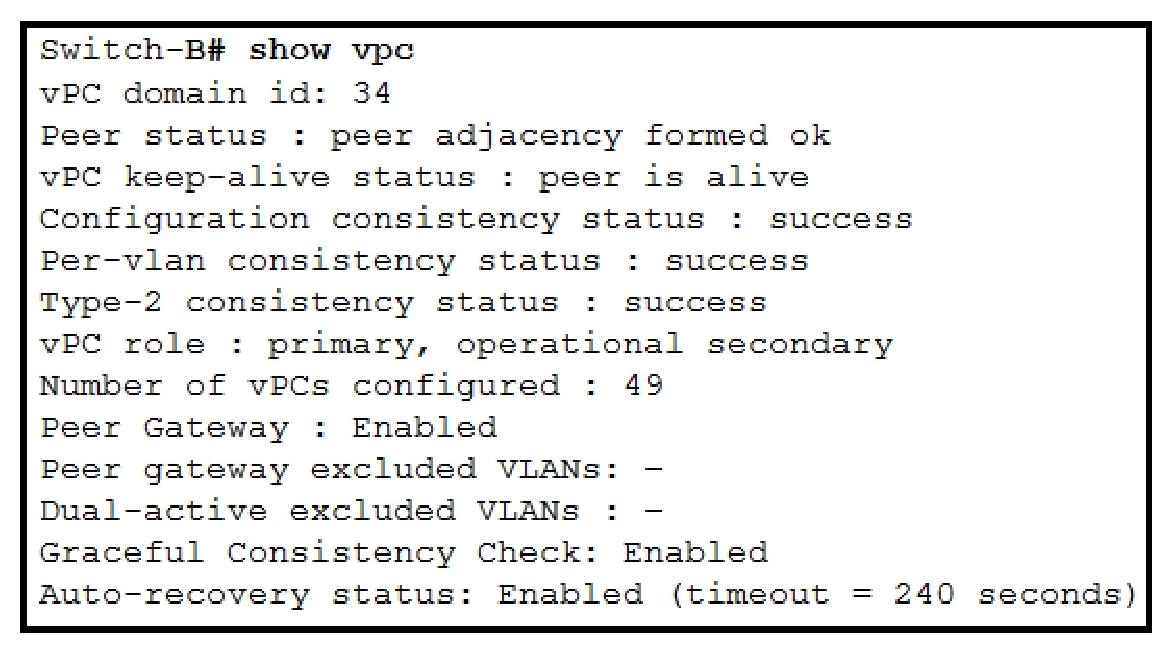
Refer to the exhibit. After a failover occurs, which two actions must be performed on Switch-B to manually preempt the operational primary role back to Switch-A? (Choose two.)
Show answer and explanation
Correct answer: A, E
A. Configure the local vPC role priority to have a lower value than Switch-A. E. Disable and then re-enable the vPC peer link. To manually preempt the operational primary role back to Switch-A after a failover, two actions must be performed on Switch-B. First, the local vPC role priority on Switch-B must be configured to have a lower value than Switch-A, making Switch-A the preferred primary (lower priority values win in vPC role selection). Second, the vPC peer link must be disabled and then re-enabled to trigger a role negotiation that allows the new priority configuration to take effect and restore Switch-A to the primary role. The peer-keepalive link does not need to be cycled as it is separate from the peer link used for vPC synchronization.
Why the other options are wrong
- B. Configuring a higher priority value on Switch-B would make it remain or become primary, not cause preemption back to Switch-A.
- C. Disabling and re-enabling the peer-keepalive link does not trigger vPC role renegotiation; only the peer link affects role status.
- D. Setting the same priority value would not establish a clear preference for Switch-A to become primary during role negotiation.
Question 4
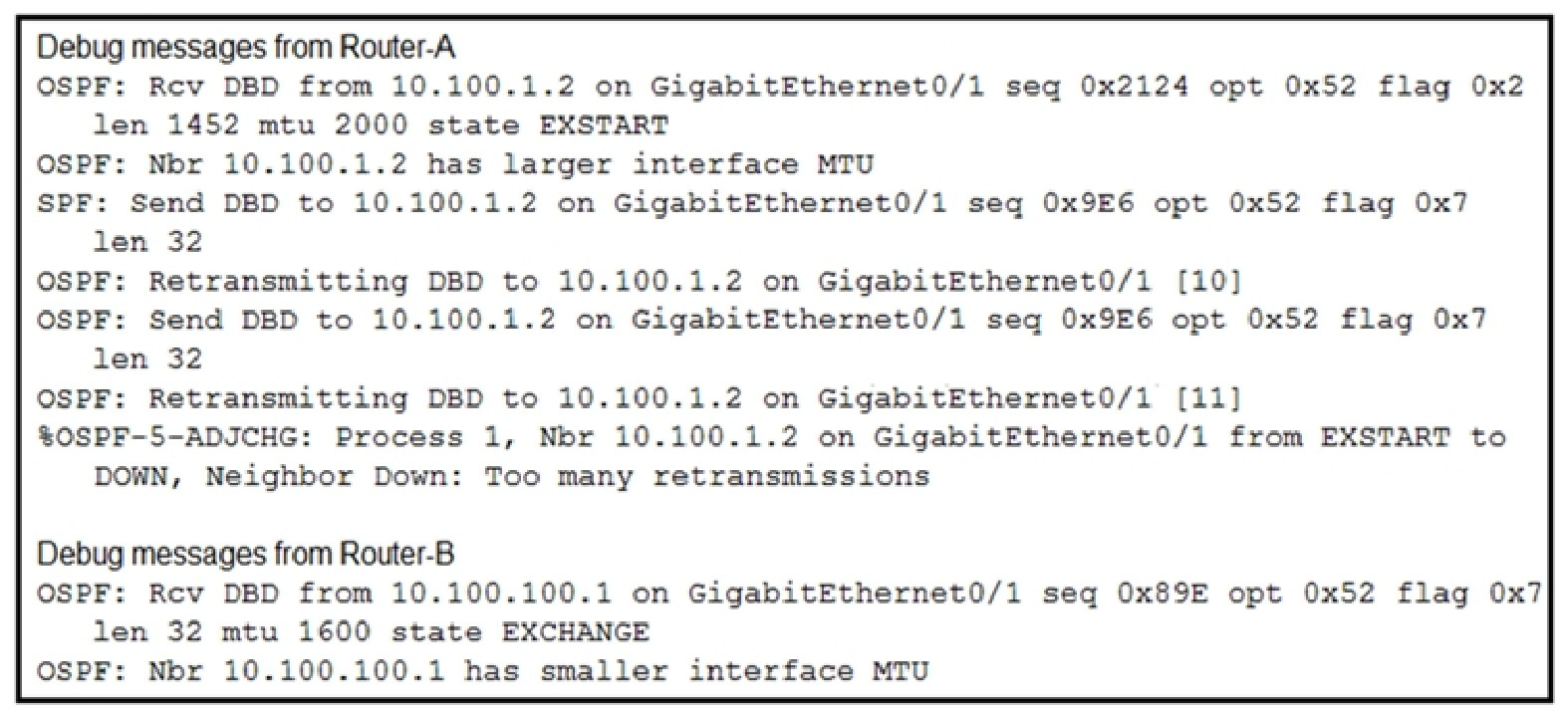
Refer to the exhibit. An OSPF adjacency between Router-A and Router-B fails to reach the FULL state.
Which action resolves the issue?
Show answer and explanation
Correct answer: B. Disable the check of the MTU value.
The debug output shows a critical MTU mismatch issue: Router-A has an MTU of 2000 bytes while Router-B has an MTU of 1600 bytes. Router-A reports that Router-B "has larger interface MTU" and Router-B reports that Router-A "has smaller interface MTU." The adjacency fails because OSPF Database Description (DBD) packets from Router-A (length 1452) exceed Router-B's MTU of 1600, causing excessive retransmissions and the neighbor state to transition from EXSTART to DOWN with the message "Too many retransmissions." Disabling the MTU check allows OSPF to establish adjacency despite the MTU mismatch by fragmenting packets at the IP layer rather than rejecting them at the OSPF level.
Why the other options are wrong
- A. Adjusting Router-A's MTU to 1600 would match Router-B, but the root cause is the MTU check itself rejecting the adjacency.
- C. Changing the media type to point-to-point does not resolve the underlying MTU mismatch problem causing packet rejection.
- D. Adjusting Router-B's MTU to 1604 still does not address the mismatch with Router- A's 2000 MTU and does not resolve the core issue.
Question 5
The Cisco Nexus switch is connected to a peer switch that is not running Cisco NX-OS. The switches are connected using port channel and are experiencing packet loss.
Which action should be performed on the Cisco Nexus switch ports to resolve this issue?
Show answer and explanation
Correct answer: C. Turn off lacp graceful-convergence.
When connecting to non-Cisco switches via port channel, graceful-convergence must be disabled (C) to ensure compatibility. The lacp graceful-convergence feature is a Cisco- specific enhancement that may not be supported by non-Cisco peers, causing negotiation failures and packet loss. Disabling this feature forces standard LACP behavior compatible with all vendors.
Why the other options are wrong
- A. Suspend-individual allows individual ports to remain active when the peer is down; enabling it does not resolve non-Cisco compatibility.
- B. Graceful-convergence should be disabled, not enabled, for non-Cisco peer compatibility.
- D. Suspend-individual controls port behavior during peer failure, not LACP interoperability with non-Cisco devices.
Question 6
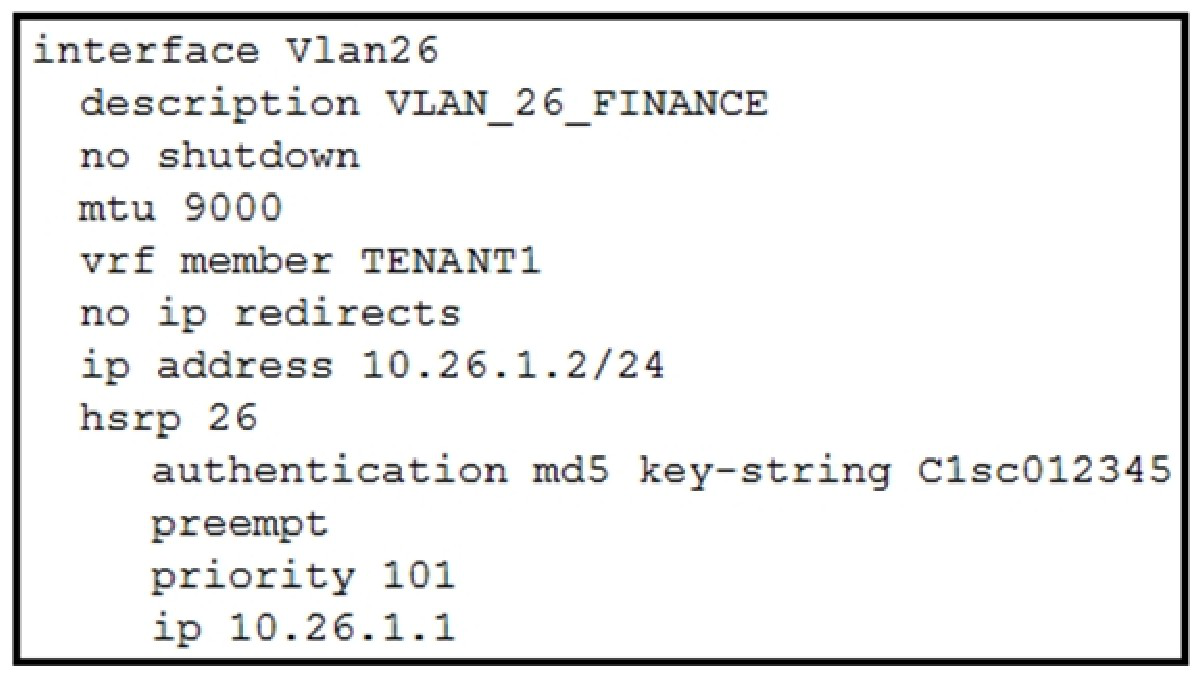
Refer to the exhibit. The HSRP configuration in the exhibit fails to function.
Which action resolves this issue?
Show answer and explanation
Correct answer: A. Enable IP redirects.
The configuration shows 'no ip redirects' which disables ICMP redirect messages. HSRP requires IP redirects to be enabled so that when a host sends traffic to the virtual IP address and the active router receives it, the router can send an ICMP redirect to inform the host about a better route or a more optimal path through the standby router. Without IP redirects enabled, HSRP cannot function properly because hosts cannot be redirected to use the virtual gateway efficiently.
Why the other options are wrong
- B. MTU 9000 bytes is configured for jumbo frames and is not causing the HSRP failure; standard HSRP operates fine with larger MTU values.
- C. HSRP version 1 and version 2 can both function; version selection is not the root cause of this configuration failure.
- D. The HSRP group number 26 is already configured on this single interface; the issue is not about multiple devices needing the same group number but about HSRP functionality within this interface.
Question 7
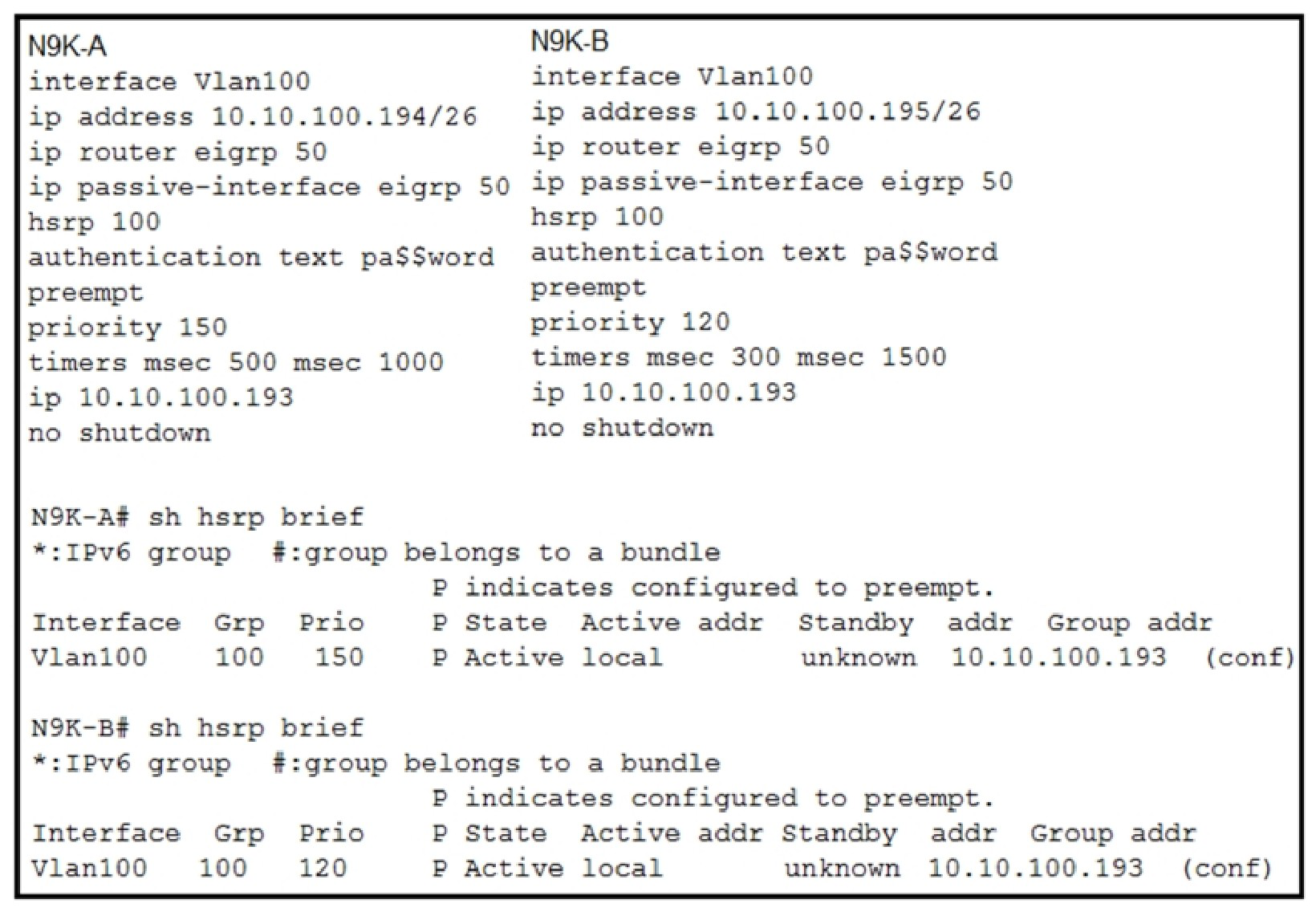
Refer to the exhibit. The HSRP instance on both switches is showing as active.
Which action resolves the issue?
Show answer and explanation
Correct answer: D. Configure preempt on only one of the switches.
Both N9K-A and N9K-B are showing as Active in their respective HSRP instances, which indicates they are not communicating with each other properly. Both devices have preempt enabled, meaning each one believes it has the highest priority and takes the Active role when it boots. N9K-A has priority 150 and N9K-B has priority 120, so N9K-A should win if they were communicating. The issue is that both have preempt configured, preventing proper HSRP negotiation. By disabling preempt on N9K-B (the lower priority device), N9K-A will remain Active and N9K-B will become Standby, resolving the split- brain condition.
Why the other options are wrong
- A. The timers are already different (N9K-A: 500/1000, N9K-B: 300/1500) but this is not the cause of both being Active; different timers can work if devices communicate properly.
- B. VLAN 100 connectivity between the switches is required for HSRP to function at all, and since both show Active states, some communication is occurring; this is not the root cause.
- C. Both devices already have IP addresses on the same /26 subnet (10.10.100.194/26 and 10.10.100.195/26 are in the same network range), so subnet alignment is not the issue.
Question 8
An engineer troubleshoots a fabric discovery failure.
Which two requirements about switch connectivity must be verified to solve the problem? (Choose two.)
Show answer and explanation
Correct answer: D, E
D. A Cisco APIC must be dual-attached to two separate spine nodes. E. Leaf nodes must connect to spine nodes only. Fabric discovery in ACI requires APICs to be dual-attached to two separate spine nodes (D) for redundancy and proper fabric communication. Additionally, leaf nodes must connect to spine nodes only (E) to maintain proper fabric topology and discovery propagation. The spine-leaf topology with dual APIC attachment ensures control plane stability and complete fabric visibility.
Why the other options are wrong
- A. APICs can be attached to either spine or leaf nodes; spine-only is not a requirement.
- B. APICs are typically attached to spines, not leaves, for optimal fabric management.
- C. Spine nodes do not necessarily connect to other spine nodes; they connect to leaves.
Question 9
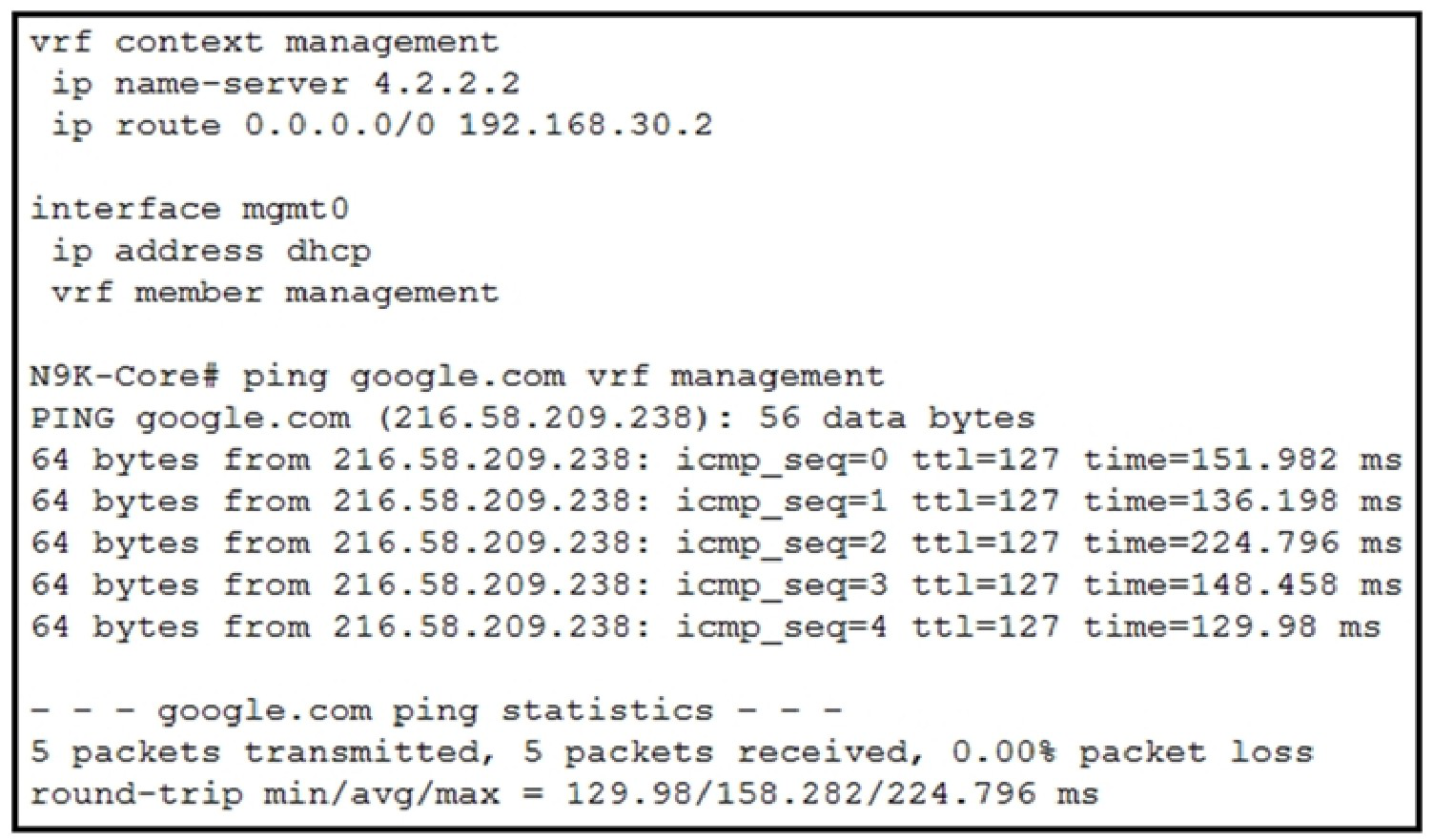
Refer to the exhibit. A network engineer connects the Cisco Nexus switch management port to the Internet using DHCP to allow the Guest shell that runs on the switch to download Python packages. The engineer can ping google.com from the Cisco Nexus switch, but the Guest shell fails to download Python packages.
Which action resolves the problem?
Show answer and explanation
Correct answer: B. Manually configure DNS in the Guest shell, even if it is claimed on the Cisco Nexus switch through DHCP.
is claimed on the Cisco Nexus switch through DHCP. The ping to google.com succeeds because ICMP resolution uses the IP address directly (216.58.209.238), which was resolved by the management interface's DHCP-acquired DNS settings. However, the Guest shell is a containerized environment that runs independently from the host Cisco Nexus switch and does not automatically inherit the DNS configuration from the management plane. When Python package managers attempt to download packages, they require DNS name resolution to reach package repositories, which fails because the Guest shell lacks DNS server configuration. While the management interface obtained DNS via DHCP, this configuration is not shared with the isolated Guest shell container, requiring manual DNS configuration within the Guest shell environment itself.
Why the other options are wrong
- A. Updating Python packages directly on the Nexus switch does not solve the Guest shell's DNS resolution problem, as the packages still need to be downloaded from external repositories.
- C. NTP configuration is used for time synchronization and is unrelated to DNS name resolution required for downloading Python packages.
- D. Guest shell connects through the management plane and does not require data plane interfaces; the issue is DNS configuration, not interface connectivity.
Question 10
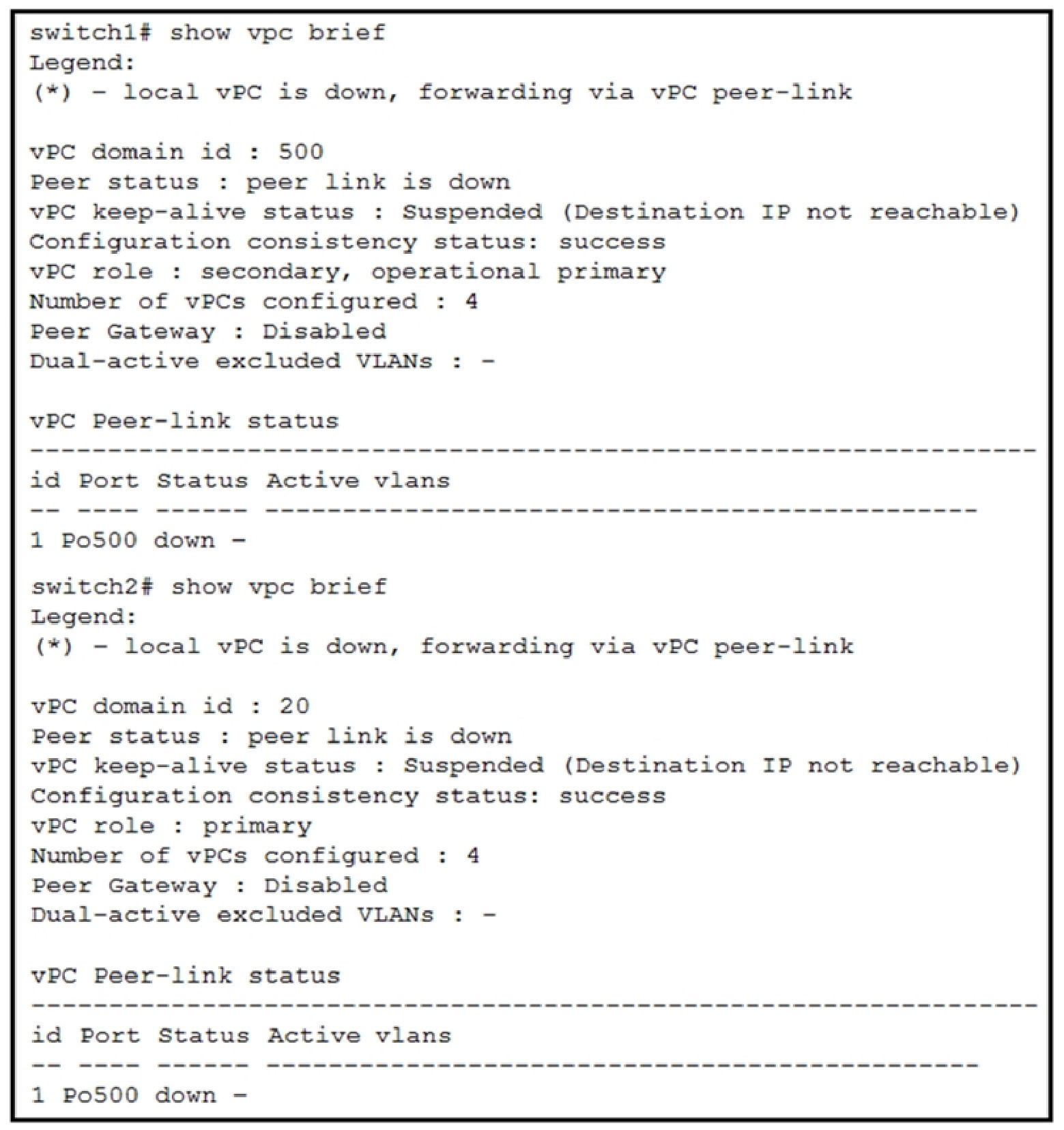
Refer to the exhibit. The vPC between switch1 and switch2 does not work.
Which two actions resolve the problem? (Choose two.)
Show answer and explanation
Correct answer: A, D
A. Match the vPC domain ID between the two devices. D. Correct the configuration of the vPC peer link and the vPC peer keepalive. The exhibit shows both switches have mismatched vPC domain IDs (switch1 has domain 500, switch2 has domain 20) and both report 'peer link is down' with 'vPC keep-alive status: Suspended (Destination IP not reachable)'. Option A is correct because vPC domain IDs must match between peer switches for the vPC to function, the current mismatch prevents peer communication. Option D is correct because the peer link status is down and the keepalive is unreachable, indicating fundamental issues with the peer link connectivity and keepalive configuration that must be corrected for vPC to operate. Both conditions directly prevent vPC operation and must be resolved.
Why the other options are wrong
- B. IP address configuration on an interface is not related to establishing vPC peer relationships or peer link connectivity.
- C. VLANs are already configured on the vPC; the problem is at the peer discovery and keepalive level, not VLAN activation.
- E. Both switches already have defined roles (switch1 is secondary/operational primary, switch2 is primary); role assignment is not the issue preventing vPC operation.
That was 10 of 291.
The full Cisco 300-615 DCIT pack has all 291 questions, each with the answer, the explanation and why the other options are wrong, plus a questions-only copy for timed runs. US$39, paid once, with free monthly updates and a pass-or-your-money-back guarantee.