
10 free Cisco 300-410 ENARSI practice questions with the correct answer and a full explanation for each, taken from the CertStash pack of 620 questions. Work through them, then open each answer to check your reasoning.
Get all 620 questions (US$39) · Download these 10 as a PDF
Question 1
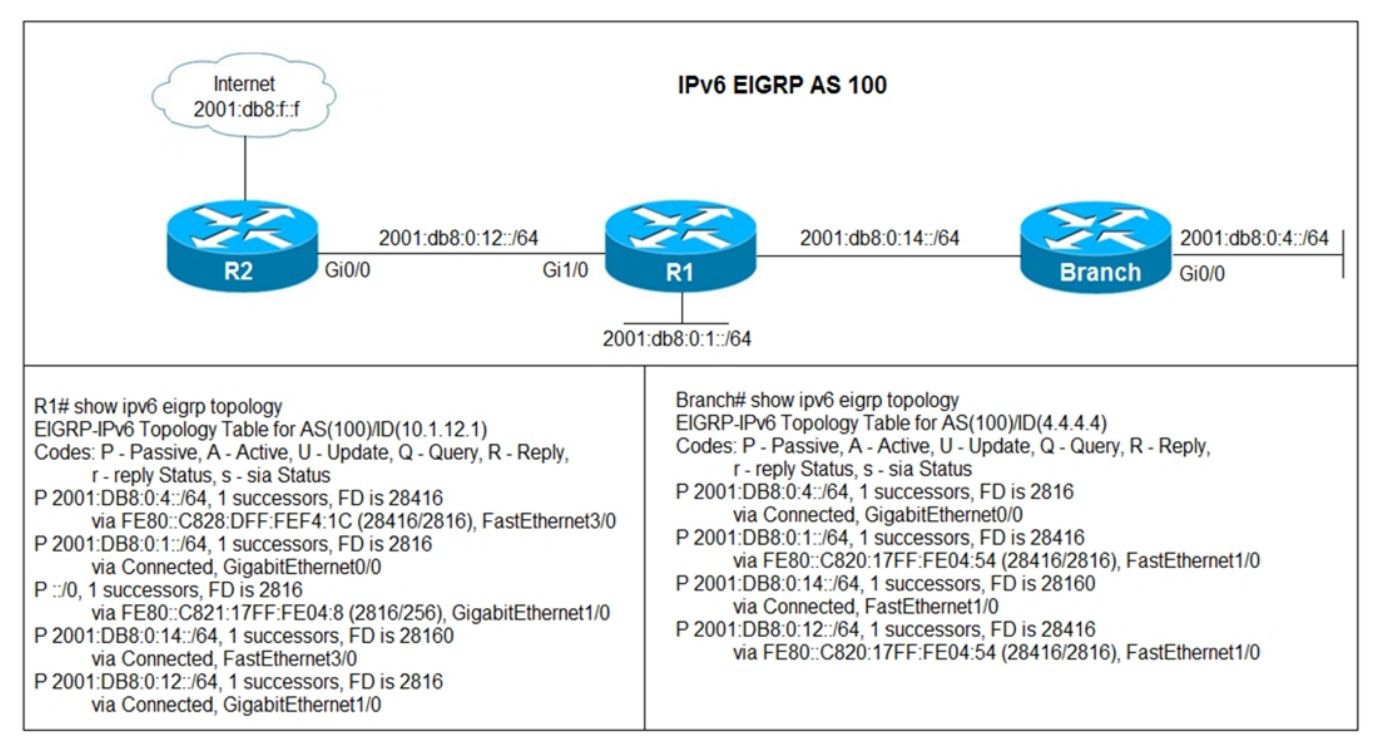
Refer to the exhibit. Users in the branch network of 2001:db8:0:4::/64 report that they cannot access the Internet.
Which command is issued in IPv6 router EIGRP 100 configuration mode to solve this issue?
Show answer and explanation
Correct answer: B. Issue the no eigrp stub command on R1.
The branch network users cannot reach the Internet because R1 is configured as an EIGRP stub router, which by default does not advertise routes learned from other neighbors. Since R1 is the gateway between the branch (2001:db8:0:4::/64) and the rest of the network (R2 and the Internet), the stub configuration prevents R1 from advertising the default route or Internet routes to the branch. The 'no eigrp stub' command on R1 removes the stub designation, allowing R1 to advertise all learned routes including the Internet path via R2, restoring connectivity for branch users.
Why the other options are wrong
- A. Issuing 'eigrp stub' on R1 would further restrict routing and worsen the problem, not solve it.
- C. R2 is the Internet gateway and does not need stub configuration; the issue originates at R1 blocking route advertisements.
- D. Removing stub from R2 would not help because R2 is not the problematic router; R1 is the blocking point for branch traffic.
Question 2
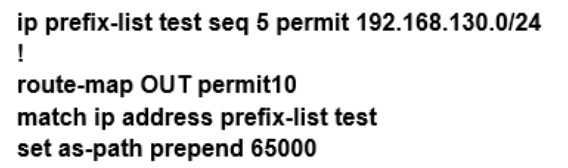
R2 has a locally originated prefix 192.168.130.0/24 and has these configurations:
What is the result when the route-map OUT command is applied toward an eBGP neighbor R1 (1.1.1.1) by using the neighbor 1.1.1.1 route-map OUT out command?
Show answer and explanation
Correct answer: A. R1 sees 192.168.130.0/24 as two AS hops away instead of one AS hop away.
The route-map OUT command uses 'set as-path prepend 65000' which adds AS 65000 to the beginning of the AS-PATH attribute before advertising the prefix 192.168.130.0/24 to eBGP neighbor R1. This causes R1 to see the route as originating from an additional AS hop away, making the AS-PATH length appear as two hops instead of one. The AS-PATH is used by BGP for path selection, so R1 will perceive this locally originated prefix as coming through an extra autonomous system.
Why the other options are wrong
- B. The route-map only manipulates the AS-PATH attribute of 192.168.130.0/24; it does not filter other routes or prevent their acceptance at R1.
- C. AS-PATH prepending affects route selection metrics but does not block traffic forwarding; R1 will still forward traffic to 192.168.130.0/24 if it is the best path.
- D. AS-PATH prepending makes the route less preferred but does not prevent it from entering the routing table; R1 will still accept and store the route in its BGP table.
Question 3
Which method changes the forwarding decision that a router makes without first changing the routing table or influencing the IP data plane?
Show answer and explanation
Correct answer: C. policy-based routing
Policy-based routing (PBR) allows a router to make forwarding decisions based on policies and criteria other than just the destination IP address, without modifying the routing table itself or the IP data plane routing logic. It intercepts packets and applies match-action rules to redirect them independently of normal routing table lookups.
Why the other options are wrong
- A. Nonbroadcast multiaccess (NBMA) describes a network topology type, not a forwarding decision method.
- B. Packet switching is the general process of forwarding packets, not a method that changes forwarding decisions outside the routing table.
- D. The Forwarding Information Base (FIB) is derived from and depends on the routing table, so changes to forwarding via FIB involve routing table changes.
Question 4
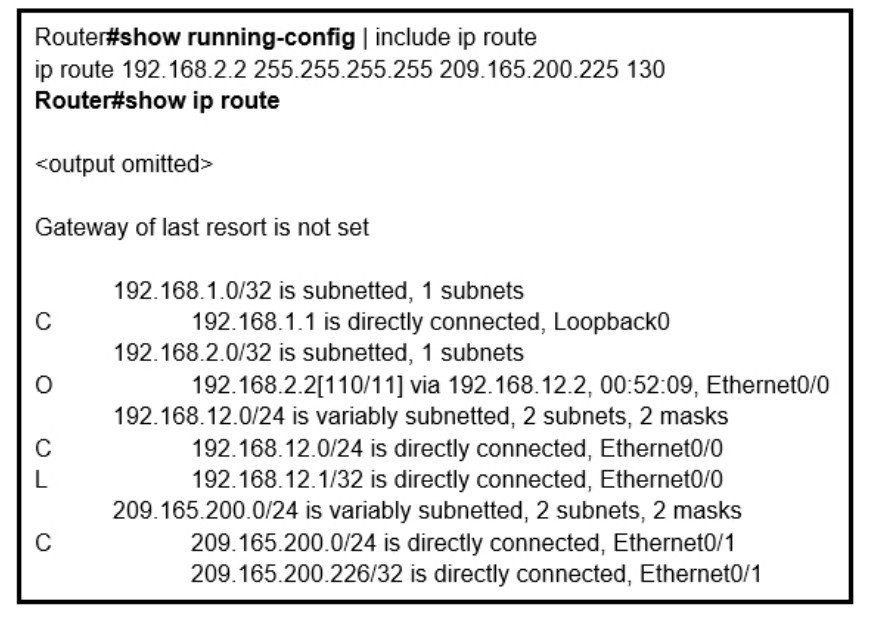
Refer to the exhibit. An engineer configures a static route on a router, but when the engineer checks the route to the destination, a different next hop is chosen.
What is the reason for this?
Show answer and explanation
The answer and explanation for this question are in the free sample PDF.
Question 5
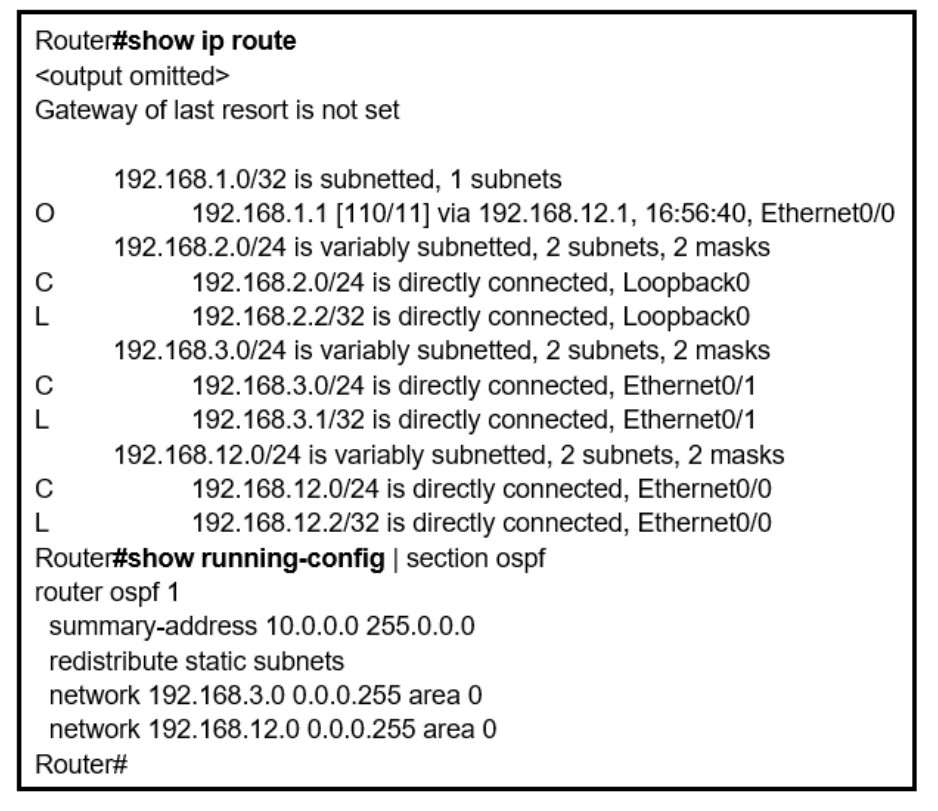
Refer to the exhibit. An engineer is trying to generate a summary route in OSPF for network 10.0.0.0/8, but the summary route does not show up in the routing table.
Why is the summary route missing?
Show answer and explanation
Correct answer: C. There is no route for a subnet inside 10.0.0.0/8, so the summary route is not generated.
The summary-address command is configured on an ASBR and summarizes redistributed external routes. It generates the summary only when at least one component route inside the summary range is actually being redistributed into OSPF. The routing table here contains only 192.168.x.x entries, with nothing inside 10.0.0.0/8, so there is no component route for the range. With no component route present, the router never creates the summary, which is why 10.0.0.0/8 appears neither as an advertised external LSA nor as the local discard entry in the routing table.
Why the other options are wrong
- A. The summary-address command summarizes redistributed external routes on an ASBR, while area range performs inter-area summarization on an ABR; neither works without component routes.
- B. When a summary is actually generated it is installed locally, normally as a discard route to Null0; nothing is generated here because no component route exists.
- D. Since no summary is created, the prefix is absent from the database and the routing table of every router in the OSPF domain, not just this one.
Question 6
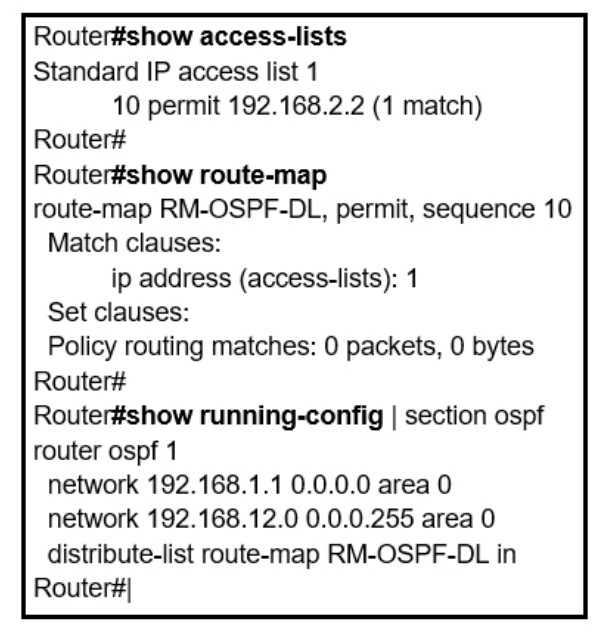
Refer to the exhibit. An engineer is trying to block the route to 192.168.2.2 from the routing table by using the configuration that is shown. The route is still present in the routing table as an OSPF route.
Which action blocks the route?
Show answer and explanation
The answer and explanation for this question are in the free sample PDF.
Question 7
What is a prerequisite for configuring BFD?
Show answer and explanation
Correct answer: C. Cisco Express Forwarding must be enabled on all participating BFD endpoints.
Cisco Express Forwarding (CEF) must be enabled on all participating BFD endpoints because BFD relies on CEF's fast switching and efficient packet handling to detect failures rapidly and accurately. CEF provides the underlying forwarding infrastructure that BFD depends on.
Why the other options are wrong
- A. Jumbo frame support is not a prerequisite for BFD; BFD works with standard frame sizes.
- B. Only the two BFD endpoints need BFD enabled; intermediate routers in the path do not require BFD configuration.
- D. The timers 3 9 command is not a prerequisite; BFD can be configured with BGP using default or custom timers without this specific command being mandatory.
Question 8
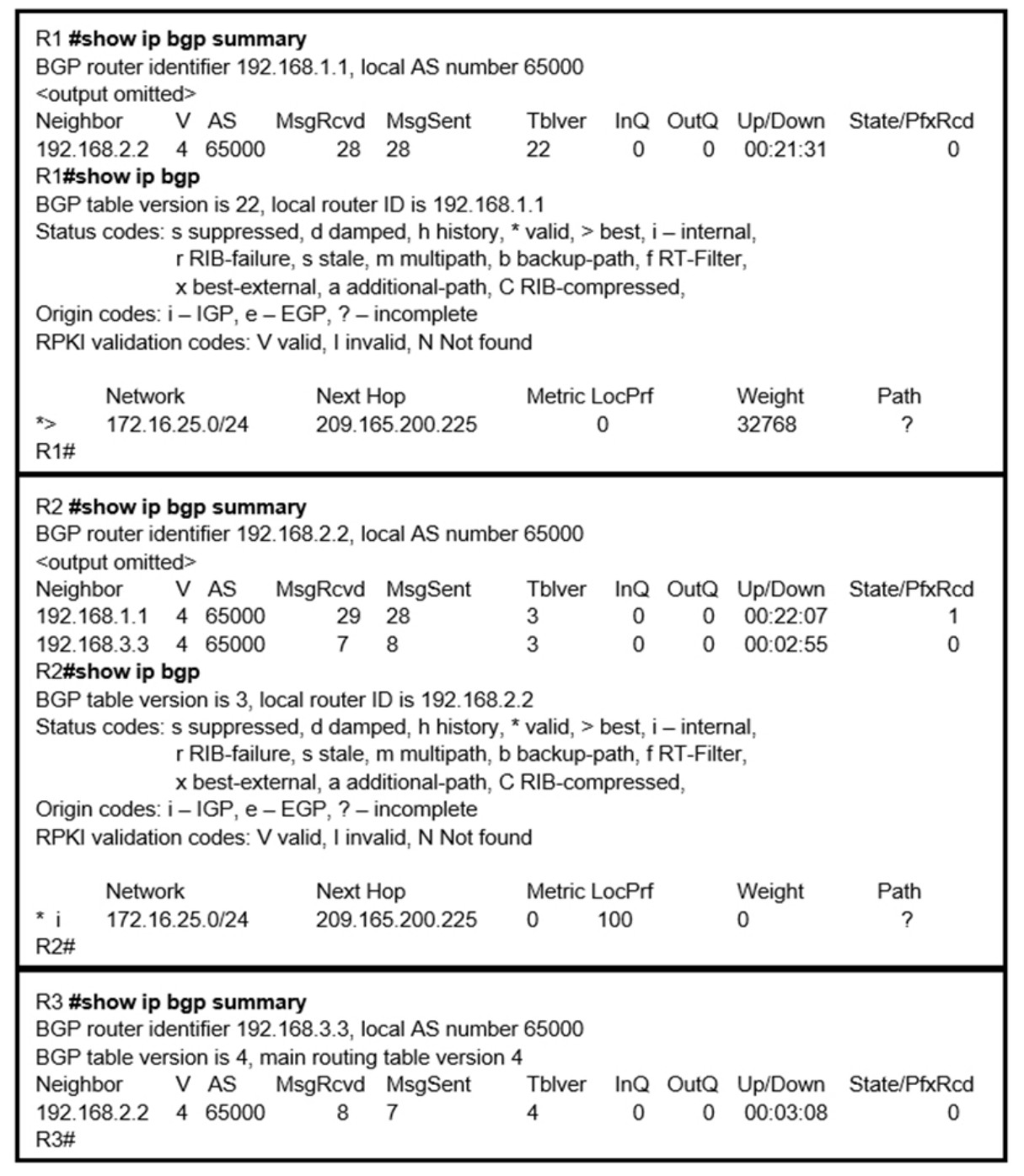
Refer to the exhibit. R2 is a route reflector, and R1 and R3 are route reflector clients. The route reflector learns the route to 172.16.25.0/24 from R1, but it does not advertise to R3.
What is the reason the route is not advertised?
Show answer and explanation
Correct answer: A. R2 does not have a route to the next hop, so R2 does not advertise the prefix to other clients.
On R2 the prefix is listed as "* i 172.16.25.0/24" with no ">" character, so the path was received from R1 but was not selected as the best path. BGP, including a route reflector, advertises only best paths, which is why R3's summary shows 0 prefixes received. The next hop 209.165.200.225 is R1's external link address and is carried unchanged over IBGP, and R2 has no route to that address in its routing table, so the path can never be chosen and never reflected. Giving R2 a route to the next-hop network, or configuring next-hop-self on R1, allows the prefix to be reflected to R3.
Why the other options are wrong
- B. Route reflectors exist precisely to remove the full IBGP mesh requirement, so a full mesh is not needed for this prefix to reach R3.
- C. BGP advertises prefixes with their masks, and classful boundaries play no part in what a route reflector passes to its clients.
- D. Reflecting routes learned from one client to other clients is the core function of a route reflector, so the design itself is not blocking the prefix.
Question 9
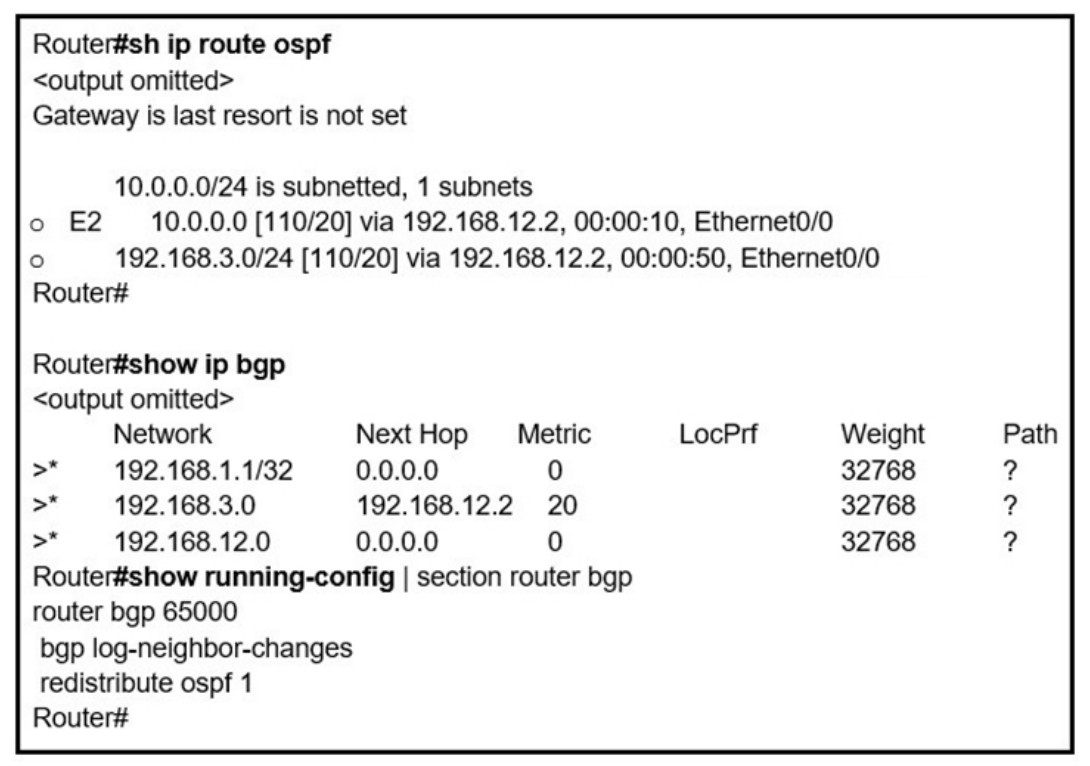
Refer to the exhibit. An engineer is trying to redistribute OSPF to BGP, but not all of the routes are redistributed.
What is the reason for this issue?
Show answer and explanation
The answer and explanation for this question are in the free sample PDF.
Question 10
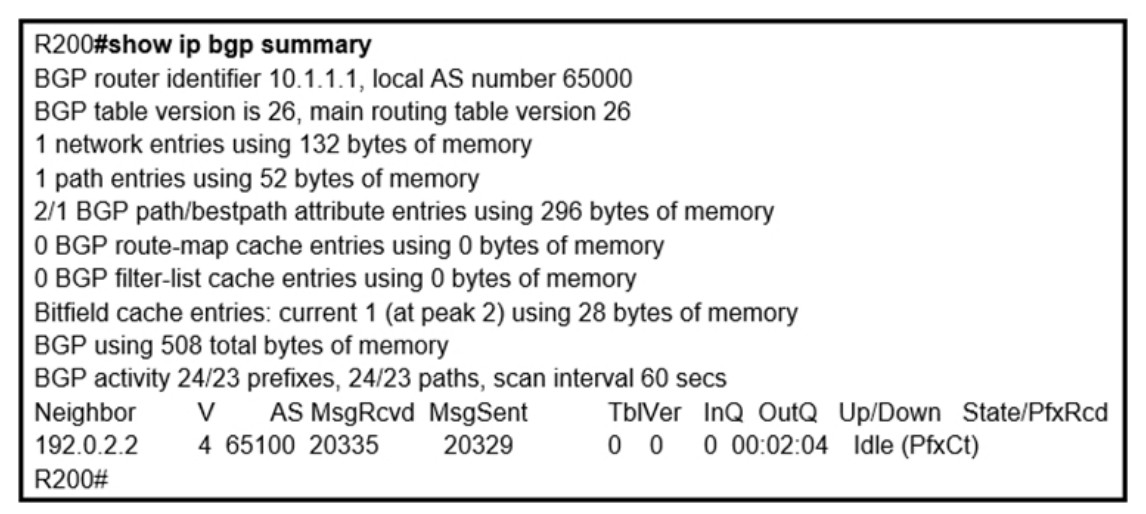
Refer to the exhibit. In which circumstance does the BGP neighbor remain in the idle condition?
Show answer and explanation
Correct answer: D. if prefixes exceed the maximum limit
A BGP neighbor transitions to the Idle state when the maximum prefix limit is exceeded. When a BGP peer sends more prefixes than the configured maximum limit (max-prefix), the router resets the connection and returns the neighbor to Idle state as a protective mechanism to prevent route table exhaustion. This is a standard BGP safeguard that disconnects the neighbor when the threshold is breached, contrasting with simply rejecting individual prefixes when at the limit.
Why the other options are wrong
- A. Not receiving prefixes would not cause the neighbor to enter Idle; the neighbor would remain in Established state even with zero prefixes received.
- B. Reaching the maximum limit (not exceeding it) does not trigger Idle state; the neighbor remains Established and simply stops accepting additional prefixes.
- C. Applying an inbound prefix list filters prefixes but does not change neighbor state; the neighbor remains Established while the list silently rejects non-matching routes.
That was 10 of 620.
The full Cisco 300-410 ENARSI pack has all 620 questions, each with the answer, the explanation and why the other options are wrong, plus a questions-only copy for timed runs. US$39, paid once, with free monthly updates and a pass-or-your-money-back guarantee.