CISCO · 350-501

Cisco 350-501 SPCOR Exam Practice Questions

515 questionsPDF by emailUpdated September 2026

US$39

Try 10 questions free

Card, Apple Pay or Google Pay. Your PDF is sent by email as soon as you check out.

Pass or your money backFail the exam after using this pack and we refund it. How the guarantee works
Category:
TRY BEFORE YOU BUY

Three of the 515 questions in this pack

Question 1

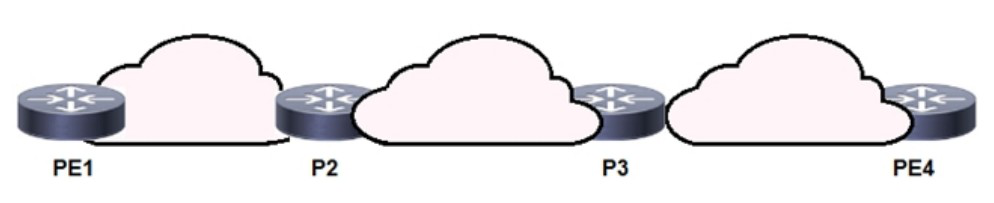
Refer to the exhibit. P3 and PE4 are at the edge of the service provider core and serve as ABR routers. Aggregation areas are on either side of the core.

Which statement about the architecture is true?

Exhibit for question 1

  1. To support seamless MPLS, the BGP route reflector feature must be disabled.
  2. If each area is running its own IGP, BGP must provide an end-to-end MPLS LSP.
  3. If each area is running its own IGP, the ABR routers must redistribute the IGP routing table into BGP.
  4. To support seamless MPLS, TDP must be used as the label protocol.
Show answer and explanation

Correct answer: B. If each area is running its own IGP, BGP must provide an end-to-end MPLS LSP.

an end-to-end MPLS LSP. In a seamless MPLS architecture where each aggregation area runs its own IGP and the core runs a separate IGP, BGP must provide end-to-end MPLS LSP connectivity between PE routers across the multiple IGP domains. The ABR routers (P3 and PE4) act as domain boundaries, and BGP enables label distribution and LSP establishment across these independent IGP domains, creating a seamless MPLS path from PE1 to PE4 despite the fragmented IGP topology.

Why the other options are wrong

  • A. BGP route reflectors are standard in MPLS architectures and do not need to be disabled for seamless MPLS to function.
  • C. While redistribution between IGP and BGP may occur, it is not a required statement for this architecture; BGP provides LSP capability independently.
  • D. TDP (Tag Distribution Protocol) is obsolete; seamless MPLS uses LDP or BGP-LU for label distribution, not TDP.

Question 2

Which component is similar to an EVPN instance?

  1. router distinguisher
  2. MPLS label
  3. IGP router ID
  4. VRF
Show answer and explanation

Correct answer: D. VRF

A VRF (Virtual Routing and Forwarding) instance is the functional equivalent to an EVPN instance. Both provide logical separation of routing tables and create isolated forwarding domains. A VRF on a device operates similarly to how an EVPN instance provides service isolation in a network, making them directly analogous concepts.

Why the other options are wrong

  • A. A router distinguisher is a component used within EVPN to create unique identifiers but is not itself equivalent to an EVPN instance.
  • B. An MPLS label is a forwarding mechanism used by EVPN but does not represent an instance structure.
  • C. An IGP router ID is a network-wide identifier for a router and is unrelated to EVPN instance functionality.

Question 3

Why do Cisco MPLS TE tunnels require a link-state routing protocol?

  1. The link-state database provides segmentation by area, which improves the path- selection process.
  2. The link-state database provides a data repository from which the tunnel endpoints can dynamically select a source ID.
  3. Link-state routing protocols use SPF calculations that the tunnel endpoints leverage to implement the tunnel.
  4. The tunnel endpoints use the link-state database to evaluate the entire topology and determine the best path.
Show answer and explanation

Correct answer: D. The tunnel endpoints use the link-state database to evaluate the entire topology and determine the best path.

evaluate the entire topology and determine the best path. MPLS TE requires a link-state protocol because the headend must see the complete topology, including the TE extensions that carry available bandwidth, affinities and TE metrics, before it can pick a path. Distance-vector protocols only advertise reachability and metrics learned from neighbors, so a router could never evaluate the network end to end. With the full link-state database, the tunnel endpoints can weigh every candidate path against the configured constraints and install the best one.

Why the other options are wrong

  • A. Dividing a network into areas helps IGP scalability, and it actually limits TE path computation because the headend cannot see beyond its own area.
  • B. A tunnel source is taken from the locally configured interface or router ID, not chosen from the link-state database.
  • C. Running SPF is a property of any link-state IGP and does not by itself build a tunnel: the headend must apply the configured constraints to the TE topology database to compute and signal the path.

See all 10 free questions Get the full pack, US$39

515 practice questions for Cisco 350-501 SPCOR v1.1, the core exam for CCNP Service Provider and the CCIE Service Provider written, with full explanations.

Every question comes with the correct answer, the reasoning behind it, and a note on why each wrong option is wrong. Work through it once with the answers, then again with the questions-only copy under exam conditions.

  • 515 questions across all five SPCOR domains
  • Answers and explanations for every question, including the wrong options
  • A questions-only PDF for timed practice runs
  • Instant delivery by email the moment you check out
  • Free monthly updates for as long as the exam is live
  • Pass or your money back

A failed 350-501 attempt costs another US$400. This pack is US$39, paid once, and refunded if you fail.

Try 10 questions free before you buy.

Last updated September 2026 · 515 questions

What makes the SPCOR hard

SPCOR is the carrier-grade core exam, and v1.1 is the version that dragged it into the SRv6 era. Segment routing is no longer a side topic: segment types, the SR control plane across BGP, OSPF and IS-IS, SR-TE, TI-LFA, PCE and PCC architectures, and SRv6 locators are all named in the blueprint, next to LDP sync and unified MPLS.

Networking is the biggest domain at 30%: IS-IS for IPv4 and IPv6, OSPFv2 and v3, the BGP path selection algorithm, routing policy language, IPv6 transition with NAT64, and high availability with NSF, NSR and BFD. Services covers EVPN, inter-AS VPN, carrier supporting carrier, Carrier Ethernet, L3VPN, and multicast with PIM-SM and SSM. Architecture reaches into 5G vRAN and ORAN transport, routed optical networking, NFV, and MACsec. Automation adds NSO, YANG, Ansible and Terraform, secure ZTP, and gRPC and gNMI with mTLS.

About the exam

350-501 (Implementing and Operating Cisco Service Provider Network Core Technologies v1.1, SPCOR) earns the Cisco Certified Specialist, Service Provider Core certification, is the core exam for CCNP Service Provider, and is the qualifying written exam for CCIE Service Provider. It covers service provider architecture and security, IS-IS, OSPF and BGP networking, MPLS and segment routing, L2VPN, L3VPN, multicast and QoS services, and automation and assurance. No prerequisites.

Exam domains

  • Architecture: 15%
  • Networking: 30%
  • MPLS and Segment Routing: 20%
  • Services: 20%
  • Automation and Assurance: 15%

120 minutes, US$400 per attempt, Pearson VUE test centre or online, certification valid for three years. Cisco does not publish a fixed passing score.
Reviews

There are no reviews yet.

Only logged in customers who have purchased this product may leave a review.

Questions before you buy

What do I get when I buy the Cisco 350-501 SPCOR pack?

515 practice questions as a PDF, each with the correct answer, a full explanation and a note on why the other options are wrong, plus a separate questions-only PDF for timed practice.

How quickly do I receive it?

Your PDF is prepared and sent to your email address after checkout, and you get a confirmation as soon as it is on its way.

Is there a free sample?

Yes. Ten questions from this pack, with answers and explanations, are free on this page and as a PDF, so you can judge the quality before you pay.

Are updates included?

Yes. The pack is updated every month for as long as the exam is live, and updates are free for everyone who has bought it.

What if I fail the exam?

We refund the pack. Sit the exam 7 to 30 days after buying, then send your official score report within 7 days of the exam date, as set out in the refund policy.

Can I share it with colleagues?

Each purchase is licensed to one person. For a team, school or training organisation, email support@certstash.com for a licence that fits.