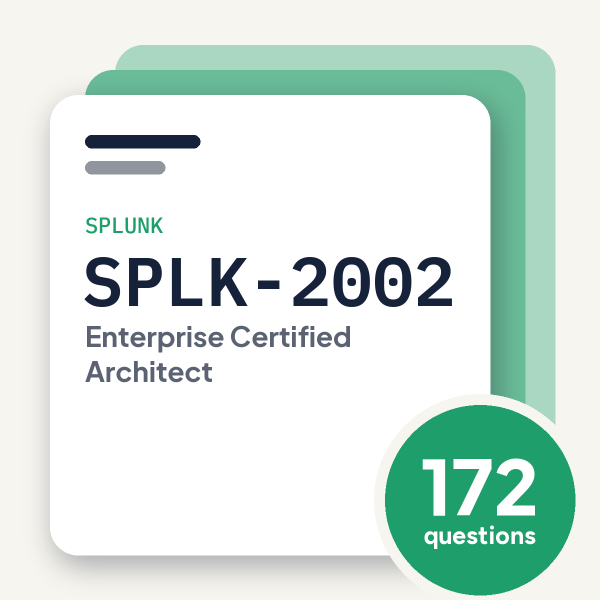
SPLUNK · SPLK-2002

Splunk SPLK-2002 Exam Practice Questions

172 questionsPDF by emailUpdated September 2026

US$39

Try 10 questions free

Card, Apple Pay or Google Pay. Your PDF is sent by email as soon as you check out.

Pass or your money backFail the exam after using this pack and we refund it. How the guarantee works
Category:
TRY BEFORE YOU BUY

Three of the 172 questions in this pack

Question 1

Which of the following will cause the greatest reduction in disk size requirements for a cluster of N indexers running Splunk Enterprise Security?

  1. Setting the cluster search factor to N-1.
  2. Increasing the number of buckets per index.
  3. Decreasing the data model acceleration range.
  4. Setting the cluster replication factor to N-1.
Show answer and explanation

Correct answer: C. Decreasing the data model acceleration range.

In an Enterprise Security deployment the data model acceleration summaries are the dominant disk consumer, frequently approaching or exceeding the size of the indexed data itself. Reducing the acceleration range (the summariesonly time span ES accelerates) deletes or prevents the largest volume of tsidx summary files across every indexer, so it produces the greatest single reduction in storage. Replication and search factor settings change how many copies exist, but in a cluster they are set to fixed values such as 3 by default and are not tied to the indexer count N, so they offer no comparable guaranteed savings.

Why the other options are wrong

  • A. The search factor is normally far lower than the indexer count, so setting it to N-1 in a cluster of N indexers would add searchable copies and increase disk usage rather than reduce it.
  • B. Increasing the number of buckets simply redistributes the same volume of data into smaller units and can add overhead.
  • D. The replication factor is independent of the number of indexers and defaults to a small number, so raising it to N-1 would multiply the copies of raw data and grow the footprint.

Question 2

Stakeholders have identified high availability for searchable data as their top priority. Which of the following best addresses this requirement?

  1. Increasing the search factor in the cluster.
  2. Increasing the replication factor in the cluster.
  3. Increasing the number of search heads in the cluster.
  4. Increasing the number of CPUs on the indexers in the cluster.
Show answer and explanation

Correct answer: A. Increasing the search factor in the cluster.

The search factor defines how many searchable copies of each bucket the indexer cluster maintains, and a searchable copy includes the tsidx and metadata files needed to return results. Raising the search factor means that when an indexer goes down, another peer already holds a searchable copy and the cluster keeps serving complete results without waiting for a rebuild. That is exactly what high availability of searchable data means.

Why the other options are wrong

  • B. The replication factor governs how many total copies of raw data survive a peer failure, and non-searchable copies must first be converted into searchable ones before results are complete.
  • C. Adding search heads protects the search tier and user access, not the availability of the indexed data being searched.
  • D. More CPU on the indexers increases search and indexing throughput but provides no redundancy if a peer fails.

Question 3

Search dashboards in the Monitoring Console indicate that the distributed deployment is approaching its capacity. Which of the following options will provide the most search performance improvement?

  1. Replace the indexer storage to solid state drives (SSD).
  2. Add more search heads and redistribute users based on the search type.
  3. Look for slow searches and reschedule them to run during an off-peak time.
  4. Add more search peers and make sure forwarders distribute data evenly across all indexers.
Show answer and explanation

Correct answer: D. Add more search peers and make sure forwarders distribute data evenly across all indexers.

distribute data evenly across all indexers. When a distributed deployment approaches capacity, adding more indexers (search peers) and ensuring even data distribution provides the most immediate and substantial search performance improvement. This increases the total indexable and searchable data capacity while distributing load. SSD upgrades help but are expensive with diminishing returns. Rescheduling slow searches addresses specific issues but doesn't solve overall capacity problems. Adding search heads without indexers doesn't improve search performance since the bottleneck is data processing, not search head resources.

Why the other options are wrong

  • A. Storage upgrades provide benefits but are less efficient than horizontal scaling of indexing capacity.
  • B. Search heads distribute searches but don't increase the data processing capacity when indexers are the bottleneck.
  • C. Rescheduling addresses specific slow searches but doesn't resolve systemic capacity issues affecting overall performance.

See all 10 free questions Get the full pack, US$39

172 practice questions for Splunk Enterprise Certified Architect (SPLK-2002), with full explanations.

Every question comes with the correct answer, the reasoning behind it, and a short note on why each wrong option is wrong. Work through it once with the answers, then again with the questions-only copy under exam conditions.

  • 172 questions across all eight SPLK-2002 exam topics
  • Answers and explanations for every question, including the wrong options
  • A questions-only PDF for timed practice runs
  • Instant delivery by email the moment you check out
  • Free monthly updates for as long as the exam is live
  • Pass or your money back

A SPLK-2002 attempt costs US$130. This pack is US$39, paid once.

Try 10 questions free before you buy.

Last updated September 2026 · 172 questions

What makes the SPLK-2002 hard

SPLK-2002 is the summit of the Splunk Enterprise track: a 90 minute, 85 question exam on designing and troubleshooting large-scale deployments. Indexer clustering, search head clustering, deployment sizing, forwarder tiers and diag analysis all feature. It assumes you have already passed the Core Certified Power User and Enterprise Certified Admin exams plus the required coursework, so there is little room to be learning the fundamentals as you go.

Splunk does not publish domain weightings or a passing score for this exam, so there is no single area to prioritise. The safest approach is even coverage across deployment planning, both clustering topics, ingestion architecture, performance tuning and troubleshooting, since any of them can appear in depth.

About the exam

The Splunk Enterprise Certified Architect validates the ability to design, deploy and troubleshoot large-scale Splunk Enterprise environments: deployment planning, indexer and search head clustering, data ingestion architecture, and performance troubleshooting. It requires the Splunk Core Certified Power User and Splunk Enterprise Certified Admin certifications, plus the prerequisite architect coursework and practical lab.

Exam domains

  • Deployment planning and sizing
  • Splunk deployment architecture and topologies
  • Indexer clustering
  • Search head clustering
  • Forwarder and data ingestion architecture
  • Splunk performance monitoring and tuning
  • Troubleshooting: splunkd, search, and clustering issues
  • Large-scale deployment best practices

85 questions, 90 minutes, taken at a Pearson VUE test centre or online proctored, US$130 per attempt.
Reviews

There are no reviews yet.

Only logged in customers who have purchased this product may leave a review.

Questions before you buy

What do I get when I buy the Splunk SPLK-2002 pack?

172 practice questions as a PDF, each with the correct answer, a full explanation and a note on why the other options are wrong, plus a separate questions-only PDF for timed practice.

How quickly do I receive it?

Your PDF is prepared and sent to your email address after checkout, and you get a confirmation as soon as it is on its way.

Is there a free sample?

Yes. Ten questions from this pack, with answers and explanations, are free on this page and as a PDF, so you can judge the quality before you pay.

Are updates included?

Yes. The pack is updated every month for as long as the exam is live, and updates are free for everyone who has bought it.

What if I fail the exam?

We refund the pack. Sit the exam 7 to 30 days after buying, then send your official score report within 7 days of the exam date, as set out in the refund policy.

Can I share it with colleagues?

Each purchase is licensed to one person. For a team, school or training organisation, email support@certstash.com for a licence that fits.