
SNOWFLAKE · DEA-C02

Snowflake SnowPro Advanced Data Engineer DEA-C02 Exam Practice Questions

65 questionsPDF by emailUpdated September 2026

US$39

Try 10 questions free

Card, Apple Pay or Google Pay. Your PDF is sent by email as soon as you check out.

Pass or your money backFail the exam after using this pack and we refund it. How the guarantee works
Category:
TRY BEFORE YOU BUY

Three of the 65 questions in this pack

Question 1

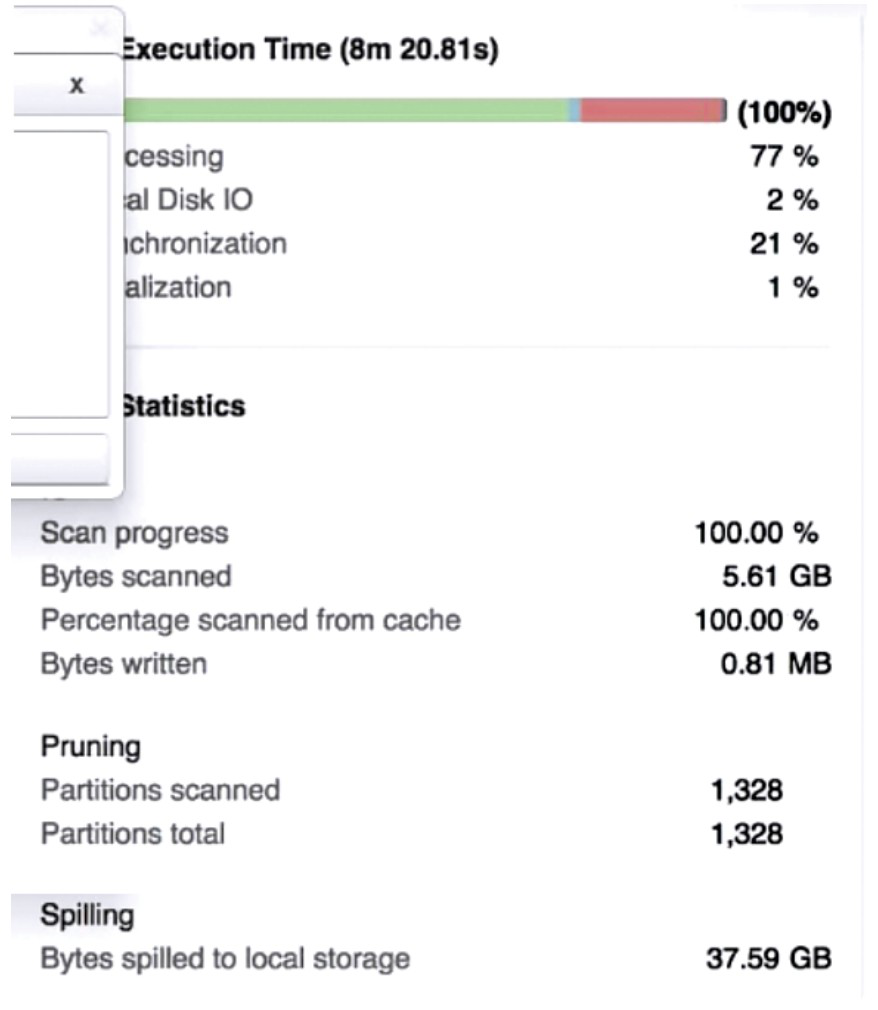
A Data Engineer is investigating a query that is taking a long time to return. The Query Profile shows the following: What step should the Engineer take to increase the query performance?

Exhibit for question 1

  1. Add additional virtual warehouses.
  2. Increase the size of the virtual warehouse.
  3. Rewrite the query using Common Table Expressions (CTEs).
  4. Change the order of the joins and start with smaller tables first.
Show answer and explanation

Correct answer: B. Increase the size of the virtual warehouse.

The execution profile shows that Processing (CPU-bound operations) accounts for 77% of the total execution time, with Synchronization contributing 21%. This indicates the virtual warehouse is CPU-constrained and unable to handle the computational workload efficiently. The statistics show 5.61 GB scanned from cache with only 0.81 MB written, and 37.59 GB spilled to local storage, which confirms the warehouse is struggling with memory and compute resources. Increasing the virtual warehouse size provides more CPU cores and memory to handle the processing workload more efficiently, directly addressing the bottleneck.

Why the other options are wrong

  • A. Adding more virtual warehouses helps with concurrency and parallel query execution, not the execution time of a single query.
  • C. Rewriting the query with CTEs does not address the fundamental compute and memory bottleneck revealed by the profile.
  • D. Join order optimization is a query rewrite strategy that may help but is secondary to the fact that the warehouse lacks sufficient compute resources for the current workload.

Question 2

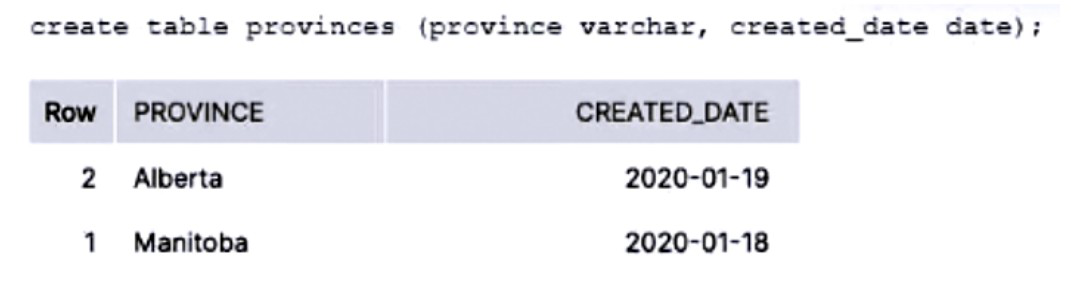
How can the following relational data be transformed into semi-structured data using the LEAST amount of operational overhead?

Exhibit for question 2

  1. Use the TO_JSON function.
  2. Use the PARSE_JSON function to produce a VARIANT value.
  3. Use the OBJECT_CONSTRUCT function to return a Snowflake object.
  4. Use the TO_VARIANT function to convert each of the relational columns to VARIANT.
Show answer and explanation

Correct answer: C. Use the OBJECT_CONSTRUCT function to return a Snowflake object.

Snowflake object. OBJECT_CONSTRUCT is the optimal function for converting relational data into semi- structured format with minimal overhead. It directly constructs a Snowflake OBJECT (semi-structured data type) by accepting column names and values as key-value pairs, transforming the flat relational structure into a nested hierarchical object in a single operation. This approach requires no intermediate conversions and produces native semi- structured data that Snowflake can efficiently process.

Why the other options are wrong

  • A. TO_JSON converts data to a JSON string representation rather than a semi- structured VARIANT or OBJECT type, adding serialization overhead without creating true semi-structured data.
  • B. PARSE_JSON requires input as a string that must first be created or converted, adding unnecessary operational steps compared to directly constructing an object from relational columns.
  • D. TO_VARIANT converts individual columns separately to VARIANT type but does not organize them into a cohesive semi-structured object, requiring additional manual object construction logic afterward.

Question 3

A Data Engineer executes a complex query and wants to make use of Snowflake’s query results caching capabilities to reuse the results. Which conditions must be met? (Choose three.)

  1. The results must be reused within 72 hours.
  2. The query must be executed using the same virtual warehouse.
  3. The USED_CACHED_RESULT parameter must be included in the query.
  4. The table structure contributing to the query result cannot have changed.
  5. The new query must have the same syntax as the previously executed query.
  6. The micro-partitions cannot have changed due to changes to other data in the table.
Show answer and explanation

Correct answer: D, E, F

D. The table structure contributing to the query result cannot have changed. E. The new query must have the same syntax as the previously executed query. F. The micro-partitions cannot have changed due to changes to other data in the table. Snowflake's query results cache reuses results when three conditions are met: the micro- partitions accessed by the query have not changed due to DML operations (option F), the table structure has not changed (option D), and the query syntax must be identical including whitespace and case (option E). The results are cached for 24 hours, not 72 hours, the same virtual warehouse is not required, and no parameter needs to be explicitly included in the query.

Why the other options are wrong

  • A. Query results are cached for 24 hours, not 72 hours.
  • B. The virtual warehouse does not need to be the same for results to be reused from cache.
  • C. There is no USED_CACHED_RESULT parameter; caching is automatic when conditions are met.

See all 10 free questions Get the full pack, US$39

65 practice questions for Snowflake SnowPro Advanced: Data Engineer Certification (DEA-C02), with full explanations.

Every question comes with the correct answer, the reasoning behind it, and a short note on why each wrong option is wrong. Work through it once with the answers, then again with the questions-only copy under exam conditions.

  • 65 questions across all five DEA-C02 domains
  • Answers and explanations for every question, including the wrong options
  • A questions-only PDF for timed practice runs
  • Instant delivery by email the moment you check out
  • Free monthly updates for as long as the exam is live
  • Pass or your money back

A DEA-C02 attempt costs US$375. This pack is US$39, paid once.

Try 10 questions free before you buy.

Last updated September 2026 · 65 questions

What makes the DEA-C02 hard

DEA-C02 replaced DEA-C01 and moved the Data Engineer exam firmly into the Snowpark era: transformation is now a quarter of the paper on its own, and Snowpipe Streaming, dynamic tables and Iceberg tables appear where the old exam had COPY and tasks. It is 65 questions in 115 minutes, scaled to 750 out of 1000, requires an active SnowPro Core, and Snowflake pitches it at engineers with two or more years of production pipeline work. The questions are pipeline scenarios: a source, a latency target, a cost constraint, and four ways to build it.

Data Movement is the largest domain at 26%: batch loading with stages, file formats and COPY options, continuous ingestion with Snowpipe and Snowpipe Streaming, the Kafka connector, streams and tasks for change data capture, external tables and Iceberg, data sharing and replication as movement patterns, and unloading. Data Transformation at 25% covers Snowpark DataFrames in Python, Java and Scala, SQL, JavaScript and Snowpark UDFs, UDTFs and UDAFs, secure UDFs, external functions, stored procedures, dynamic tables and materialised tables, and transforming semi-structured data.

Performance Optimization at 21% covers the Query Profile, clustering, search optimisation, warehouse sizing and multi-cluster strategy, query acceleration, caching and diagnosing spilling and skew. Storage and Data Protection at 14% covers Time Travel and Fail-safe, cloning, micro-partition behaviour, storage costs and data retention. Data Governance at 14% covers masking and row access policies, tags, object dependencies, access history and the account usage views. If you have not used Snowpark in production, that domain is where the marks disappear.

About the exam

DEA-C02 (SnowPro Advanced: Data Engineer Certification) validates the ability to build, optimise and govern production data pipelines on Snowflake: data movement, data transformation, performance optimisation, storage and data protection, and data governance. Prerequisite: an active SnowPro Core certification. Snowflake recommends two or more years of hands-on data engineering experience.

Exam domains

  • Data Movement: 26%
  • Data Transformation: 25%
  • Performance Optimization: 21%
  • Storage and Data Protection: 14%
  • Data Governance: 14%

65 multiple-choice and multiple-select questions, 115 minutes, passing score 750 on a 0 to 1000 scale, US$375 per attempt, taken at a Pearson VUE test centre or online proctored, certification valid for two years and renewed with the DEA-R02 recertification exam.
Reviews

There are no reviews yet.

Only logged in customers who have purchased this product may leave a review.

Questions before you buy

What do I get when I buy the Snowflake SnowPro Advanced Data Engineer DEA-C02 pack?

65 practice questions as a PDF, each with the correct answer, a full explanation and a note on why the other options are wrong, plus a separate questions-only PDF for timed practice.

How quickly do I receive it?

Your PDF is prepared and sent to your email address after checkout, and you get a confirmation as soon as it is on its way.

Is there a free sample?

Yes. Ten questions from this pack, with answers and explanations, are free on this page and as a PDF, so you can judge the quality before you pay.

Are updates included?

Yes. The pack is updated every month for as long as the exam is live, and updates are free for everyone who has bought it.

What if I fail the exam?

We refund the pack. Sit the exam 7 to 30 days after buying, then send your official score report within 7 days of the exam date, as set out in the refund policy.

Can I share it with colleagues?

Each purchase is licensed to one person. For a team, school or training organisation, email support@certstash.com for a licence that fits.