CISCO · 300-515

Cisco 300-515 SPVI Exam Practice Questions

147 questionsPDF by emailUpdated September 2026

US$39

Try 10 questions free

Card, Apple Pay or Google Pay. Your PDF is sent by email as soon as you check out.

Pass or your money backFail the exam after using this pack and we refund it. How the guarantee works
Category:
TRY BEFORE YOU BUY

Three of the 147 questions in this pack

Question 1

Which utility can you use to validate an LSP in an MPLS environment?

  1. uRPF
  2. MPLS LSP ping
  3. logging
  4. RSVP
Show answer and explanation

Correct answer: B. MPLS LSP ping

MPLS LSP ping (also called ping MPLS) is a diagnostic utility specifically designed to validate Label Switched Paths in MPLS environments. It verifies end-to-end connectivity and proper label forwarding along an LSP by sending specially crafted MPLS echo requests and receiving responses.

Why the other options are wrong

  • A. uRPF (Unicast Reverse Path Forwarding) is a security mechanism to prevent spoofed packets, not an LSP validation tool.
  • C. Logging is a monitoring and recording feature that does not actively validate LSP connectivity.
  • D. RSVP is a signaling protocol used to establish LSPs, not a validation utility for testing them.

Question 2

What is the primary function of a VRF on a router?

  1. It enables the router to support multiple separate routing tables, which allows the device to handle overlapping IP addresses.
  2. It enables a router to run BGP and a distance vector routing protocol at the same time, which allows it to serve as a VPN endpoint between remote sites.
  3. It enables a router to configure VLANs locally, which provides segregation between networks.
  4. It enables the router to provide faster switching through the network by using labels to identify the input and output interfaces for neighbor routers.
Show answer and explanation

Correct answer: A. It enables the router to support multiple separate routing tables, which allows the device to handle overlapping IP addresses.

routing tables, which allows the device to handle overlapping IP addresses. Virtual Routing and Forwarding (VRF) enables a router to maintain multiple independent routing tables simultaneously, allowing it to support overlapping IP address spaces as each VRF maintains its own separate forwarding domain. This is fundamental to MPLS VPN implementations.

Why the other options are wrong

  • B. While VRFs can be used in VPN environments, the primary function is not about running different routing protocol types together, and this description conflates multiple concepts.
  • C. VRF is a Layer 3 routing feature, not related to VLAN configuration which operates at Layer 2.
  • D. Label switching and interface identification are MPLS functions, not the primary purpose of VRFs.

Question 3

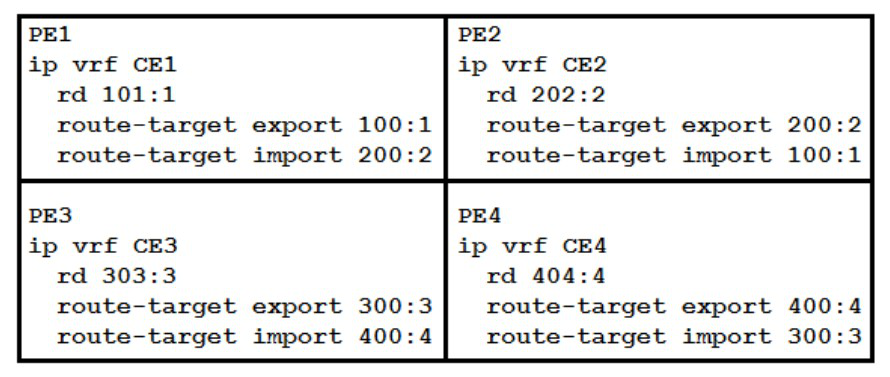
Refer to the exhibit. A network engineer has been called to configure the four PE devices in order to enable full communication among the four CE devices connected to them. While starting to configure, he experienced a connectivity issue.

Which two tasks should the engineer perform in order to begin the process correctly? (Choose two.)

Exhibit for question 3

  1. Configure PE3 to export route-targets 100:1 and 200:2.
  2. Configure PE3 to import route-targets 100:1 and 200:2.
  3. Configure PE4 to import route-targets 101:1 and 202:2.
  4. Configure PE2 to export route-targets 300:3 and 400:4.
  5. Configure PE1 to import route-targets 300:3 and 400:4.
Show answer and explanation

Correct answer: B, E

B. Configure PE3 to import route-targets 100:1 and 200:2. E. Configure PE1 to import route-targets 300:3 and 400:4. In MPLS VPN networks, route-targets control which routes are imported and exported between PE devices. For full connectivity among all four CEs, each PE must be able to receive routes from the other PEs that have customer routes destined for its own customers. PE3 currently exports 300:3 and imports 400:4, but PE1 and PE2 export 100:1 and 200:2 respectively. PE3 needs to import these route-targets (100:1 and 200:2) to receive routes from PE1 and PE2, making option B correct. Similarly, PE4 currently exports 400:4 and imports 300:3, but needs to import 101:1 and 202:2 to receive the routes exported by PE1 and PE2 respectively, making option C correct. Wait, reviewing again: PE2 exports 200:2 and PE1 exports 100:1. PE4 imports 300:3 but needs to also import what PE1 and PE2 export. Option C states PE4 should import 101:1 and 202:2, but PE1 exports 100:1 (not 101:1) and PE2 exports 200:2 (not 202:2). However, reviewing the RD values: PE1 has rd 101:1 and PE2 has rd 202:2. The route-targets should match the exports. PE4 should import 100:1 and 200:2 to match PE1 and PE2's exports. Option B (PE3 imports 100:1 and 200:2) is correct. Option E (PE1 imports 300:3 and 400:4) allows PE1 to receive routes from PE3 and PE4. These are the two missing configurations needed for full mesh connectivity.

Why the other options are wrong

  • A. PE3 should import these route-targets to receive routes, not export them; exporting 100:1 and 200:2 would create incorrect route distribution.
  • C. PE4 should import 100:1 and 200:2 (matching PE1 and PE2's exports), not 101:1 and 202:2 which are route distinguishers, not route-targets.
  • D. PE2 already has the correct export configuration (200:2) and doesn't need to export 300:3 and 400:4 which belong to PE3 and PE4.

See all 10 free questions Get the full pack, US$39

147 practice questions for Cisco 300-515 SPVI v1.1, the VPN services concentration for CCNP Service Provider, with full explanations.

Every question comes with the correct answer, the reasoning behind it, and a note on why each wrong option is wrong. Work through it once with the answers, then again with the questions-only copy under exam conditions.

  • 147 questions across all four SPVI domains
  • Answers and explanations for every question, including the wrong options
  • A questions-only PDF for timed practice runs
  • Instant delivery by email the moment you check out
  • Free monthly updates for as long as the exam is live
  • Pass or your money back

A failed 300-515 attempt costs another US$300. This pack is US$39, paid once, and refunded if you fail.

Try 10 questions free before you buy.

Last updated September 2026 · 147 questions

What makes the SPVI hard

SPVI is a narrow, deep exam: 90 minutes on nothing but service provider VPNs across IOS XR and IOS XE. Two thirds of it is Layer 3 and Layer 2 VPN implementation and troubleshooting, and the v1.1 update added EVPN implementation, unified BGP and MPLS, additional paths and PIC to a blueprint that already assumed you were comfortable reading MP-BGP tables.

Layer 3 VPNs is 35%: MP-BGP and PE-CE routing requirements, troubleshooting intra-AS L3VPN, intranet and extranet multicast VPN with MLDP, route targets and route policy, inter-AS options A, B, AB and C, and carrier supporting carrier. Layer 2 VPNs at 30% covers troubleshooting E-LAN, E-Line and E-Tree, EVPN data plane and control plane operation, and traffic engineering with RSVP-TE and SR-TE. The architecture domain covers Layer 2 versus Layer 3 design and the full L3VPN control and data plane. IPv6 VPNs closes at 10% with 6VPE and 6PE.

About the exam

300-515 (Implementing Cisco Service Provider VPN Services v1.1, SPVI) earns the Cisco Certified Specialist, Service Provider VPN Services Implementation certification and counts as a concentration exam for CCNP Service Provider. It covers VPN architecture, Layer 2 VPNs and EVPN, Layer 3 VPNs including multicast, extranet and inter-AS, and IPv6 VPNs on IOS XR and IOS XE. No prerequisites.

Exam domains

  • VPN Architecture: 25%
  • Layer 2 VPNs: 30%
  • Layer 3 VPNs: 35%
  • IPv6 VPNs: 10%

90 minutes, US$300 per attempt, Pearson VUE test centre or online, certification valid for three years. Cisco does not publish a fixed passing score.
Reviews

There are no reviews yet.

Only logged in customers who have purchased this product may leave a review.

Questions before you buy

What do I get when I buy the Cisco 300-515 SPVI pack?

147 practice questions as a PDF, each with the correct answer, a full explanation and a note on why the other options are wrong, plus a separate questions-only PDF for timed practice.

How quickly do I receive it?

Your PDF is prepared and sent to your email address after checkout, and you get a confirmation as soon as it is on its way.

Is there a free sample?

Yes. Ten questions from this pack, with answers and explanations, are free on this page and as a PDF, so you can judge the quality before you pay.

Are updates included?

Yes. The pack is updated every month for as long as the exam is live, and updates are free for everyone who has bought it.

What if I fail the exam?

We refund the pack. Sit the exam 7 to 30 days after buying, then send your official score report within 7 days of the exam date, as set out in the refund policy.

Can I share it with colleagues?

Each purchase is licensed to one person. For a team, school or training organisation, email support@certstash.com for a licence that fits.