

PYTHON INSTITUTE · PCEP-30-02

Python Institute PCEP-30-02 Exam Practice Questions

481 questionsInstant PDF downloadUpdated September 2026

US$39

Try 10 questions free

Card, Apple Pay or Google Pay. Your PDF is sent by email as soon as you check out.

Pass or your money backFail the exam after using this pack and we refund it. How the guarantee works
Category:
TRY BEFORE YOU BUY

Three of the 481 questions in this pack

Question 1

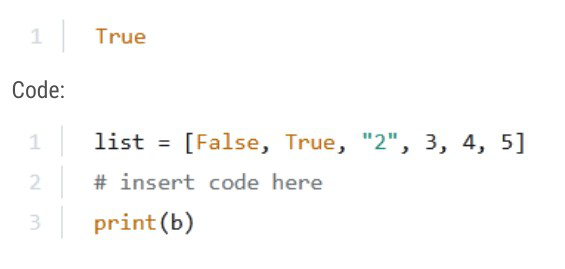
Insert the correct snippet so that the program produces the expected output.

Expected output:

Code:

Exhibit for question 1

  1. b = 0 not in list
  2. b = list[0]
  3. b = 0 in list
  4. b = False
Show answer and explanation

Correct answer: C. b = 0 in list

The expected output is 'True', which means the code snippet must produce a boolean True value that gets printed. Option C, 'b = 0 in list', checks if the integer 0 is a member of the list. Since list[0] is False (which is equivalent to 0 in Python), the expression '0 in list' evaluates to True because False == 0 in Python's type system, making this the correct answer.

Why the other options are wrong

  • A. The expression '0 not in list' would evaluate to False (since 0 is in the list via False), not True.
  • B. Assigning b = list[0] sets b to False, and printing False outputs 'False', not 'True'.
  • D. Assigning b = False directly outputs 'False' when printed, not 'True'.

Question 2

Assuming that the tuple is a correctly created tuple, the fact that tuples are immutable means that the following instruction:

Exhibit for question 2

  1. is illegal
  2. may be illegal if the tuple contains strings
  3. can be executed if and only if the tuple contains at least two elements
  4. is fully correct
Show answer and explanation

Correct answer: A. is illegal

Tuples in Python are immutable, meaning their elements cannot be modified after creation. The instruction attempts to reassign my_tuple[1] by adding to it, which violates the immutability constraint. Python will raise a TypeError: 'tuple' object does not support item assignment, making this operation illegal regardless of the tuple's contents or length.

Why the other options are wrong

  • B. The type of elements (strings or otherwise) is irrelevant; the immutability of tuples themselves prevents any item reassignment.
  • C. The tuple can have any number of elements (including zero or one), but the operation remains illegal due to tuple immutability, not based on element count.
  • D. The code is not correct; attempting to modify a tuple element will always raise a TypeError in Python.

Question 3

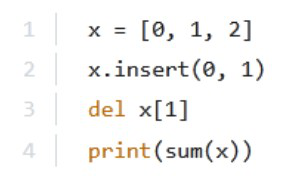
What is the expected output of the following code?

Exhibit for question 3

  1. 2
  2. 4
  3. 5
  4. 3
Show answer and explanation

Correct answer: B. 4

Starting with x = [0, 1, 2], the insert(0, 1) method inserts the value 1 at index 0, making x = [1, 0, 1, 2]. Then del x[1] deletes the element at index 1 (the value 0), leaving x = [1, 1, 2]. Finally, sum(x) adds these elements: 1 + 1 + 2 = 4.

Why the other options are wrong

  • A. The sum of [1, 1, 2] is 4, not 2.
  • C. This would require a different sequence of operations or initial values.
  • D. The sum is not 3; the correct calculation yields 4.

See all 10 free questions Get the full pack, US$39

481 practice questions for Python Institute Certified Entry-Level Python Programmer (PCEP-30-02), MCQs and fill-in-the-blank, with full explanations.

Every question comes with the correct answer, a clear explanation, and a note on why each other option is wrong, including every fill-in-the-blank format from the objectives so nothing about it is new on exam day.

  • 481 questions, MCQs and fill-in-the-blank, mapped to the PCEP-30-02 exam objectives
  • Answers and explanations for every question, including the wrong options
  • A questions-only PDF for timed practice runs
  • Instant delivery by email the moment you check out
  • Free monthly updates for as long as the exam is live
  • Pass or your money back

A failed PCEP attempt costs another US$59, plus the time it takes to prepare again. This pack is US$39, paid once, and refunded if you fail.

Try 10 questions free before you buy.

Last updated September 2026 · 481 questions

What makes the PCEP hard

The PCEP is only US$59, but failing an entry-level exam is still frustrating: it delays your timeline, dents confidence, and means starting the preparation process over again.

Generic practice questions and tutorials often do not match how the exam actually asks things. The fill-in-the-blank questions catch a lot of candidates off guard: you cannot guess your way through them, you have to know the syntax exactly.

About the exam

The PCEP is Python Institute’s entry-level certification. It validates foundational knowledge of Python programming, including syntax, data types, control flow, functions and exceptions. It is the starting point for candidates progressing toward the PCAP and PCPP certifications, and a recognised credential for junior developer and data analyst roles.

Exam domains

  • Computer programming and Python fundamentals: 18%
  • Control flow (conditional blocks and loops): 29%
  • Data collections (tuples, dictionaries, lists and strings): 25%
  • Functions and exceptions: 28%

30 questions, 40 minutes, passing score 70%, taken online proctored through OpenEDG, includes fill-in-the-blank questions, US$59 per attempt.
Reviews

There are no reviews yet.

Only logged in customers who have purchased this product may leave a review.

Questions before you buy

What do I get when I buy the Python Institute PCEP-30-02 pack?

481 practice questions as a PDF, each with the correct answer, a full explanation and a note on why the other options are wrong, plus a separate questions-only PDF for timed practice.

How quickly do I receive it?

Straight away. The full PDF and a questions-only copy are emailed to you the moment your payment goes through, and the same links are on your order page.

Is there a free sample?

Yes. Ten questions from this pack, with answers and explanations, are free on this page and as a PDF, so you can judge the quality before you pay.

Are updates included?

Yes. The pack is updated every month for as long as the exam is live, and updates are free for everyone who has bought it.

What if I fail the exam?

We refund the pack. Sit the exam 7 to 30 days after buying, then send your official score report within 7 days of the exam date, as set out in the refund policy.

Can I share it with colleagues?

Each purchase is licensed to one person. For a team, school or training organisation, email support@certstash.com for a licence that fits.