ORACLE · 1Z0-908

Oracle 1Z0-908 Exam Practice Questions

228 questionsPDF by emailUpdated September 2026

US$39

Try 10 questions free

Card, Apple Pay or Google Pay. Your PDF is sent by email as soon as you check out.

Pass or your money backFail the exam after using this pack and we refund it. How the guarantee works
Category:
TRY BEFORE YOU BUY

Three of the 228 questions in this pack

Question 1

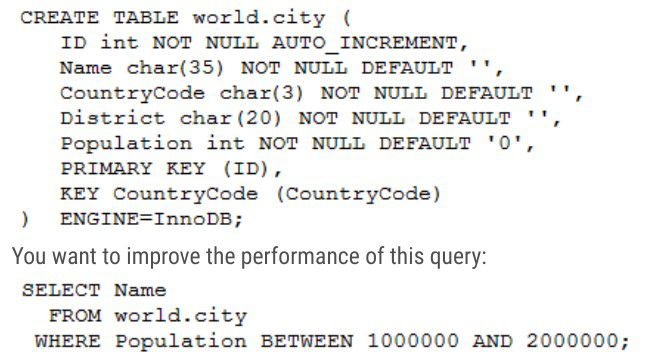
Examine this statement, which executes successfully: You want to improve the performance of this query: Which change enables the query to succeed while accessing fewer rows?

Exhibit for question 1

  1. ALTER TABLE world.city ADD SPATIAL INDEX (Name);
  2. ALTER TABLE world.city ADD SPATIAL INDEX (Population);
  3. ALTER TABLE world.city ADD INDEX (Population);
  4. ALTER TABLE world.city ADD INDEX (Name);
  5. ALTER TABLE world.city ADD FULLTEXT INDEX (Name);
  6. ALTER TABLE world.city ADD FULLTEXT INDEX (Population);
Show answer and explanation

Correct answer: C. ALTER TABLE world.city ADD INDEX (Population);

The query filters rows using a BETWEEN condition on the Population column, which is a range query. A B-tree index on Population (option C) allows the database engine to quickly locate and access only the rows where Population falls between 1000000 and 2000000, significantly reducing the number of rows scanned. SPATIAL indexes are designed for geometric data and are inappropriate for integer range queries. FULLTEXT indexes are designed for text search operations, not numeric range filtering. An index on Name would not help because the WHERE clause does not filter by Name.

Why the other options are wrong

  • A. SPATIAL indexes are for geographic/geometric data types, not for numeric range filtering on integer columns.
  • B. SPATIAL indexes cannot efficiently process BETWEEN conditions on numeric columns; they are designed for spatial queries.
  • D. An index on Name provides no benefit since the WHERE clause filters only on Population, not Name.
  • E. FULLTEXT indexes are for text search (MATCH/AGAINST), not for numeric range queries.
  • F. FULLTEXT indexes are for text search operations and cannot process BETWEEN conditions on numeric columns.

Question 2

Which three are characteristics of a newly created role? (Choose three.)

  1. It can be dropped using the DROP ROLE statement.
  2. It is stored in the mysql.role table.
  3. It is created as a locked account.
  4. It can be renamed using the RENAME ROLE statement.
  5. It can be granted to user accounts.
  6. It can be protected with a password.
Show answer and explanation

Correct answer: A, C, E

A. It can be dropped using the DROP ROLE statement. C. It is created as a locked account. E. It can be granted to user accounts. A newly created role can be dropped using DROP ROLE, is created as a locked account by default (requiring a password to be set before use), and can be granted to user accounts. Roles are stored in the mysql.user table along with users, not a separate mysql.role table. Roles cannot be renamed with a RENAME ROLE statement, this statement doesn't exist for roles. While roles can be associated with passwords, this is not an inherent characteristic of a newly created role.

Why the other options are wrong

  • B. Roles are stored in the mysql.user table, not mysql.role.
  • D. There is no RENAME ROLE statement in MySQL.
  • F. While roles can have passwords assigned, this is not a default characteristic of a newly created role.

Question 3

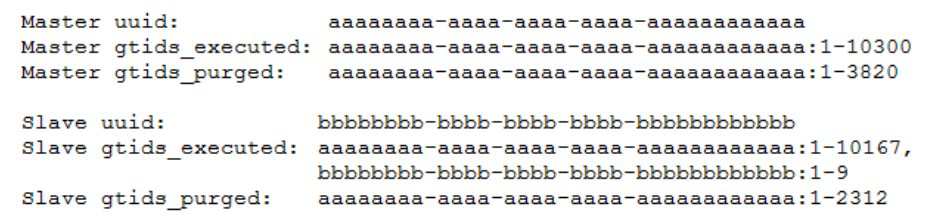
You have configured GTID-based asynchronous replication with one master and one slave. A user accidentally updated some data on the slave. To fix this, you stopped replication and successfully reverted the accidental changes. Examine the current GTID information: You must fix GTID sets on the slave to avoid replicating unwanted transactions in case of failover. Which set of actions would allow the slave to continue replicating without erroneous transactions?

Exhibit for question 3

  1. RESET MASTER; SET GLOBAL gtid_purged=aaaaaaaaaaaa-aaaaaaaa- aaaaaaaaaaaa:1-10167;
  2. SET GLOBAL gtid_purged=aaaaaaaaaaaa-aaaaaaaa-aaaaaaaaaaaa:1- 2312,bbbbbbbbbbbb-bbbbbbbb-bbbbbbbbbbbb:1-9; SET GLOBAL gtid_executed=aaaaaaaaaaaa-aaaaaaaa-aaaaaaaaaaaa:1-10167;
  3. RESET SLAVE; SET GLOBAL gtid_purged=aaaaaaaaaaaa-aaaaaaaa- aaaaaaaaaaaa:1-3820; SET GLOBAL gtid_executed=aaaaaaaaaaaa-aaaaaaaa, aaaaaaaaaaaa:1-10300;
  4. RESET MASTER; SET GLOBAL gtid_purged-aaaaaaaaaaaa-aaaaaaaa- aaaaaaaaaaaa:1-2312; SET GLOBAL gtid_executed=aaaaaaaaaaaa-aaaaaaaa- aaaaaaaaaaaa:1-10167;
  5. RESET SLAVE; SET GLOBAL gtid_purged=aaaaaaaaaaaa-aaaaaaaa- aaaaaaaaaaaa:1-10167;
Show answer and explanation

Correct answer: E. RESET SLAVE; SET GLOBAL gtid_purged=aaaaaaaaaaaa-aaaaaaaa- aaaaaaaaaaaa:1-10167;

gtid_purged=aaaaaaaaaaaa-aaaaaaaa-aaaaaaaaaaaa:1-10167; After reverting accidental changes on the slave, the slave's gtid_executed set (aaaaaaaa- aaaa-aaaa-aaaa-aaaaaaaaaaaa:1-10300) contains transactions beyond what the master has executed (aaaaaaaa-aaaa-aaaa-aaaa-aaaaaaaaaaaa:1-10300 executed, but only 1- 3820 purged). The slave also has its own transaction (bbbbbbbb-bbbb-bbbb-bbbb- bbbbbbbbbbbb:1-9) that should not be replicated. RESET SLAVE clears replication state while preserving the GTID information needed. Setting gtid_purged to aaaaaaaa-aaaa- aaaa-aaaa-aaaaaaaaaaaa:1-10167 marks all master transactions up to that point as already applied, allowing replication to resume from the master's perspective without re- executing those transactions. This approach removes the slave's own GTID (bbbbbbbb transaction) from consideration and synchronizes the slave's GTID state with the master's actual executed range, preventing erroneous transaction replication during failover.

Why the other options are wrong

  • A. RESET MASTER is inappropriate for a slave as it clears binary logs and GTID state entirely, breaking replication recovery.
  • B. Attempting to set gtid_executed to a higher value than gtid_purged violates GTID constraints and creates an inconsistent state.
  • C. Sets gtid_purged to the master's gtid_purged value (3820) rather than the master's gtid_executed value (10300), leaving a gap where transactions won't be recognized as applied, causing re-execution.
  • D. RESET MASTER is inappropriate for a slave and would destroy necessary replication metadata; additionally, the gtid_executed value exceeds what should be set.

See all 10 free questions Get the full pack, US$39

228 practice questions for Oracle MySQL 8.0 Database Administrator (1Z0-908), with full explanations.

Every question comes with the correct answer, the reasoning behind it, and a short note on why each wrong option is wrong. Work through it once with the answers, then again with the questions-only copy under exam conditions.

  • 228 questions mapped to the 1Z0-908 exam topics
  • Answers and explanations for every question, including the wrong options
  • A questions-only PDF for timed practice runs
  • Instant delivery by email the moment you check out
  • Free monthly updates for as long as the exam is live
  • Pass or your money back

A failed 1Z0-908 attempt costs US$245. This pack is US$39, paid once.

Try 10 questions free before you buy.

Last updated September 2026 · 228 questions

What makes the 1Z0-908 hard

1Z0-908 is the only MySQL administration certification Oracle offers, and it has stayed on the 8.0 exam code while MySQL itself moved on to the 8.4 LTS and 9.x innovation releases, so the questions are about the features that have been stable since 8.0: the data dictionary, roles, the InnoDB architecture and the tooling around it. It is a single exam for the OCP credential with no associate-level prerequisite, and it is written for people who run MySQL rather than people who query it; the SQL questions are administrative.

The exam topics follow the DBA job. Architecture covers the server components, the data dictionary, storage engines and InnoDB internals, tablespaces, redo and undo, the buffer pool and the query cache’s removal. Installation and configuration covers installing on Linux and Windows, MySQL Shell and the option files, upgrading and the variables that matter. Security covers user accounts, authentication plugins, roles, privileges and the principle of least privilege, password policies, TLS, auditing and encryption at rest with the keyring. Monitoring covers the Performance Schema, sys schema, slow query log, EXPLAIN and error and general logs. Backup and recovery covers logical backups with mysqldump and MySQL Shell dump utilities, physical backups with MySQL Enterprise Backup, binary logs and point-in-time recovery. High availability covers replication with GTIDs and multi-threaded appliers, Group Replication, InnoDB Cluster, InnoDB ClusterSet and MySQL Router, plus the Enterprise Edition tools and MySQL HeatWave.

About the exam

1Z0-908 (MySQL 8.0 Database Administrator) earns the Oracle Certified Professional, MySQL 8.0 Database Administrator credential. It covers MySQL architecture, installation and configuration, security, monitoring, backup and recovery, and high availability with replication, Group Replication and InnoDB Cluster. No prerequisites.

Exam topics

  • MySQL architecture and InnoDB
  • Installation, configuration and upgrades
  • Security: users, roles, authentication, TLS and encryption
  • Monitoring with the Performance Schema and sys schema
  • Backup and recovery
  • High availability: replication, Group Replication, InnoDB Cluster and MySQL Router

Oracle does not publish weightings for these topics. Multiple-choice questions, about 140 minutes, passing score 62%, US$245 per attempt, delivered through Oracle MyLearn online proctored or Pearson VUE, certification does not expire.
Reviews

There are no reviews yet.

Only logged in customers who have purchased this product may leave a review.

Questions before you buy

What do I get when I buy the Oracle 1Z0-908 pack?

228 practice questions as a PDF, each with the correct answer, a full explanation and a note on why the other options are wrong, plus a separate questions-only PDF for timed practice.

How quickly do I receive it?

Your PDF is prepared and sent to your email address after checkout, and you get a confirmation as soon as it is on its way.

Is there a free sample?

Yes. Ten questions from this pack, with answers and explanations, are free on this page and as a PDF, so you can judge the quality before you pay.

Are updates included?

Yes. The pack is updated every month for as long as the exam is live, and updates are free for everyone who has bought it.

What if I fail the exam?

We refund the pack. Sit the exam 7 to 30 days after buying, then send your official score report within 7 days of the exam date, as set out in the refund policy.

Can I share it with colleagues?

Each purchase is licensed to one person. For a team, school or training organisation, email support@certstash.com for a licence that fits.