ORACLE · 1Z0-819

Oracle 1Z0-819 Exam Practice Questions

213 questionsPDF by emailUpdated September 2026

US$39

Try 10 questions free

Card, Apple Pay or Google Pay. Your PDF is sent by email as soon as you check out.

Pass or your money backFail the exam after using this pack and we refund it. How the guarantee works
Category:
TRY BEFORE YOU BUY

Three of the 213 questions in this pack

Question 1

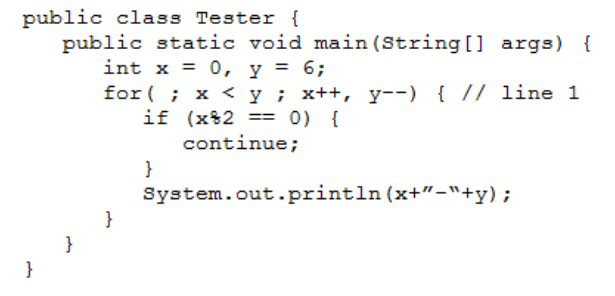
Given: What is the result?

Exhibit for question 1

  1. 2-4
  2. 0-6 1-5 2-4
  3. 1-5
  4. 1-5 2-4
  5. The compilation fails due to an error in line 1.
  6. 0-6
  7. 0-6 2-4
Show answer and explanation

Correct answer: C. 1-5

The loop initializes x=0, y=6 and continues while x < y, incrementing x and decrementing y each iteration. On each iteration, if x is even (x%2 == 0), the continue statement skips the print statement and moves to the next iteration. When x is odd, the print statement executes. Iteration 1: x=0 (even, skipped), y=5; Iteration 2: x=1 (odd, prints "1-5"), y=4; Iteration 3: x=2 (even, skipped), y=3; Iteration 4: x=3 (odd, prints "3-3"), y=2; Loop terminates when x=4, y=1 (x < y is false). Wait, recalculating: At iteration where x=3, y=2, we have x < y (3 < 2 is false), so the loop ends after x=2, y=3. So: x=0 skipped, x=1 prints "1-5", x=2 skipped, then x=3, y=2 fails the condition. Therefore only "1-5" prints.

Why the other options are wrong

  • A. Missing the output from when x=1; the loop produces one output line, not just the final state.
  • B. Includes x=0 and x=2 outputs, but these are skipped by the continue statement since they are even numbers.
  • D. Includes x=2, but x=2 is even and triggers continue, preventing any output for that iteration.
  • E. The code compiles without error; line 1 is syntactically valid.
  • F. Represents only the initial state; x=0 is skipped by continue since 0%2==0.
  • G. Includes x=0 and x=2, both of which are skipped by the continue statement for even numbers.

Question 2

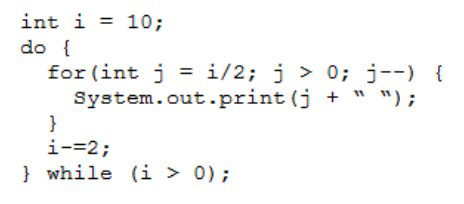
Given: What is the result?

Exhibit for question 2

  1. 5 4 3 2 1
  2. 5
  3. nothing
  4. 5 4 3 2 1 4 3 2 1 3 2 1 2 1 1
Show answer and explanation

Correct answer: D. 5 4 3 2 1 4 3 2 1 3 2 1 2 1 1

The code executes a do-while loop that continues while i > 0. In each iteration, the for loop prints values from i/2 down to 1, then i is decremented by 2. Starting with i=10: the for loop prints 5 4 3 2 1 (from 10/2=5 down to 1), then i becomes 8. Next iteration prints 4 3 2 1 (from 8/2=4 down to 1), then i becomes 6. Next iteration prints 3 2 1 (from 6/2=3 down to 1), then i becomes 4. Next iteration prints 2 1 (from 4/2=2 down to 1), then i becomes 2. Final iteration prints 1 (from 2/2=1 down to 1), then i becomes 0 and the loop exits. The complete output is: 5 4 3 2 1 4 3 2 1 3 2 1 2 1 1.

Why the other options are wrong

  • A. This only shows the first iteration's output and misses the subsequent iterations of the do-while loop.
  • B. This shows only a single value and ignores the for loop that prints multiple decreasing values in each iteration.
  • C. Nothing is printed only if the code doesn't execute, but the do-while loop's condition is checked after execution, ensuring at least one iteration runs.

Question 3

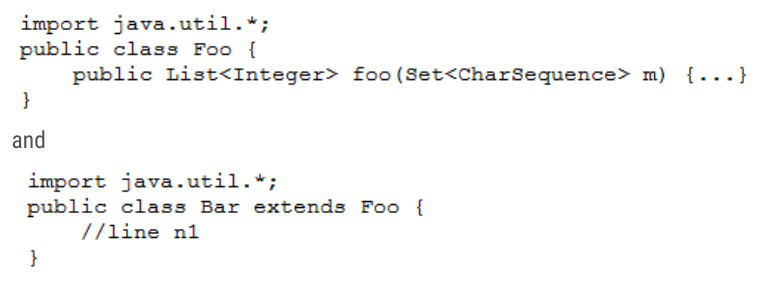
Given: and Which two method definitions at line n1 in the Bar class compile? (Choose two.)

Exhibit for question 3

  1. public List<Number> foo(Set<String> m) {...}
  2. public List<Integer> foo(Set<CharSequence> m) {...}
  3. public List<Integer> foo(TreeSet<String> m) {...}
  4. public List<Object> foo(Set<CharSequence> m) {...}
  5. public ArrayList<Integer> foo(Set<String> m) {...}
  6. public ArrayList<Number> foo(Set<CharSequence> m) {...}
Show answer and explanation

Correct answer: B, C

B. public List<Integer> foo(Set<CharSequence> m) {...} C. public List<Integer> foo(TreeSet<String> m) {...} When Bar extends Foo, it can override the foo method with a covariant return type, which must be a subtype of the parent's return type (List<Integer>). Option B uses List<Integer> with Set<CharSequence>, which is valid because CharSequence is a supertype of String, making the parameter contravariant-compatible. Option C uses TreeSet<String>, which is a subtype of Set<String>, and ArrayList<Integer> is a subtype of List<Integer>, satisfying covariance rules. Option A fails because Number is not a subtype of Integer. Option D fails because Object is not a subtype of Integer. Option E fails because the parameter must be Set<String> or a supertype thereof, not a more specific implementation. Option F fails because Number is not a subtype of Integer for the return type.

Why the other options are wrong

  • A. Number is not a subtype of Integer, violating covariant return type rules.
  • D. Object is not a subtype of Integer, violating covariant return type rules.
  • E. TreeSet is a more specific type than Set, which violates contravariance for method parameters during override.
  • F. Number is not a subtype of Integer, failing covariant return type requirements.

See all 10 free questions Get the full pack, US$39

213 practice questions for Oracle Java SE 11 Developer (1Z0-819), with full explanations.

Every question comes with the correct answer, the reasoning behind it, and a short note on why each wrong option is wrong. Work through it once with the answers, then again with the questions-only copy under exam conditions.

  • 213 questions mapped to the 1Z0-819 exam topics
  • Answers and explanations for every question, including the wrong options
  • A questions-only PDF for timed practice runs
  • Instant delivery by email the moment you check out
  • Free monthly updates for as long as the exam is live
  • Pass or your money back

A failed 1Z0-819 attempt costs US$245. This pack is US$39, paid once.

Try 10 questions free before you buy.

Last updated September 2026 · 213 questions

What makes the 1Z0-819 hard

1Z0-819 is the single exam that replaced the old two-exam Java 11 path, and Oracle compressed 160 questions of material into 50 questions and 90 minutes without dropping any topics. That is why people with years of Java experience fail it: under two minutes per question, most questions are a code listing with a “what is the result” stem, and several have more than one correct answer with no hint of how many to pick. The 68% pass mark sounds gentle until you meet the format.

The exam topics are the whole Java SE 11 language and core library: data types, operators, promotion and casting, program flow; the object-oriented approach with inheritance, polymorphism, interfaces, nested classes and enums; exception handling including try-with-resources and custom exceptions; arrays, collections and generics; streams and lambda expressions with functional interfaces, Optional and collectors; the Java Platform Module System with module declarations, services and migration; concurrency with executors, concurrent collections and thread safety; the Java I/O API including NIO.2 paths and files; secure coding; JDBC with statements, result sets and transactions; localization with locales, resource bundles and formatting; and annotations. Questions on modules, streams and concurrency are where the most time is lost, because they require tracing what the code does rather than recognising a rule.

About the exam

1Z0-819 (Java SE 11 Developer) earns the Oracle Certified Professional: Java SE 11 Developer credential. It covers Java data types, program flow, object-oriented programming, exception handling, arrays and collections, streams and lambdas, the module system, concurrency, I/O, secure coding, JDBC, localization and annotations. No prerequisites.

Exam topics

  • Working with Java data types and controlling program flow
  • Java object-oriented approach
  • Exception handling
  • Working with arrays and collections
  • Working with streams and lambda expressions
  • Java Platform Module System
  • Concurrency
  • Java I/O API
  • Secure coding in Java SE applications
  • Database applications with JDBC
  • Localization and annotations

Oracle does not publish weightings for these topics. 50 multiple-choice and multiple-select questions, 90 minutes, passing score 68%, US$245 per attempt, at a Pearson VUE centre or online proctored, certification does not expire.
Reviews

There are no reviews yet.

Only logged in customers who have purchased this product may leave a review.

Questions before you buy

What do I get when I buy the Oracle 1Z0-819 pack?

213 practice questions as a PDF, each with the correct answer, a full explanation and a note on why the other options are wrong, plus a separate questions-only PDF for timed practice.

How quickly do I receive it?

Your PDF is prepared and sent to your email address after checkout, and you get a confirmation as soon as it is on its way.

Is there a free sample?

Yes. Ten questions from this pack, with answers and explanations, are free on this page and as a PDF, so you can judge the quality before you pay.

Are updates included?

Yes. The pack is updated every month for as long as the exam is live, and updates are free for everyone who has bought it.

What if I fail the exam?

We refund the pack. Sit the exam 7 to 30 days after buying, then send your official score report within 7 days of the exam date, as set out in the refund policy.

Can I share it with colleagues?

Each purchase is licensed to one person. For a team, school or training organisation, email support@certstash.com for a licence that fits.