ORACLE · 1Z0-071

Oracle 1Z0-071 Exam Practice Questions

272 questionsInstant PDF downloadUpdated September 2026

US$39

Try 10 questions free

Card, Apple Pay or Google Pay. Your PDF is sent by email as soon as you check out.

Pass or your money backFail the exam after using this pack and we refund it. How the guarantee works
Category:
TRY BEFORE YOU BUY

Three of the 272 questions in this pack

Question 1

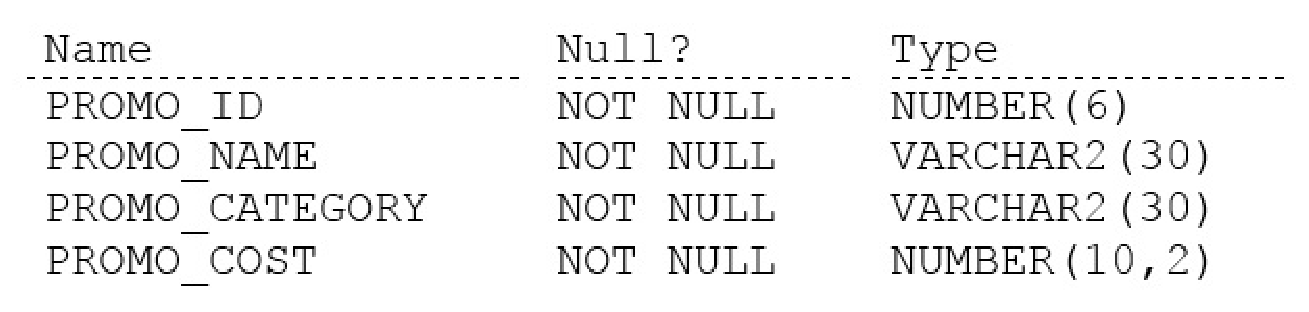
Examine the description of the PROMOTIONS table:

You want to display the unique promotion costs in each promotion category.

Which two queries can be used? (Choose two.)

Exhibit for question 1

  1. SELECT DISTINCT promo_category || ' has ' || promo_cost AS COSTS FROM promotions ORDER BY 1;
  2. SELECT DISTINCT promo_cost || ' in ' || DISTINCT promo_category FROM promotions ORDER BY 1;
  3. SELECT DISTINCT promo_category, promo_cost FROM promotions ORDER BY 1;
  4. SELECT promo_category DISTINCT promo_cost, FROM promotions ORDER BY 2;
  5. SELECT promo_cost, promo_category FROM promotions ORDER BY 1;
Show answer and explanation

Correct answer: A, C

A. SELECT DISTINCT promo_category || ' has ' || promo_cost AS COSTS FROM promotions ORDER BY 1; C. SELECT DISTINCT promo_category, promo_cost FROM promotions ORDER BY 1; Option A uses DISTINCT correctly at the beginning of the SELECT clause to eliminate duplicate combinations of promo_category and promo_cost, concatenating them with string literals for display. This properly shows unique promotion costs within each category. Option C also uses DISTINCT correctly to select and display both promo_category and promo_cost as separate columns, showing the unique combinations of these two fields. Both queries return the distinct relationships between promotion categories and their costs, which answers the requirement to display unique promotion costs in each category.

Why the other options are wrong

  • B. The DISTINCT keyword cannot be used in the middle of a concatenation expression; it must appear immediately after SELECT and before all column names.
  • D. The syntax is invalid; DISTINCT is placed incorrectly after the column name rather than after SELECT, and the comma placement is wrong.
  • E. This query lacks the DISTINCT keyword, so it will return all rows without eliminating duplicates, failing to show only the unique combinations of promotion costs and categories.

Question 2

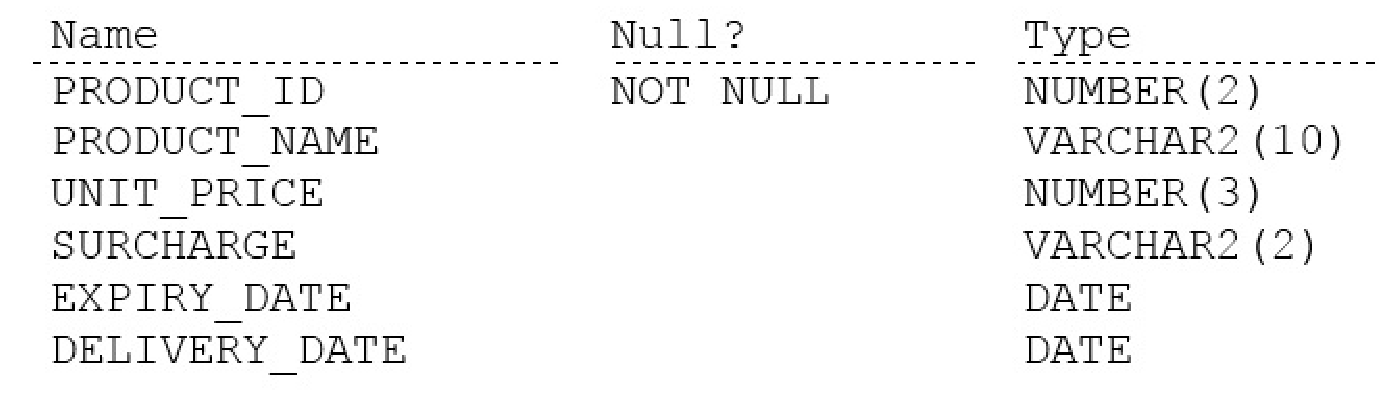
Examine the description of the PRODUCTS table:

Which three queries use valid expressions? (Choose three.)

Exhibit for question 2

  1. SELECT product_id, unit_price, S "Discount", unit_price + surcharge - discount FROM products;
  2. SELECT product_id, (unit_price * 0.15 / (4.75 + 552.25)) FROM products;
  3. SELECT product_id, (expiry_date - delivery_date) * 2 FROM products;
  4. SELECT product_id, unit_price || 5 "Discount", unit_price + surcharge - discount FROM products;
  5. SELECT product_id, expiry_date * 2 FROM products;
  6. SELECT product_id, unit_price, unit_price + surcharge FROM products; ✅Correct Answer: B, C, F
  7. SELECT product_id, (unit_price * 0.15 / (4.75 + 552.25)) FROM products;
  8. SELECT product_id, (expiry_date - delivery_date) * 2 FROM products;
  9. SELECT product_id, unit_price, unit_price + surcharge FROM products; Valid expressions must reference real columns and use operators the data types allow. B performs multiplication and division on numeric values, which is allowed. C subtracts one DATE from another to get a number of days and multiplies that result by 2, which is allowed. F adds UNIT_PRICE to SURCHARGE; SURCHARGE is VARCHAR2, but Oracle implicitly converts a numeric string to a number, so the expression is valid. The other three fail on column and data type rules: DISCOUNT is not a column of PRODUCTS, a column alias such as "Discount" cannot be reused elsewhere in the same SELECT list, S is not a column either, and a DATE value cannot be an operand of multiplication.
Show answer and explanation

The answer and explanation for this question are in the free sample PDF.

Question 3

What is true about non-equijoin statement performance? (Choose two.)

  1. The BETWEEN condition always performs less well than using the >= and <= conditions.
  2. The BETWEEN condition always performs better than using the >= and <= conditions.
  3. The Oracle join syntax performs better than the SQL:1999 compliant ANSI join syntax.
  4. Table aliases can improve performance.
  5. The join syntax used makes no difference to performance.
Show answer and explanation

Correct answer: D, E

D. Table aliases can improve performance. E. The join syntax used makes no difference to performance. Table aliases can improve performance by reducing parsing overhead and making queries more efficient. The join syntax used (Oracle vs ANSI) makes no difference to performance; the Oracle optimizer produces equivalent execution plans regardless of syntax style. BETWEEN and >= <= conditions perform equivalently when properly optimized.

Why the other options are wrong

  • A. BETWEEN and >= <= conditions perform identically when optimized by the Oracle engine.
  • B. BETWEEN does not inherently perform better than separate >= and <= conditions.
  • C. Oracle syntax and ANSI SQL:1999 syntax produce identical performance after optimization.

See all 10 free questions Get the full pack, US$39

272 practice questions for Oracle Database SQL Associate (1Z0-071), with full explanations.

Every question comes with the correct answer, the reasoning behind it, and a note on why each wrong option is wrong. Work through it once with the answers, then again with the questions-only copy under timed conditions.

  • 272 questions mapped to the 1Z0-071 exam objectives
  • Answers and explanations for every question, including the wrong options
  • A questions-only PDF for timed practice runs
  • Instant delivery by email the moment you check out
  • Free monthly updates for as long as the exam is live
  • Pass or your money back

A failed 1Z0-071 attempt costs US$245, plus the weeks it takes to get ready again. This pack is US$39, paid once, and refunded if you fail.

Try 10 questions free before you buy.

Last updated September 2026 · 272 questions

What makes the 1Z0-071 hard

The 1Z0-071 is the evergreen SQL exam: two decades of demand and still one of the highest-volume database certifications, because it is the standard proof of SQL for DBAs, developers and analysts alike.

It punishes approximate SQL. Candidates need to know exactly what a join returns with NULLs in play, single-row versus aggregate function behaviour, which subquery types are legal where, set operators, and the DDL and constraint questions: what happens to indexes and privileges when you drop and recreate them. People who write SQL daily still fail it, because production habits and Oracle’s precise semantics diverge in exactly the places the exam looks.

About the exam

1Z0-071 certifies Oracle SQL proficiency: queries, joins, subqueries, set operators, DML and DDL, and data dictionary basics, and awards the Oracle Database SQL Certified Associate credential. No prerequisites, and the certification does not expire.

Exam topics

  • SELECT, restricting and sorting data, single-row and conversion functions
  • Aggregates, joins and subqueries
  • Set operators and hierarchical retrieval
  • DML and transaction control
  • DDL: tables, constraints, views, sequences, indexes

78 questions, 120 minutes, passing score 63%, US$245 per attempt, at a Pearson VUE centre or online proctored, does not expire.
Reviews

There are no reviews yet.

Only logged in customers who have purchased this product may leave a review.

Questions before you buy

What do I get when I buy the Oracle 1Z0-071 pack?

272 practice questions as a PDF, each with the correct answer, a full explanation and a note on why the other options are wrong, plus a separate questions-only PDF for timed practice.

How quickly do I receive it?

Straight away. The full PDF and a questions-only copy are emailed to you the moment your payment goes through, and the same links are on your order page.

Is there a free sample?

Yes. Ten questions from this pack, with answers and explanations, are free on this page and as a PDF, so you can judge the quality before you pay.

Are updates included?

Yes. The pack is updated every month for as long as the exam is live, and updates are free for everyone who has bought it.

What if I fail the exam?

We refund the pack. Sit the exam 7 to 30 days after buying, then send your official score report within 7 days of the exam date, as set out in the refund policy.

Can I share it with colleagues?

Each purchase is licensed to one person. For a team, school or training organisation, email support@certstash.com for a licence that fits.