NVIDIA · NCP-AIO

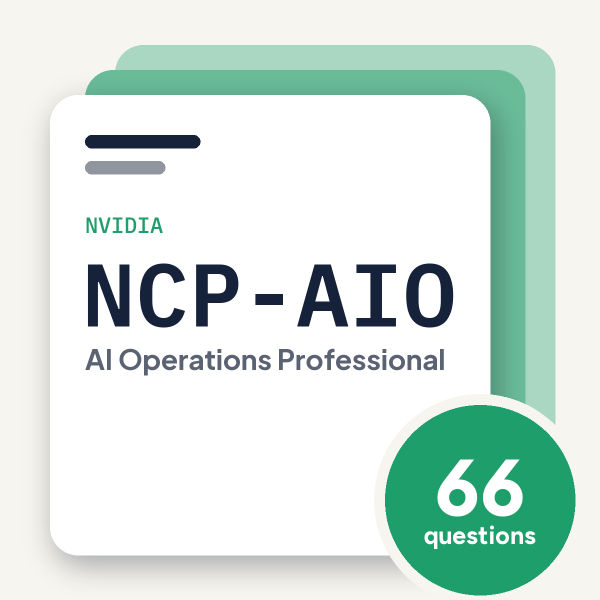
NVIDIA NCP-AIO Exam Practice Questions

66 questionsPDF by emailUpdated September 2026

US$39

Try 10 questions free

Card, Apple Pay or Google Pay. Your PDF is sent by email as soon as you check out.

Pass or your money backFail the exam after using this pack and we refund it. How the guarantee works
Category:
TRY BEFORE YOU BUY

Three of the 66 questions in this pack

Question 1

A Slurm user needs to submit a batch job script for execution tomorrow. Which command should be used to complete this task?

  1. sbatch -begin=tomorrow
  2. submit -begin=tomorrow
  3. salloc -begin=tomorrow
  4. srun -begin=tomorrow
Show answer and explanation

Correct answer: A. sbatch -begin=tomorrow

sbatch is the Slurm command for submitting batch job scripts for deferred execution. The --begin parameter (or -begin) allows users to specify when a job should start, including tomorrow or any future time. submit is not a valid Slurm command, salloc allocates resources interactively rather than submitting batch jobs, and srun executes commands directly without batch submission.

Why the other options are wrong

  • B. submit is not a valid Slurm command; Slurm uses sbatch for batch job submission.
  • C. salloc is used for interactive resource allocation, not batch job submission with deferred execution.
  • D. srun executes commands directly on allocated resources without submitting batch jobs to the queue.

Question 2

You are configuring networking for a new AI cluster in your data center. The cluster will handle large-scale distributed training jobs that require fast communication between servers. What type of networking architecture can maximize performance for these AI workloads?

  1. Implement a leaf-spine network topology using standard Ethernet switches to ensure scalability as more nodes are added.
  2. Prioritize out-of-band management networks over compute networks to ensure efficient job scheduling across nodes.
  3. Use standard Ethernet networking with a focus on increasing bandwidth through multiple connections per server.
  4. Use InfiniBand networking to provide low-latency, high-throughput communication between servers in the cluster.
Show answer and explanation

Correct answer: D. Use InfiniBand networking to provide low-latency, high-throughput communication between servers in the cluster.

high-throughput communication between servers in the cluster. InfiniBand networking provides the low-latency, high-throughput communication required for distributed AI training workloads where nodes need to exchange large amounts of data rapidly. InfiniBand's superior performance characteristics make it the optimal choice for AI clusters compared to standard Ethernet. While leaf-spine topology (option A) is a good architectural pattern, it applies to Ethernet networks. Out-of-band management networks (option B) are separate from compute networks and less critical than compute performance. Standard Ethernet with multiple connections (option C) cannot match InfiniBand's latency and throughput for this use case.

Why the other options are wrong

  • A. Leaf-spine topology with standard Ethernet is scalable but does not provide the low- latency, high-throughput performance needed for AI distributed training compared to InfiniBand.
  • B. Out-of-band management networks are administrative, not compute networks; prioritizing them over compute networks would harm AI workload performance.
  • C. Standard Ethernet with increased bandwidth cannot achieve the low-latency performance characteristics that InfiniBand provides for distributed AI training.

Question 3

A system administrator needs to optimize the delivery of their AI applications to the edge. What NVIDIA platform should be used?

  1. Base Command Platform
  2. Base Command Manager
  3. Fleet Command
  4. NetQ
Show answer and explanation

Correct answer: C. Fleet Command

Fleet Command is NVIDIA's platform specifically designed for deploying and managing AI applications at the edge. It provides orchestration, lifecycle management, and optimization of edge AI applications across distributed edge nodes. Base Command Platform and Manager are designed for data center-scale AI cluster management and job scheduling. NetQ is NVIDIA's network telemetry and management tool focused on network infrastructure monitoring.

Why the other options are wrong

  • A. Base Command Platform is for managing large-scale data center AI clusters, not edge deployment optimization.
  • B. Base Command Manager handles cluster resource management and job scheduling for data centers, not edge AI application delivery.
  • D. NetQ is a network visibility and telemetry tool for infrastructure monitoring, not an AI application delivery platform.

See all 10 free questions Get the full pack, US$39

66 practice questions for NVIDIA AI Operations Professional (NCP-AIO), with full explanations.

Every question comes with the correct answer, the reasoning behind it, and a short note on why each wrong option is wrong. Work through it once with the answers, then again with the questions-only copy under exam conditions.

  • 66 questions mapped to the NCP-AIO exam blueprint, across all four domains
  • Answers and explanations for every question, including why each wrong option is wrong
  • A questions-only PDF for timed practice runs
  • Instant delivery by email the moment you check out
  • Free monthly updates for as long as the exam is live
  • Pass or your money back

An NCP-AIO attempt costs US$500. This pack is US$39, paid once.

Try 10 questions free before you buy.

Last updated September 2026 · 66 questions

What makes the NCP-AIO hard

NCP-AIO is the day-two exam. Where NCP-AII asks whether you can build the cluster, AI Operations asks whether you can run it: provision it, schedule work on it, share the GPUs fairly, and fix it when Slurm, Kubernetes or a Fabric Manager service misbehaves. NVIDIA rebuilt the format in 2026: it is now 30 multiple-choice questions plus three hands-on lab exercises, all inside one 120-minute session, with the lab environment provisioned automatically when the exam starts. That makes it the only NVIDIA professional exam where you are marked on what you configure, not just what you know, and it is built around NVIDIA’s own management stack, so generic Kubernetes administration experience only gets you part of the way.

Installation and Deployment is the largest domain at 31%: installing and configuring Base Command Manager, initialising Kubernetes on NVIDIA hosts, deploying containers from NGC and cloud VMI images, storage requirements for AI data centres, and deploying DOCA services on BlueField DPU Arm cores. Administration, Workload Management, and Troubleshooting and Optimization are 23% each. Administration covers Fleet Command, Slurm cluster management, AI data centre architecture, BCM cluster provisioning, Run:ai administration and configuring Multi-Instance GPU for AI and HPC workloads.

Workload Management covers administering Kubernetes clusters, keeping workloads efficient through scheduling and quotas, and the system management tools used to resolve operational issues. Troubleshooting and Optimization covers Docker, the Fabric Manager service for NVLink and NVSwitch systems, Base Command Manager and the Magnum IO components, and GPU performance tuning. The multiple-choice half describes a job stuck in the queue or a node dropping out of the fabric and asks for the first diagnostic step; the lab half expects the commands to actually be run, so practise on a real cluster rather than just reading about one.

About the exam

NCP-AIO (NVIDIA-Certified Professional: AI Operations) is an intermediate-level certification validating the ability to administer, deploy, manage and troubleshoot NVIDIA AI infrastructure in data centre and edge environments: administration with BCM, Slurm, Run:ai and MIG, workload management on Kubernetes, installation and deployment, and troubleshooting and optimisation. NVIDIA recommends hands-on experience operating NVIDIA AI infrastructure.

Exam domains

  • Administration: 23%
  • Workload Management: 23%
  • Installation and Deployment: 31%
  • Troubleshooting and Optimization: 23%

30 multiple-choice questions plus 3 hands-on lab exercises, 120 minutes total, US$500 per attempt, online remote proctored through Certiverse. NVIDIA does not publish a passing score for this exam. Certification valid for two years.
Reviews

There are no reviews yet.

Only logged in customers who have purchased this product may leave a review.

Questions before you buy

What do I get when I buy the NVIDIA NCP-AIO pack?

66 practice questions as a PDF, each with the correct answer, a full explanation and a note on why the other options are wrong, plus a separate questions-only PDF for timed practice.

How quickly do I receive it?

Your PDF is prepared and sent to your email address after checkout, and you get a confirmation as soon as it is on its way.

Is there a free sample?

Yes. Ten questions from this pack, with answers and explanations, are free on this page and as a PDF, so you can judge the quality before you pay.

Are updates included?

Yes. The pack is updated every month for as long as the exam is live, and updates are free for everyone who has bought it.

What if I fail the exam?

We refund the pack. Sit the exam 7 to 30 days after buying, then send your official score report within 7 days of the exam date, as set out in the refund policy.

Can I share it with colleagues?

Each purchase is licensed to one person. For a team, school or training organisation, email support@certstash.com for a licence that fits.