AWS · SOA-C03

AWS SOA-C03 Exam Practice Questions

200 questionsPDF by emailUpdated September 2026

US$39

Try 10 questions free

Card, Apple Pay or Google Pay. Your PDF is sent by email as soon as you check out.

Pass or your money backFail the exam after using this pack and we refund it. How the guarantee works
Category:
TRY BEFORE YOU BUY

Three of the 200 questions in this pack

Question 1

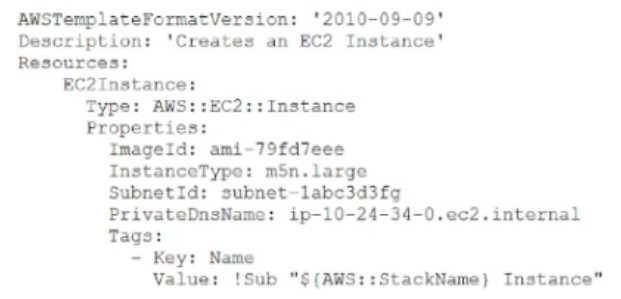
A CloudOps engineer is examining the following AWS CloudFormation template: Why will the stack creation fail?

Exhibit for question 1

  1. The Outputs section of the CloudFormation template was omitted.
  2. The Parameters section of the CloudFormation template was omitted.
  3. The PrivateDnsName cannot be sot from a CloudFormation template.
  4. The VPC was not specified in the CloudFormation template.
Show answer and explanation

Correct answer: C. The PrivateDnsName cannot be sot from a CloudFormation template.

CloudFormation template. The PrivateDnsName is not a valid property that can be set directly in a CloudFormation EC2 instance resource definition. PrivateDnsName is an attribute that is automatically assigned by AWS when an EC2 instance is launched within a VPC with DNS hostnames enabled, but it cannot be explicitly configured as a property in the template. This will cause the stack creation to fail because CloudFormation will reject the unknown property.

Why the other options are wrong

  • A. The Outputs section is optional in CloudFormation templates and its omission does not cause stack creation to fail.
  • B. The Parameters section is optional in CloudFormation templates and is not required for stack creation to succeed.
  • D. A VPC is not required to be explicitly specified in the template; if omitted, the instance will be launched in the default VPC.

Question 2

A company applies user-defined tags to resources that are associated with the company's AWS workloads. Twenty days after applying the tags, the company notices that it cannot use the tags to filter views in the AWS Cost Explorer console. What is the reason for this issue?

  1. It takes at least 30 days to be able to use tags to filter views in Cost Explorer.
  2. The company has not activated the user-defined tags for cost allocation.
  3. The company has not created an AWS Cost and Usage Report.
  4. The company has not created a usage budget in AWS Budgets.
Show answer and explanation

Correct answer: B. The company has not activated the user-defined tags for cost allocation.

for cost allocation. User-defined tags must be explicitly activated for cost allocation in AWS before they can be used to filter views in Cost Explorer. By default, tags are created but not enabled for cost allocation purposes. The activation process takes some time to propagate through the billing system, which is why tags applied 20 days ago are still not appearing as filter options. Once activated, tags typically become available within 24 hours.

Why the other options are wrong

  • A. While Cost Explorer data is delayed, tags can be activated and used much sooner than 30 days if they are properly enabled.
  • C. AWS Cost and Usage Reports are separate from tag activation and not required to use tags in Cost Explorer filtering.
  • D. AWS Budgets are independent of tag activation and do not control tag availability in Cost Explorer.

Question 3

An environment consists of 100 Amazon EC2 Windows instances. The Amazon CloudWatch agent is deployed and running on all EC2 instances with a baseline configuration file to capture log files. There is a new requirement to capture the DHCP log files that exist on 50 of the instances. What is the MOST operationally efficient way to meet this new requirement?

  1. Create an additional CloudWatch agent configuration filo to capture the DHCP logs. Use the AWS Systems Manager Run Command to restart the CloudWatch agent on each EC2 instance with the append-config option to apply the additional configuration file.
  2. Log in to each EC2 instance with administrator rights. Create a PowerShell script to push the needed baseline log files and DHCP log files to CloudWatch.
  3. Run the CloudWatch agent configuration file wizard on each EC2 instance. Verify that the baseline log files are included and add the DHCP log files during the wizard creation process.
  4. Run the CloudWatch agent configuration file wizard on each EC2 instance and select the advanced detail level. This will capture the operating system log files.
Show answer and explanation

Correct answer: A. Create an additional CloudWatch agent configuration filo to capture the DHCP logs. Use the AWS Systems Manager Run Command to restart the CloudWatch agent on each EC2 instance with the append-config option to apply the additional configuration file.

filo to capture the DHCP logs. Use the AWS Systems Manager Run Command to restart the CloudWatch agent on each EC2 instance with the append-config option to apply the additional configuration file. The most operationally efficient approach is to create an additional configuration file for DHCP logs and use AWS Systems Manager Run Command with the append-config option to apply it to the 50 instances. This method avoids manual intervention on each instance, preserves the existing baseline configuration, and leverages automation at scale. The append-config option allows you to add new log sources without overwriting the existing configuration.

Why the other options are wrong

  • B. Manually logging into each of 50 instances and creating custom PowerShell scripts is not operationally efficient and does not scale well.
  • C. Running the configuration wizard on each of 50 instances is time-consuming and manual, lacking operational efficiency compared to Systems Manager automation.
  • D. The advanced detail level of the wizard does not specifically target DHCP logs and would not be a precise solution to the stated requirement.

See all 10 free questions Get the full pack, US$39

200 practice questions for AWS Certified CloudOps Engineer, Associate (SOA-C03), with full explanations.

Every question comes with the correct answer, the reasoning behind it, and a note on why each wrong option is wrong. Work through it once with the answers, then again with the questions-only copy under exam conditions.

  • 200 questions across all five SOA-C03 domains
  • Answers and explanations for every question, including the wrong options
  • A questions-only PDF for timed practice runs
  • Instant delivery by email the moment you check out
  • Free monthly updates for as long as the exam is live
  • Pass or your money back

A failed SOA-C03 attempt costs another US$150. This pack is US$39, paid once, and refunded if you fail.

Try 10 questions free before you buy.

Last updated September 2026 · 200 questions

What makes the SOA-C03 hard

SysOps Administrator is gone: SOA-C02 retired in September 2025, and SOA-C03 relaunched the certification as CloudOps Engineer, pulling containers and roughly twenty-five new services into scope. Older SysOps banks now miss practice questions.

The exam thinks like a two a.m. pager: an Auto Scaling group that will not scale in, a private-subnet instance that cannot reach S3, a CloudWatch alarm that never fired, what broke and what is the least-effort fix. ECS and EKS operations are now explicitly tested, alongside Systems Manager automation, EventBridge remediation and multi-account patterns; there are no labs, SOA-C03 is question-only. Three domains tie at 22% each, so there is nowhere to hide a weak area.

About the exam

SOA-C03 certifies deploying, managing and operating workloads on AWS: monitoring, remediation, reliability, automation, security and networking operations. It replaced SysOps Administrator (SOA-C02, retired September 2025). Valid for three years.

Exam domains

  • Monitoring, logging, analysis, remediation, and performance optimisation: 22%
  • Reliability and business continuity: 22%
  • Deployment, provisioning, and automation: 22%
  • Security and compliance: 16%
  • Networking and content delivery: 18%

65 questions (50 scored plus 15 unscored), 130 minutes, pass mark 720 out of 1000, US$150 per attempt, Pearson VUE or online proctored, valid for three years.
Reviews

There are no reviews yet.

Only logged in customers who have purchased this product may leave a review.

Questions before you buy

What do I get when I buy the AWS SOA-C03 pack?

200 practice questions as a PDF, each with the correct answer, a full explanation and a note on why the other options are wrong, plus a separate questions-only PDF for timed practice.

How quickly do I receive it?

Your PDF is prepared and sent to your email address after checkout, and you get a confirmation as soon as it is on its way.

Is there a free sample?

Yes. Ten questions from this pack, with answers and explanations, are free on this page and as a PDF, so you can judge the quality before you pay.

Are updates included?

Yes. The pack is updated every month for as long as the exam is live, and updates are free for everyone who has bought it.

What if I fail the exam?

We refund the pack. Sit the exam 7 to 30 days after buying, then send your official score report within 7 days of the exam date, as set out in the refund policy.

Can I share it with colleagues?

Each purchase is licensed to one person. For a team, school or training organisation, email support@certstash.com for a licence that fits.