MICROSOFT · DP-300

Microsoft DP-300 Exam Practice Questions

373 questionsInstant PDF downloadUpdated September 2026

US$39

Try 10 questions free

Card, Apple Pay or Google Pay. Your PDF is sent by email as soon as you check out.

Pass or your money backFail the exam after using this pack and we refund it. How the guarantee works
Category:
TRY BEFORE YOU BUY

Three of the 373 questions in this pack

Question 1

You have 20 Azure SQL databases provisioned by using the vCore purchasing model. You plan to create an Azure SQL Database elastic pool and add the 20 databases. Which three metrics should you use to size the elastic pool to meet the demands of your workload? Each correct answer presents part of the solution. NOTE: Each correct selection is worth one point.

  1. total size of all the databases
  2. geo-replication support
  3. number of concurrently peaking databases * peak CPU utilization per database
  4. maximum number of concurrent sessions for all the databases
  5. total number of databases * average CPU utilization per database
Show answer and explanation

Correct answer: A, C, E

A. total size of all the databases C. number of concurrently peaking databases * peak CPU utilization per database E. total number of databases * average CPU utilization per database To properly size an Azure SQL Database elastic pool, you need three key metrics: A) the total size of all databases to determine storage requirements, C) the number of concurrently peaking databases multiplied by peak CPU utilization per database to understand peak computational demand, and E) the total number of databases multiplied by average CPU utilization per database to understand baseline resource consumption. These three metrics together provide the storage, peak load, and average load dimensions needed for accurate pool sizing.

Why the other options are wrong

  • B. Geo-replication support is a feature configuration, not a sizing metric for the elastic pool itself.
  • D. While concurrent sessions matter for capacity planning, the specific metric of maximum concurrent sessions for all databases is less relevant than CPU utilization metrics for elastic pool sizing.

Question 2

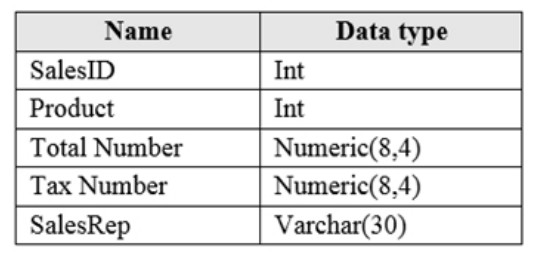
You have an Azure SQL database that contains a table named factSales. FactSales contains the columns shown in the following table. FactSales has 6 billion rows and is loaded nightly by using a batch process. You must provide the greatest reduction in space for the database and maximize performance. Which type of compression provides the greatest space reduction for the database?

Exhibit for question 2

  1. page compression
  2. row compression
  3. columnstore compression
  4. columnstore archival compression
Show answer and explanation

Correct answer: D. columnstore archival compression

Columnstore archival compression provides the greatest space reduction for large fact tables in data warehouse scenarios. Given that factSales contains 6 billion rows and is batch-loaded nightly (typical data warehouse pattern), columnstore archival compression is optimal. It combines columnstore storage format with additional compression algorithms, achieving 10x or greater compression ratios compared to other methods. While columnstore compression alone (option C) offers significant benefits, archival compression adds an extra compression layer specifically designed for read-heavy, batch-loaded analytical tables, making it the best choice for maximum space reduction.

Why the other options are wrong

  • A. Page compression provides moderate space reduction (typically 50-80%) but is far less effective than columnstore archival compression for large analytical tables with billions of rows.
  • B. Row compression is the most basic compression type, offering minimal space reduction (typically 10-20%) and is least suitable for a 6 billion row fact table.
  • C. Columnstore compression offers excellent compression ratios but columnstore archival compression builds upon it with additional compression techniques, providing even greater reduction for batch-loaded data warehouses.

Question 3

You have a Microsoft SQL Server 2019 database named DB1 that uses the following database-level and instance-level features. • Clustered columnstore indexes • Automatic tuning • Change tracking • PolyBase You plan to migrate DB1 to an Azure SQL database. What feature should be removed or replaced before DB1 can be migrated?

  1. Clustered columnstore indexes
  2. PolyBase
  3. Change tracking
  4. Automatic tuning
Show answer and explanation

Correct answer: B. PolyBase

PolyBase must be removed before migration to Azure SQL Database because Azure SQL Database does not support PolyBase functionality. Clustered columnstore indexes, automatic tuning, and change tracking are all supported features in Azure SQL Database, so they can remain in place during migration.

Why the other options are wrong

  • A. Clustered columnstore indexes are fully supported in Azure SQL Database.
  • C. Change tracking is a supported feature in Azure SQL Database and does not need to be removed.
  • D. Automatic tuning is supported in Azure SQL Database and can be migrated without modification.

See all 10 free questions Get the full pack, US$39

373 practice questions for Microsoft Certified: Azure Database Administrator Associate (DP-300), with full explanations.

Every question comes with the correct answer, the reasoning behind it, and a note on why each wrong option is wrong. Work through it once with the answers, then again with the questions-only copy under exam conditions.

  • 373 questions mapped to the DP-300 exam objectives
  • Answers and explanations for every question, including the wrong options
  • A questions-only PDF for timed practice runs
  • Instant delivery by email the moment you check out
  • Free monthly updates for as long as the exam is live
  • Pass or your money back

Fail the DP-300 and it costs another US$165. This pack is US$39, paid once, and refunded if you fail.

Try 10 questions free before you buy.

Last updated September 2026 · 373 questions Aligned to the 24 April 2026 blueprint.

What makes the DP-300 hard

DP-300 is a DBA exam wearing a cloud costume, and it punishes both directions: on-premises DBAs who do not know the Azure deployment options, and cloud specialists who have never tuned a query plan.

The exam’s favourite fork is deployment choice: Azure SQL Database versus Managed Instance versus SQL Server on a VM, and which service tier survives the scenario’s HA/DR requirement. It also goes deep on execution plans and index tuning, Query Store, deadlock diagnosis, automated backup chains, failover groups versus availability groups versus active geo-replication, and the security stack from TDE to Always Encrypted.

Three domains carry 20 to 25% each, securing the environment, performance monitoring and optimisation, and high availability and disaster recovery, so the exam is far more evenly balanced than the job title suggests. This pack has 373 practice questions for the DP-300, including the HA/DR and performance scenarios that decide it.

About the exam

DP-300 certifies administering SQL Server database infrastructure on Azure: deployment, security, monitoring, performance optimisation, automation, and high availability and disaster recovery. Skills measured as of 24 April 2026. Renews annually via a free online assessment.

Exam domains

  • Plan and implement data platform resources: 15 to 20%
  • Implement a secure environment: 20 to 25%
  • Monitor, configure, and optimize database resources: 20 to 25%
  • Configure and manage automation of tasks: 15 to 20%
  • Plan and configure a high availability and disaster recovery environment: 20 to 25%

Around 40 to 60 questions, 100 minutes, pass mark 700 out of 1000, US$165 in the US, priced by local currency elsewhere, online proctored or test centre, renews annually for free.
Reviews

There are no reviews yet.

Only logged in customers who have purchased this product may leave a review.

Questions before you buy

What do I get when I buy the Microsoft DP-300 pack?

373 practice questions as a PDF, each with the correct answer, a full explanation and a note on why the other options are wrong, plus a separate questions-only PDF for timed practice.

How quickly do I receive it?

Straight away. The full PDF and a questions-only copy are emailed to you the moment your payment goes through, and the same links are on your order page.

Is there a free sample?

Yes. Ten questions from this pack, with answers and explanations, are free on this page and as a PDF, so you can judge the quality before you pay.

Are updates included?

Yes. The pack is updated every month for as long as the exam is live, and updates are free for everyone who has bought it.

What if I fail the exam?

We refund the pack. Sit the exam 7 to 30 days after buying, then send your official score report within 7 days of the exam date, as set out in the refund policy.

Can I share it with colleagues?

Each purchase is licensed to one person. For a team, school or training organisation, email support@certstash.com for a licence that fits.