
DATABRICKS · Machine Learning Professional

Databricks Machine Learning Professional Exam Practice Questions

216 questionsPDF by emailUpdated September 2026

US$39

Try 10 questions free

Card, Apple Pay or Google Pay. Your PDF is sent by email as soon as you check out.

Pass or your money backFail the exam after using this pack and we refund it. How the guarantee works
Category:
TRY BEFORE YOU BUY

Three of the 216 questions in this pack

Question 1

Which of the following describes concept drift?

  1. Concept drift is when there is a change in the distribution of an input variable
  2. Concept drift is when there is a change in the distribution of a target variable
  3. Concept drift is when there is a change in the relationship between input variables and target variables
  4. Concept drift is when there is a change in the distribution of the predicted target given by the model
  5. None of these describe Concept drift
Show answer and explanation

Correct answer: C. Concept drift is when there is a change in the relationship between input variables and target variables

relationship between input variables and target variables Concept drift occurs when the underlying relationship between input features and the target variable changes over time, even if the distributions of individual variables remain constant. This is fundamentally different from feature drift (changes in input distributions) or label drift (changes in target distribution). The model's decision boundaries or the predictive pattern becomes invalid as the relationship shifts.

Why the other options are wrong

  • A. This describes feature drift, not concept drift.
  • B. This describes label drift or target drift, not concept drift.
  • D. Changes in predictions alone do not define concept drift; predictions change as a symptom when concept drift occurs.
  • E. Option C correctly describes concept drift.

Question 2

A machine learning engineer is monitoring categorical input variables for a production machine learning application. The engineer believes that missing values are becoming more prevalent in more recent data for a particular value in one of the categorical input variables. Which of the following tools can the machine learning engineer use to assess their theory?

  1. Kolmogorov-Smirnov (KS) test
  2. One-way Chi-squared Test
  3. Two-way Chi-squared Test
  4. Jenson-Shannon distance
  5. None of these
Show answer and explanation

Correct answer: B. One-way Chi-squared Test

A one-way Chi-squared test is appropriate for testing whether the distribution of a single categorical variable has changed over time. The engineer can create a contingency table comparing the frequency of each categorical value (including missing values) between recent and historical data, then apply the Chi-squared test to determine if the distributions differ significantly.

Why the other options are wrong

  • A. The Kolmogorov-Smirnov test is designed for continuous numeric distributions, not categorical data.
  • C. A two-way Chi-squared test is used when examining the relationship between two categorical variables, but here we're monitoring one variable across time periods.
  • D. Jensen-Shannon distance measures distributional divergence but is typically applied to numeric or probability distributions, not categorical missing value patterns.
  • E. Option B is appropriate for this task.

Question 3

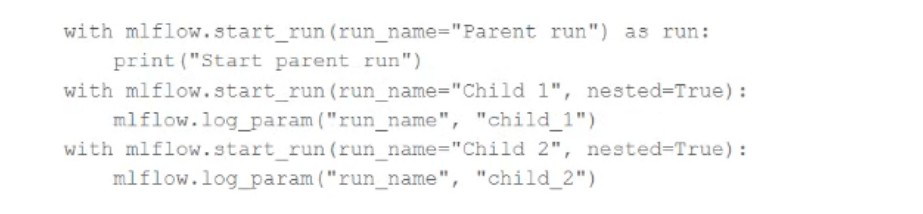
A data scientist is using MLflow to track their machine learning experiment. As a part of each MLflow run, they are performing hyperparameter tuning. The data scientist would like to have one parent run for the tuning process with a child run for each unique combination of hyperparameter values. They are using the following code block: The code block is not nesting the runs in MLflow as they expected. Which of the following changes does the data scientist need to make to the above code block so that it successfully nests the child runs under the parent run in MLflow?

Exhibit for question 3

  1. Indent the child run blocks within the parent run block
  2. Add the nested=True argument to the parent run
  3. Remove the nested=True argument from the child runs
  4. Provide the same name to the run_name parameter for all three run blocks
  5. Add the nested=True argument to the parent run and remove the nested=True arguments from the child runs
Show answer and explanation

Correct answer: A. Indent the child run blocks within the parent run block

block In MLflow, nested runs are created through code indentation within the parent run's context manager. The child runs must be indented inside the parent run's `with` block to establish the parent-child relationship. The `nested=True` parameter on child runs is actually unnecessary and can be omitted since nesting is determined by the contextual hierarchy of the `with` statements. The current code shows the child run blocks at the same indentation level as the parent run's print statement, placing them outside the parent run's scope, which prevents proper nesting. Moving the child run blocks to be indented within the parent run's context manager will establish the correct hierarchical relationship.

Why the other options are wrong

  • B. Adding nested=True to the parent run does nothing to establish nesting; the parent run doesn't need this parameter.
  • C. Removing nested=True from child runs alone without indenting them within the parent context will not create the nesting structure.
  • D. Using the same run_name for all three runs would create conflicts and confusion in tracking, not establish nesting relationships.
  • E. While removing nested=True from child runs is harmless, adding it to the parent run is unnecessary and incorrect; only proper indentation is needed.

See all 10 free questions Get the full pack, US$39

216 practice questions for Databricks Certified Machine Learning Professional, with full explanations.

Every question comes with the correct answer, the reasoning behind it, and a short note on why each wrong option is wrong. Work through it once with the answers, then again with the questions-only copy under exam conditions.

  • 216 questions mapped to the Machine Learning Professional exam guide
  • Answers and explanations for every question, including the wrong options
  • A questions-only PDF for timed practice runs
  • Instant delivery by email the moment you check out
  • Free monthly updates for as long as the exam is live
  • Pass or your money back

A Machine Learning Professional attempt costs US$200. This pack is US$39, paid once.

Try 10 questions free before you buy.

Last updated September 2026 · 216 questions

What makes the Machine Learning Professional exam hard

Machine Learning Professional is widely called the hardest of the Databricks exams, and the rebuilt guide made that reputation official: it collapsed the old four domains into three and put 88% of the marks on model development and MLOps in equal halves.

The format is 59 scored questions in 120 minutes, all Python, and the questions assume a candidate has taken a model from a notebook to a monitored production endpoint more than once.

Model Development covers when Spark ML beats single-node frameworks, distributed hyperparameter tuning with Optuna and Hyperopt, Pandas UDFs for parallel training, and advanced feature engineering. MLOps covers MLflow at depth: experiments, model signatures, the Unity Catalog model registry, model lineage, Lakeflow Jobs for retraining, CI/CD for ML code, and Lakehouse Monitoring for drift. Model Deployment at 12% covers batch, streaming and Model Serving with traffic splitting. The questions are long scenarios with code, and the wrong options usually work at small scale and fail in production.

About the exam

The Databricks Certified Machine Learning Professional validates advanced machine learning engineering on the Databricks Data Intelligence Platform: scalable model development, MLOps with MLflow, Unity Catalog and Lakehouse Monitoring, and model deployment. There are no formal prerequisites; Databricks recommends the Machine Learning Associate and at least a year of hands-on ML engineering on Databricks.

Exam domains

  • Model Development: 44%
  • MLOps: 44%
  • Model Deployment: 12%

59 scored multiple choice questions, 120 minutes, passing score not published by Databricks (commonly cited as 70%), US$200 per attempt, online proctored or test centre, certification valid for two years.

Reviews

There are no reviews yet.

Only logged in customers who have purchased this product may leave a review.

Questions before you buy

What do I get when I buy the Databricks Machine Learning Professional pack?

216 practice questions as a PDF, each with the correct answer, a full explanation and a note on why the other options are wrong, plus a separate questions-only PDF for timed practice.

How quickly do I receive it?

Your PDF is prepared and sent to your email address after checkout, and you get a confirmation as soon as it is on its way.

Is there a free sample?

Yes. Ten questions from this pack, with answers and explanations, are free on this page and as a PDF, so you can judge the quality before you pay.

Are updates included?

Yes. The pack is updated every month for as long as the exam is live, and updates are free for everyone who has bought it.

What if I fail the exam?

We refund the pack. Sit the exam 7 to 30 days after buying, then send your official score report within 7 days of the exam date, as set out in the refund policy.

Can I share it with colleagues?

Each purchase is licensed to one person. For a team, school or training organisation, email support@certstash.com for a licence that fits.