
10 free Splunk SPLK-1002 practice questions with the correct answer and a full explanation for each, taken from the CertStash pack of 234 questions. Work through them, then open each answer to check your reasoning.
Get all 234 questions (US$39) · Download these 10 as a PDF
Question 1
Which one of the following statements about the search command is true?
Show answer and explanation
Correct answer: D. It behaves exactly like search strings before the first pipe.
The search command behaves exactly like search strings before the first pipe. In Splunk, everything before the first pipe is implicitly a search command, so `search field=value` is equivalent to just `field=value`. The search command allows wildcards, is case-insensitive by default, and can appear anywhere in the pipeline, not just at the beginning.
Why the other options are wrong
- A. The search command does allow wildcards such as * and ?
- B. The search command is case-insensitive by default unless specified otherwise
- C. The search command can be used anywhere in the pipeline, not just at the beginning
Question 2
Which of the following actions can the eval command perform?
Show answer and explanation

Question 3
When can a pipe follow a macro?
Show answer and explanation
Correct answer: A. A pipe may always follow a macro.
A pipe may always follow a macro in Splunk. Macros are designed to be reusable components that can be placed anywhere in the search pipeline and extended with additional commands via pipes. There are no restrictions based on ownership, app definition, or sharing settings that would prevent a pipe from following a macro.
Why the other options are wrong
- B. Ownership of the macro is not a requirement for using a pipe after it
- C. The macro does not need to be defined in the current app; it can be shared across apps
- D. Sharing settings do not restrict the ability to pipe after a macro
Question 4
Data models are composed of one or more of which of the following datasets? (Choose all that apply.)
Show answer and explanation

Question 5
When using the Field Extractor (FX), which of the following delimiters will work? (Choose all that apply.)
Show answer and explanation
Correct answer: A, B, D
A. Tabs B. Pipes D. Spaces The Field Extractor's delimiter-based extraction splits structured events on a chosen separator. The supported choices include space, comma, tab, pipe, semicolon, and a custom character, so tabs, pipes, and spaces all work as delimiters.
Why the other options are wrong
- C. Colons are not one of the Field Extractor delimiter choices
Question 6
Which group of users would most likely use pivots?
Show answer and explanation
Correct answer: A. Users
Pivots are primarily used by general Users who need to perform ad-hoc data analysis and create visual summaries without writing SPL. Pivots provide a user-friendly interface for exploring data from data models. While other roles may use pivots, regular Users represent the primary audience for this feature's design and functionality.
Why the other options are wrong
- B. Architects typically work at a higher level designing data models rather than using pivots for analysis
- C. Administrators focus on system configuration and maintenance rather than exploratory data analysis
- D. Knowledge Managers create and maintain knowledge objects but are not the primary pivot users
Question 7
When multiple event types with different color values are assigned to the same event, what determines the color displayed for the event?
Show answer and explanation
Correct answer: C. Priority
When multiple event types with different color values are assigned to the same event, the Priority value determines which color is displayed. Priority is the distinguishing factor in Splunk's event correlation and display logic that controls the visual representation when conflicts occur.
Why the other options are wrong
- A. Rank does not determine event color display in Splunk
- B. Weight does not determine event color display in Splunk
- D. Precedence is not the correct terminology; Priority is used in Splunk
Question 8
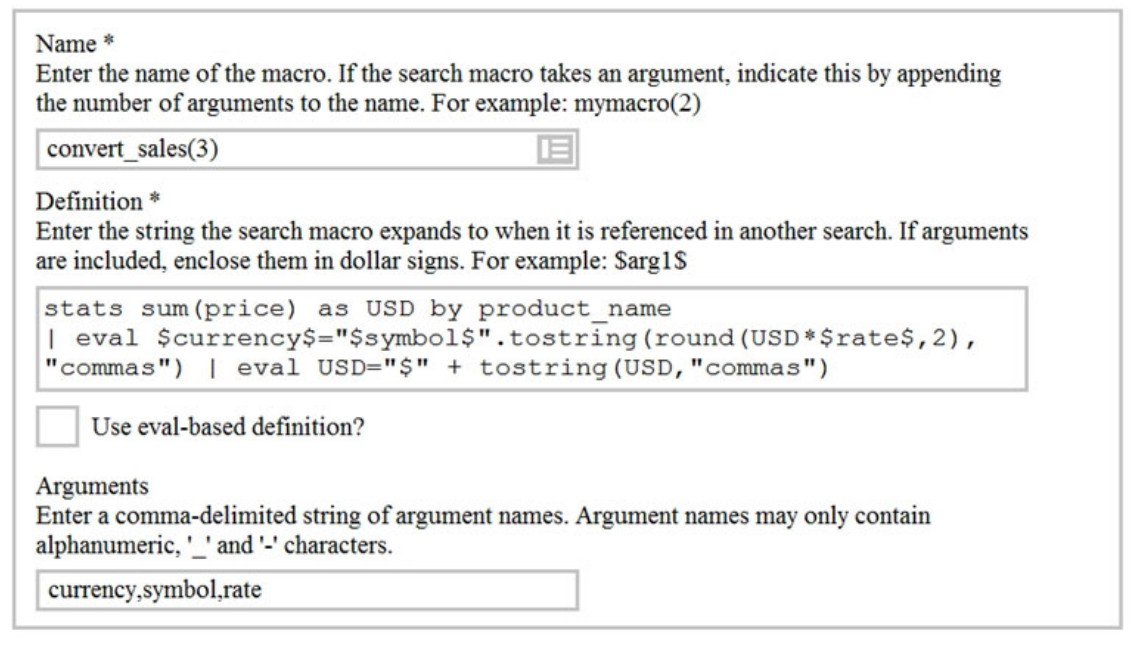
Based on the macro definition shown below, what is the correct way to execute the macro in a search string?
Show answer and explanation
Correct answer: B. 'convert_sales(euro,79.,¬‚ג)'
Dollar signs appear only in the macro definition, where they mark placeholders such as $currency$, $symbol$, and $rate$. To execute a three-argument macro you enclose the reference in the macro quoting characters and pass the literal argument values in order, separated by commas, with no dollar signs around them. Option B shows that form: the macro name, the three plain values in parentheses, and the surrounding single quote style reference characters.
Why the other options are wrong
- A. Double quotes do not invoke a macro; they are read as a literal string.
- C. Double quotes do not invoke a macro, and the dollar signs belong in the definition only.
- D. The quoting is right, but dollar signs mark placeholders in the definition, not values in the call.
Question 9
There are several ways to access the field extractor.
Which option automatically identifies the data type, source type, and sample event?
Show answer and explanation
Correct answer: A. Event Actions > Extract Fields
Accessing the Field Extractor through Event Actions > Extract Fields automatically identifies the data type, source type, and sample event based on the context of the selected event. This method is specifically designed to streamline the field extraction process by pre-populating metadata. Other access methods require manual configuration of these parameters.
Why the other options are wrong
- B. The Fields sidebar method requires more manual configuration and doesn't automatically pre-populate metadata
- C. Settings access point doesn't automatically identify and populate the event context
- D. Settings access point doesn't automatically identify and populate the event context
Question 10
Which of the following statements would help a user choose between the transaction and stats commands?
Show answer and explanation
Correct answer: C. There is a 1000 event limitation with the transaction command.
The transaction command has a default limitation of 1000 events, which is an important practical constraint users need to be aware of when deciding between transaction and stats commands. This limitation distinguishes when stats might be more appropriate for larger datasets. The transaction command groups related events into single correlated events based on field values, while stats performs aggregations and calculations without this 1000-event constraint.
Why the other options are wrong
- A. Stats can group events by multiple fields and criteria, not just IP addresses.
- B. The transaction command is typically less efficient than stats due to event grouping overhead.
- D. This describes the transaction command's purpose, not a distinguishing factor for choosing between them.
That was 10 of 234.
The full Splunk SPLK-1002 pack has all 234 questions, each with the answer, the explanation and why the other options are wrong, plus a questions-only copy for timed runs. US$39, paid once, with free monthly updates and a pass-or-your-money-back guarantee.