DATABRICKS · Data Engineer Associate

Databricks Data Engineer Associate Exam Practice Questions

280 questionsPDF by emailUpdated September 2026

US$39

Try 10 questions free

Card, Apple Pay or Google Pay. Your PDF is sent by email as soon as you check out.

Pass or your money backFail the exam after using this pack and we refund it. How the guarantee works
Category:
TRY BEFORE YOU BUY

Three of the 280 questions in this pack

Question 1

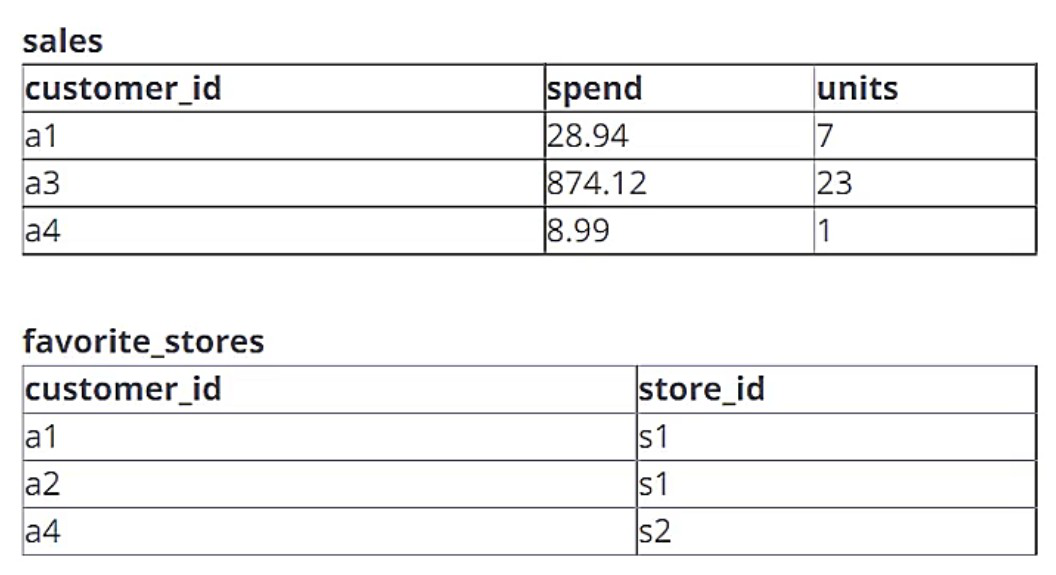
A data engineer is working with two tables. Each of these tables is displayed below in its entirety.

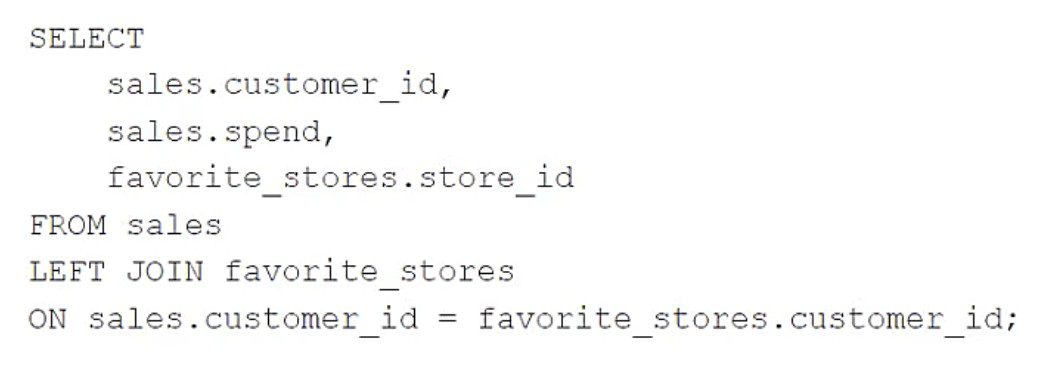
The data engineer runs the following query to join these tables together:

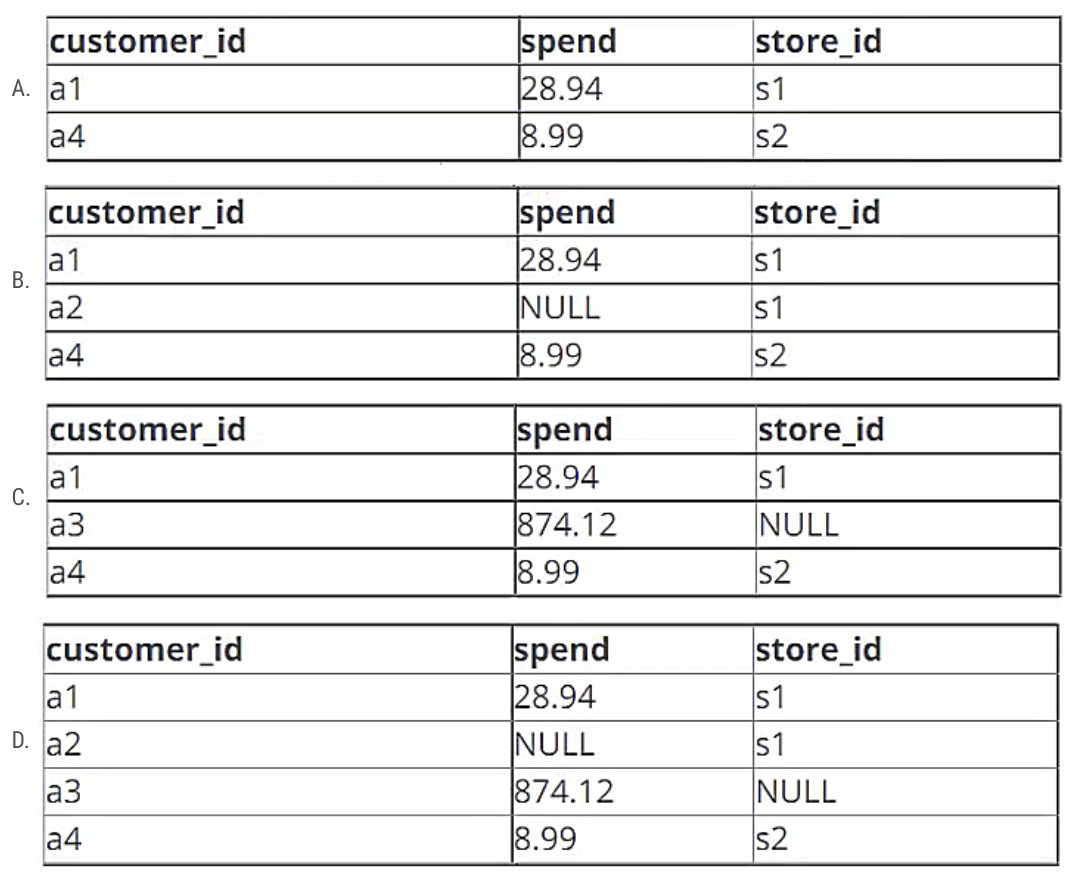
Which of the following will be returned by the above query?

Exhibit for question 1

Exhibit for question 1

Exhibit for question 1

Show answer and explanation

Correct answer: C. customer_id: a1, a3, a4 | spend: 28.94, 874.12, 8.99 |

store_id: s1, NULL, s2 A LEFT JOIN returns all rows from the left table (sales) with matching rows from the right table (favorite_stores). The sales table contains customers a1, a3, and a4. Customer a1 matches with store s1 in favorite_stores. Customer a3 has no match in favorite_stores, so store_id is NULL. Customer a4 matches with store s2. The result preserves all three customers from the sales table with their corresponding spend values and store information (NULL where no match exists).

Why the other options are wrong

  • A. Option A incorrectly excludes customer a3, which should appear in the result because LEFT JOIN includes all rows from the left table regardless of match status.
  • B. Option B incorrectly includes customer a2 from the favorite_stores table, but a2 does not exist in the sales table, so it should not appear in a LEFT JOIN result.
  • D. Option D incorrectly includes customer a2, which only exists in favorite_stores but not in the sales table; a LEFT JOIN includes all left table rows, not right table rows without matches.

Question 2

Which of the following benefits is provided by the array functions from Spark SQL?

  1. An ability to work with data in a variety of types at once
  2. An ability to work with data within certain partitions and windows
  3. An ability to work with time-related data in specified intervals
  4. An ability to work with complex, nested data ingested from JSON files
Show answer and explanation

Correct answer: D. An ability to work with complex, nested data ingested from JSON files

from JSON files Array functions in Spark SQL are specifically designed to work with complex, nested data structures commonly found in JSON files. They enable operations on array columns and nested JSON objects, allowing users to manipulate hierarchical data directly within SQL queries without flattening the structure.

Why the other options are wrong

  • A. Array functions don't provide the ability to work with multiple data types simultaneously; they specifically target array and nested structures.
  • B. Window functions and partition operations are separate Spark SQL capabilities, not array functions.
  • C. Time-interval operations are handled by date/time functions, not array functions.

Question 3

Which of the following is hosted completely in the control plane of the classic Databricks architecture?

  1. Worker node
  2. JDBC data source
  3. Databricks web application
  4. Databricks Filesystem
  5. Driver node
Show answer and explanation

Correct answer: C. Databricks web application

The Databricks web application is a user-facing interface hosted entirely within the control plane. It provides the notebook editor, workspace management, job scheduling, and administrative features. All other options either reside in the data plane (worker and driver nodes) or are external data sources/storage systems.

Why the other options are wrong

  • A. Worker nodes are part of the data plane, not the control plane.
  • B. JDBC data sources are external systems outside the Databricks architecture.
  • D. Databricks Filesystem spans both control and data plane components.
  • E. The driver node is part of the data plane cluster, not the control plane.

See all 10 free questions Get the full pack, US$39

280 practice questions for the Databricks Certified Data Engineer Associate, with full explanations.

Every question comes with the correct answer, the reasoning behind it, and a short note on why each wrong option is wrong. Work through it once with the answers, then again with the questions-only copy under exam conditions.

  • 280 questions mapped to the current Data Engineer Associate exam guide
  • Answers and explanations for every question, including the wrong options
  • A questions-only PDF for timed practice runs
  • Instant delivery by email the moment you check out
  • Free monthly updates for as long as the exam is live
  • Pass or your money back

Failing this exam costs another US$200. This pack is US$39, paid once.

Try 10 questions free before you buy.

Last updated September 2026 · 280 questions

What makes the Data Engineer Associate hard

This is the most-taken Databricks exam, and its guide has changed more than any other. The current version has seven domains, up from five: Lakeflow Jobs replaced Workflows, Lakeflow Declarative Pipelines replaced Delta Live Tables, and Unity Catalog governance and CI/CD each got a domain of their own. A question bank built on the old five-domain guide is missing about a fifth of the current paper.

Ingestion and transformation together make up 43% of the exam. Data Ingestion and Loading covers Auto Loader and its checkpointing, COPY INTO, reading from cloud storage, and the incremental patterns that avoid rescanning a directory. Data Transformation and Modeling covers Spark SQL and PySpark transformations, the medallion architecture, and Delta Lake operations including MERGE, schema evolution and time travel.

The format is 45 scored questions in 90 minutes, about two minutes each, with no hands-on component. The distractors are usually approaches that work but are not incremental, not governed or not idempotent.

About the exam

The Databricks Certified Data Engineer Associate validates the ability to build ingestion, transformation and production pipelines on the Databricks Data Intelligence Platform with Spark SQL, PySpark, Delta Lake, Lakeflow Jobs and Unity Catalog. There are no prerequisites, though Databricks recommends six months of hands-on experience.

Exam domains

  • Databricks Intelligence Platform: 6%
  • Data Ingestion and Loading: 21%
  • Data Transformation and Modeling: 22%
  • Working with Lakeflow Jobs: 16%
  • Governance and Security: 15%
  • Implementing CI/CD: 10%
  • Troubleshooting, Monitoring and Optimization: 10%

45 scored multiple-choice questions plus possible unscored items, 90 minutes, passing score not published by Databricks (commonly cited as 70%), US$200 per attempt, online proctored or test centre, valid for two years.
Reviews

There are no reviews yet.

Only logged in customers who have purchased this product may leave a review.

Questions before you buy

What do I get when I buy the Databricks Data Engineer Associate pack?

280 practice questions as a PDF, each with the correct answer, a full explanation and a note on why the other options are wrong, plus a separate questions-only PDF for timed practice.

How quickly do I receive it?

Your PDF is prepared and sent to your email address after checkout, and you get a confirmation as soon as it is on its way.

Is there a free sample?

Yes. Ten questions from this pack, with answers and explanations, are free on this page and as a PDF, so you can judge the quality before you pay.

Are updates included?

Yes. The pack is updated every month for as long as the exam is live, and updates are free for everyone who has bought it.

What if I fail the exam?

We refund the pack. Sit the exam 7 to 30 days after buying, then send your official score report within 7 days of the exam date, as set out in the refund policy.

Can I share it with colleagues?

Each purchase is licensed to one person. For a team, school or training organisation, email support@certstash.com for a licence that fits.