
10 free Microsoft MS-721 practice questions with the correct answer and a full explanation for each, taken from the CertStash pack of 300 questions. Work through them, then open each answer to check your reasoning.
Get all 300 questions (US$39) · Download these 10 as a PDF
Question 1
You have a Teams Phone deployment that uses Direct Routing on a single Session Border Controller (SBC).
Users report that outbound PSTN calls are failing, but inbound PSTN calls are successful.
When you review the SBC logs, you discover that Microsoft is responding to SIP option requests, but is NOT sending SIP option requests.
What is the cause of the issue?
Show answer and explanation
Correct answer: C. An external DNS entry is missing from the FQDN of the SBC.
When Microsoft cannot send SIP OPTIONS requests to the SBC, it indicates a connectivity issue from Microsoft's side. An external DNS entry for the SBC's FQDN is required for Microsoft to locate and communicate with the SBC. Without proper DNS resolution, Microsoft cannot initiate outbound SIP OPTIONS requests, though inbound calls may still succeed if they're routed through different pathways. This explains the asymmetric call flow where inbound works but outbound fails.
Why the other options are wrong
- A. If the PSTN gateway were disabled, both inbound and outbound calls would fail, not just outbound.
- B. An expired certificate would affect both inbound and outbound call establishment, not selectively prevent Microsoft from sending SIP OPTIONS.
- D. Unassigned number treatment affects how calls to unassigned numbers are handled, not the ability to make outbound calls for assigned users.
Question 2
The sales department at your company needs to route a call to multiple users and have calls route differently after business hours.
Which two features should you implement? Each correct answer presents part of the solution.
NOTE: Each correct selection is worth one point.
Show answer and explanation
Correct answer: A, D
A. call queues D. auto attendants Auto attendants handle call routing based on time-of-day rules, enabling different routing after business hours. Call queues route calls to multiple users within a department and support agent availability configurations. Together, these features allow the sales department to route calls to multiple users during business hours and implement different routing logic after hours. Call queues provide the multi-user routing, and auto attendants provide the time-based routing logic.
Why the other options are wrong
- B. Calling policies control whether users can make outbound calls and receive inbound calls, not how calls are routed between multiple users.
- C. Voice routing policies determine which PSTN gateway or route is used for calls, not how calls are distributed among multiple recipients.
- E. Caller ID policies control what caller ID information is displayed, not call routing logic.
Question 3
You have a Microsoft Teams Phone deployment.
You are deploying Direct Routing by using a certified Session Border Controller (SBC). The FQDN of the SBC is sbc1.contoso.com. You use signaling port 5067.
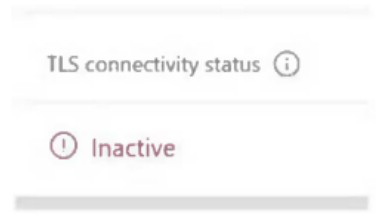
You cannot place calls and receive an error message in the Microsoft Teams admin center as shown in the following exhibit.
What is a possible cause of the issue?
Show answer and explanation
Correct answer: D. The Baltimore or the Digicert root certificates are missing on the SBC.
The exhibit shows 'TLS connectivity status: Inactive,' which indicates a failure in the TLS handshake between Teams and the SBC. This occurs when the SBC cannot present valid certificates during the TLS negotiation. Microsoft Teams requires the SBC to present certificates signed by trusted certificate authorities, specifically Baltimore or Digicert root certificates. If these root certificates are missing from the SBC's certificate chain, the TLS connection cannot be established, resulting in the inactive status shown. Without successful TLS connectivity, signaling cannot occur, preventing calls from being placed or received.
Why the other options are wrong
- A. Calling plan licenses affect user ability to make calls but would not cause a TLS connectivity status error at the SBC level.
- B. The failover timer setting controls retry behavior for SBC connections but does not directly cause TLS connectivity failures.
- C. The PAI header configuration affects call routing and identity information but is not related to TLS connectivity status.
Question 4
You have a Microsoft Teams Phone deployment that contains two users named User1 and User2.
User1 will be on leave for two weeks.
You need to redirect all calls to the phone number of User1 to the phone number of User2. The solution must minimize administrative effort.
What should you modify for User1?
Show answer and explanation
Correct answer: C. the call delegation settings
Call delegation lets User1 add User2 as a delegate so that incoming calls to User1's number ring User2 and User2 can answer them on User1's behalf. It is configured once in the user's call answering rules and stays in place for the duration of the leave, so no phone number changes or per call actions are needed. This is the setting that redirects User1's calls to User2 with the least administrative effort.
Why the other options are wrong
- A. Voicemail transfer target settings only decide where a call goes after it has already reached voicemail, so callers still wait through User1's ring and greeting.
- B. Call delay and ring order settings only control how long and in what sequence a user's own devices and existing delegates ring, so on their own they do not send calls to another person.
- D. Phone number type identifies a number as a user number or a service or toll free number and has no effect on where calls are answered.
Question 5
You have a Microsoft Teams Phone deployment.
You have a call queue named Customer Service.
You need to ensure that when the agents of Customer Service make calls, the outbound calling name appears as Contoso, and the caller ID shows the phone number of Customer Service. Other users must NOT be affected.
Which three actions should you perform? Each correct answer presents a part of the solution.
NOTE: Each correct selection is worth one point.
Show answer and explanation
Correct answer: A, B, D
A. From the Microsoft Teams admin center, configure a new caller ID policy. B. Set Calling Party Name to the organization name. D. Set Replace the caller ID with to Resource account. Caller ID behavior for outbound calls is controlled by a caller ID policy, and creating a new policy that you assign only to the Customer Service agents keeps every other user unaffected. In that policy, set Calling Party Name to the organization name so Contoso is presented, and set Replace the caller ID with to Resource account so the call queue's number is shown instead of the agent's number. Those three configuration actions together deliver the required outbound identity.
Why the other options are wrong
- C. Modifying the global (Org-wide default) caller ID policy would apply the new caller ID to every user in the tenant, which breaks the requirement that other users are not affected.
- E. Turning on the option that lets users override the caller ID policy allows agents to change or hide the presented number, which works against the fixed queue identity you are enforcing.
Question 6
Your company has offices in London and Vancouver The company has a Teams Phone deployment that uses Calling Plans.
The London office contains a user named User1.
User1 moves from the London office to the Vancouver office.
You need to update the phone number and emergency location of User1 to match the new office.
What should you do first?
Show answer and explanation
Correct answer: B. Modify the current Usage location for User1.
Usage location must be set before updating phone numbers and emergency locations in Teams Phone deployments. The usage location determines which calling plan and emergency services are available to the user. Setting the correct usage location for Vancouver first ensures that the system applies the appropriate Vancouver-based phone numbers and emergency location services when you subsequently update those settings.
Why the other options are wrong
- A. Creating a new emergency calling policy is not the first step; policies may already exist or be applied globally.
- C. Granting an emergency calling policy comes after establishing the correct usage location and available policies.
- D. While adding a new emergency location for Vancouver may be necessary, the usage location must be updated first to ensure the system recognizes Vancouver as the user's location.
Question 7
You have a Microsoft Teams Phone deployment.
You need to ensure that a user named user1@contoso.com can call international phone numbers by using Direct Routing.
Which type of policy should you use?
Show answer and explanation
Correct answer: B. a voice routing policy
With Direct Routing, outbound PSTN calls are matched by the voice routes and PSTN usages contained in the voice routing policy assigned to the user. To let user1@contoso.com dial international numbers, assign a voice routing policy whose PSTN usages include a voice route with a pattern that matches international numbers and points to the SBC. Without that policy the call has no route and is blocked.
Why the other options are wrong
- A. Teams policies govern client and app experiences such as messaging and meeting features, not PSTN call routing.
- C. Calling policies enable or disable calling features such as call forwarding, voicemail and call delegation, but they do not select the route an outbound call takes.
- D. Caller ID policies only control the number and name presented to the called party.
Question 8
You have a Microsoft Teams Phone deployment that uses Direct Routing.
You plan to use Microsoft Power BI to analyze Call Quality Dashboard (CQD) data for the deployment.
You download the Power BI query templates for CQD from the Microsoft Download Center.
You need to use Power BI Desktop to review reports about PSTN calls that go through Direct Routing.
What should you do first?
Show answer and explanation
Correct answer: C. Install the Power BI Connector for CQD.
The Power BI Connector for CQD is the required component to establish the connection between Power BI Desktop and the Call Quality Dashboard data source. This connector must be installed first to enable Power BI to query and retrieve CQD data. Without this connector, Power BI cannot access the CQD data regardless of which templates are used.
Why the other options are wrong
- A. Downloading the Tenant Data Upload file is used for bulk data uploads to CQD, not for connecting Power BI to existing CQD data.
- B. Publishing to the Power BI service occurs after creating and testing reports locally in Power BI Desktop.
- D. The Microsoft Power Platform connector is a different connector used for Power Platform integration, not specifically for CQD data.
Question 9
You have a Microsoft Teams Phone deployment that has 10 offices. Each office has a Session Border Controller (SBC).
A user reports that she can make internal calls by using the dial pad, but cannot use the dial pad to make external calls.
What is a possible cause of the issue?
Show answer and explanation
Correct answer: B. The user has the incorrect voice routing policy applied
Internal Teams calls are placed over VoIP and never touch the SBCs, so the failure is isolated to PSTN calls leaving through Direct Routing. That points to the voice routing policy assigned to the user, which either has no PSTN usage covering external numbers or contains voice routes whose patterns do not match the numbers being dialed. Assigning the correct voice routing policy restores external dialing from the dial pad.
Why the other options are wrong
- A. A missing validated emergency address affects emergency calling and number assignment, not the ability to dial ordinary external numbers.
- C. If Enterprise Voice were disabled the user would have no dial pad for PSTN calls at all, yet internal Teams calls would still work, so this does not match the reported symptom.
- D. Teams app setup policies control which apps are pinned and visible in the client and have no role in routing PSTN calls.
Question 10
Your company has an office in Seattle.
The default dial-in number for the company's Microsoft Teams meetings has an area code of 425.
The company does NOT have an office in New York. However, most of the company's customer are in New York.
You need to get a new default dial in number that has a local 718 area code You will NOT define additional location information in Teams.
Which two actions should you perform before you assign the bridge? Each correct answer presents part of the solution.
NOTE: Each correct selection is worth one point.
Show answer and explanation
Correct answer: B, E
B. Search for new numbers by using a 718 area code E. Get a Dedicated conference bridge (Toll) number To assign a new dial-in number with a 718 area code for Teams meetings, you must first search for available numbers using that area code to identify what is available in the system. You must also obtain a Dedicated conference bridge (Toll) number, which provides the actual phone line resource needed to support local dial-in access. The toll option (not toll-free) is appropriate for a standard local area code scenario where customers can dial a local number.
Why the other options are wrong
- A. Toll-free numbers are not required; the requirement is for a local 718 area code toll number.
- C. A toll-free dedicated bridge is unnecessary when a regular toll number with the requested area code will serve the purpose.
- D. Searching by location name (New York) is not the correct method; the requirement specifically states to use the area code (718) for the search.
That was 10 of 300.
The full Microsoft MS-721 pack has all 300 questions, each with the answer, the explanation and why the other options are wrong, plus a questions-only copy for timed runs. US$39, paid once, with free monthly updates and a pass-or-your-money-back guarantee.