
10 free Juniper JN0-253 JNCIA-MistAI practice questions with the correct answer and a full explanation for each, taken from the CertStash pack of 98 questions. Work through them, then open each answer to check your reasoning.
Get all 98 questions (US$39) · Download these 10 as a PDF
Question 1
Click the Exhibit button.
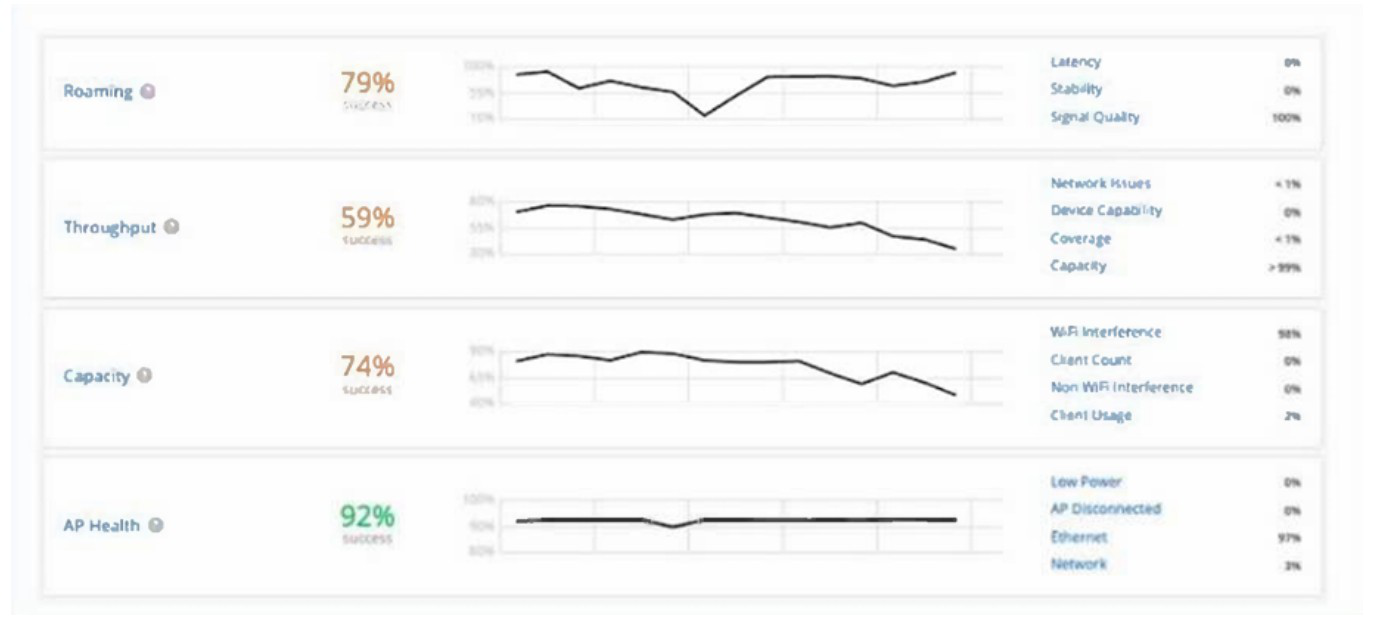
Referring to the exhibit, which Roaming Classifier is responsible for the sub-threshold SLEs?
Show answer and explanation
Correct answer: B. Signal Quality
The Roaming section displays 79% success with a graph showing relatively stable performance. The right-side metrics for Roaming include Latency (0%), Stability (0%), and Signal Quality (100%). When a roaming classifier shows sub-threshold SLEs (Service Level Events), it indicates performance issues. The Signal Quality metric at 100% is listed as a classifier for Roaming, meaning degradation in signal quality would directly impact roaming success. Since the exhibit shows Roaming at 79% success (not optimal), and Signal Quality is the associated metric, signal quality is the responsible classifier for any sub-threshold SLEs in the Roaming domain.
Why the other options are wrong
- A. Capacity is the classifier associated with Throughput metrics (Device Capability, Coverage, Capacity), not Roaming performance issues.
- C. Ethernet is listed as a classifier for AP Health (97%), not for Roaming metrics.
- D. WiFi Interference is a classifier for Capacity and AP Health (WiFi Interference at 98%), not specifically for Roaming sub-threshold SLEs.
Question 2
You are asked to display your network devices using the Juniper Mist GUI as a single solution. Your network is made up of a wireless infrastructure of only Juniper APs and the wired infrastructure has a mix of Juniper and non-Juniper switches. Your solution must ensure that all devices are displayed in the Juniper Mist GUI.
Given this scenario, how would you accomplish this task?
Show answer and explanation
Correct answer: D. Use Juniper Mist Asset Visibility.
Asset Visibility is the Juniper Mist feature specifically designed to display and manage all network devices, both Juniper and non-Juniper, in a single unified GUI. It provides comprehensive visibility across the entire network infrastructure regardless of vendor, making it the correct solution for this mixed-vendor environment.
Why the other options are wrong
- A. Wired Assurance with Monitoring focuses on performance metrics and health status rather than device discovery and display across mixed vendors.
- B. WiFi Management and Assurance handles only wireless infrastructure; LLDP alone does not provide unified GUI display of mixed-vendor wired devices.
- C. Marvis Actions is an AI-driven analytics and remediation feature, not a device visibility and management tool.
Question 3
Which two statements about webhooks and APIs are correct? (Choose two.)
Show answer and explanation
Correct answer: B, D
B. Webhooks are a push from Juniper Mist, and APIs are a pull by the client. D. There is an hourly limit to the number of API calls that an organization can have. Webhooks operate as a push mechanism where Juniper Mist sends data to configured endpoints, while APIs operate as a pull mechanism where clients request data from Juniper Mist. Additionally, API calls are subject to hourly rate limits to prevent abuse and ensure service stability, though webhook counts may not have the same restrictions.
Why the other options are wrong
- A. Not all Juniper Mist objects are configurable via webhooks; webhooks are primarily event-driven notifications rather than a complete configuration interface.
- C. Webhooks typically do not have hourly count limits; rate limiting is more commonly applied to API calls.
Question 4
With which two external directory services does Juniper Mist Access Assurance integrate? (Choose two.)
Show answer and explanation
Correct answer: A, B
A. Microsoft Azure Active Directory B. Okta Workforce Identity Juniper Mist Access Assurance integrates with Microsoft Azure Active Directory and Okta Workforce Identity, which are industry-standard external directory services for authentication and identity management. These integrations enable user authentication and access control through existing enterprise identity systems.
Why the other options are wrong
- C. Meta Social Verify is not an enterprise directory service and is not supported by Juniper Mist Access Assurance.
- D. RESTful API Fingerprinting is a technical method for device identification, not an external directory service.
Question 5
Click the Exhibit button.
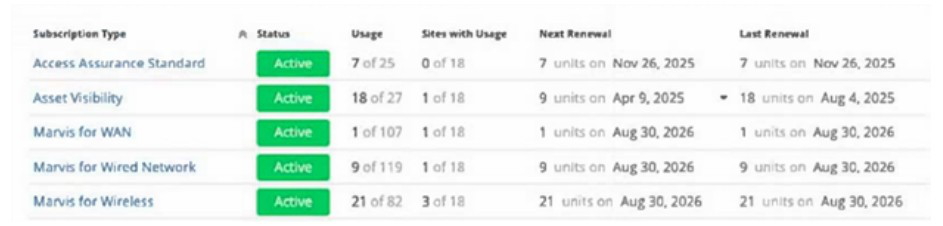
Referring to the exhibit, how many sites have unused Marvis for Wireless subscriptions?
Show answer and explanation
Correct answer: A. 15
The Marvis for Wireless subscription shows 21 of 82 units in use across all sites. The 'Sites with Usage' column indicates that only 3 of 18 sites are actually using this subscription. This means 15 sites (18 minus 3) have unused Marvis for Wireless subscriptions allocated to them. These represent sites that have the subscription but are not consuming any units.
Why the other options are wrong
- B. 21 is the total number of units in use, not the count of sites with unused subscriptions.
- C. 82 is the total number of licensed units, not the number of sites with zero usage.
- D. 18 is the total number of sites, not the number of sites with unused subscriptions.
Question 6
Which Juniper Mist feature tracks the location of important devices and objects within a building?
Show answer and explanation
Correct answer: C. Asset Visibility
Asset Visibility is the Juniper Mist feature that tracks the location of important devices and objects within a building using location analytics. It provides real-time positional data and location history for network-connected assets throughout the physical space.
Why the other options are wrong
- A. Wireless Assurance focuses on AP performance and wireless client connectivity metrics, not device location tracking.
- B. IoT Assurance monitors IoT device health and behavior patterns rather than their physical location within buildings.
- D. User Engagement tracks user satisfaction and experience metrics, not device locations.
Question 7
Which two configuration elements are available in a WLAN template? (Choose two.)
Show answer and explanation
Correct answer: C, D
C. radio management D. WLANs A WLAN template in Juniper Mist includes configuration elements for WLANs (wireless network definitions) and radio management (AP transmit power, channel selection, band steering). These are the core wireless configuration components that templates standardize across multiple access points.
Why the other options are wrong
- A. Organizations are administrative entities that contain sites and devices, but they are not configuration elements within a WLAN template.
- B. Template policies are applied through templates but are not themselves configuration elements contained within a WLAN template definition.
Question 8
Which two statements describe port profiles? (Choose two.)
Show answer and explanation
Correct answer: A, B
A. They include a set of interface configurations. B. They can be assigned to multiple ports. Port profiles contain a set of reusable interface configurations such as VLAN assignments, QoS settings, and security policies. They can be assigned to multiple ports simultaneously, allowing consistent configuration across many interfaces. This reusability is a key benefit of port profiles.
Why the other options are wrong
- C. Port profiles contain interface configurations, not routing configurations, which are typically handled at a different configuration level.
- D. Port profiles are specifically designed to be assigned to multiple ports, not limited to a single port, as that would defeat the purpose of creating reusable configuration templates.
Question 9
Which statement about microservices is correct?
Show answer and explanation
Correct answer: D. Microservices communicate with each other using APIs.
APIs. Microservices are independent, loosely coupled services that communicate with each other through APIs. This architectural approach allows services to be developed, deployed, and updated independently without requiring synchronization or shared databases, and enables resilience through service isolation.
Why the other options are wrong
- A. Microservices are intentionally decoupled and can be updated independently; they do not require developers to deliver updates to the entire suite at once.
- B. Microservices are designed to avoid shared databases; each service typically manages its own data to maintain independence and scalability.
- C. Microservices are designed to be independent; if one process fails, other microservices continue operating, providing fault isolation and resilience.
Question 10
Which two statements are true about switch configurations at the site level? (Choose two.)
Show answer and explanation
Correct answer: A, C
A. Switch configurations at the site level are an additional way to apply a switch template to a specific site. C. Site-level switch configurations override org-level templates. Site-level switch configurations provide an additional layer for applying configurations to specific sites beyond organizational templates, and site-level configurations take precedence over organization-level templates when both are defined. This hierarchy allows flexibility for site-specific customization while maintaining organization-wide standards.
Why the other options are wrong
- B. Site-level configurations are optional and provide an alternative to manual per-switch configuration, not a requirement for it.
- D. Site-level configurations override organization-level templates, not the reverse; the hierarchy flows from organization to site to device.
That was 10 of 98.
The full Juniper JN0-253 JNCIA-MistAI pack has all 98 questions, each with the answer, the explanation and why the other options are wrong, plus a questions-only copy for timed runs. US$39, paid once, with free monthly updates and a pass-or-your-money-back guarantee.