
10 free CompTIA Server+ SK0-005 practice questions with the correct answer and a full explanation for each, taken from the CertStash pack of 584 questions. Work through them, then open each answer to check your reasoning.
Get all 584 questions (US$39) · Download these 10 as a PDF
Question 1
Which of the following is typical of software licensing in the cloud?
Show answer and explanation
Correct answer: C. Subscription-based
Cloud computing environments typically utilize a subscription-based software licensing model, allowing organizations to pay recurring fees based on usage, time, or active users rather than buying perpetual licenses.
Why the other options are wrong
- A. Per-socket licensing is traditional on-premises licensing based on physical CPU sockets.
- B. Perpetual licensing involves a one-time upfront purchase for permanent software use, which is rare in cloud models.
- D. Site-based licensing covers an entire physical facility or campus rather than cloud deployment models.
Question 2
A server administrator wants to run a performance monitor for optimal system utilization.
Which of the following metrics can the administrator use for monitoring?
(Choose two.)
Show answer and explanation
Correct answer: A, E
A. Memory E. CPU CPU and memory utilization are primary system performance metrics monitored to measure resource load and ensure optimal system health and availability.
Why the other options are wrong
- B. Page file usage is secondary to system memory and monitored specifically for virtual memory paging rather than general core system utilization.
- C. Services monitoring tracks individual process states rather than hardware system utilization metrics.
- D. Application monitoring tracks software performance rather than baseline server system metrics.
- F. Heartbeat checks verify host uptime and availability rather than measuring system resource utilization levels.
Question 3
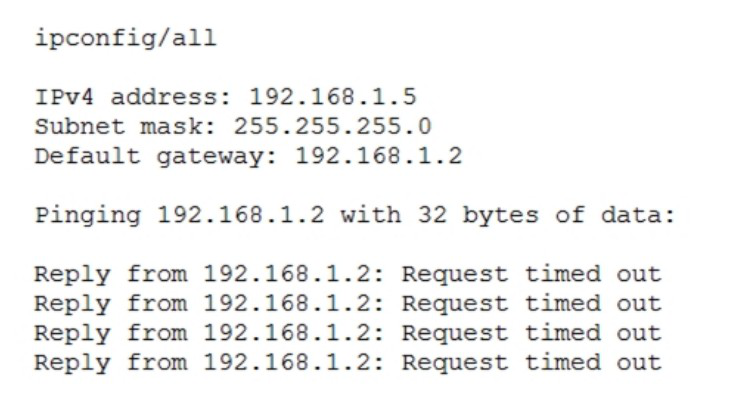
After configuring IP networking on a newly commissioned server, a server administrator installs a straight-through network cable from the patch panel to the switch. The administrator then returns to the server to test network connectivity using the ping command. The partial output of the ping and ipconfig commands are displayed below:
The administrator returns to the switch and notices an amber link light on the port where the server is connected.
Which of the following is the MOST likely reason for the lack of network connectivity?
Show answer and explanation
Correct answer: A. Network port security
An amber link light on a switch port means the port has a physical link but is not forwarding traffic, which is the classic indication of a port placed in a blocked or err-disabled state. Port security does exactly that: when the port sees a MAC address it does not expect, such as a newly commissioned server plugged into a port learned for another device, it disables or restricts the port. The server's own settings are valid, 192.168.1.5 with a 255.255.255.0 mask and a gateway of 192.168.1.2 in the same subnet, so the pings would succeed if the switch were forwarding frames. Since the port is not forwarding, every ping times out. The fix is to clear the violation and update the allowed MAC addresses on that port.
Why the other options are wrong
- B. A VLAN mismatch still forwards traffic and leaves the port green; it would place the server in the wrong broadcast domain rather than block the port.
- C. The server already holds a valid static address, mask, and gateway in the correct subnet, so DHCP plays no part in this failure.
- D. The ipconfig output confirms correct adapter settings, so the server's network configuration is not the cause.
Question 4
A user cannot save large files to a directory on a Linux server that was accepting smaller files a few minutes ago.
Which of the following commands should a technician use to identify the issue?
Show answer and explanation
Correct answer: C. df -h
The df -h command displays disk space usage for file systems in a human-readable format, allowing technicians to quickly verify if the target directory's partition has run out of space.
Why the other options are wrong
- A. The pvdisplay command shows information about LVM physical volumes rather than available file system disk space.
- B. The mount command lists currently mounted file systems but does not report disk usage details or space capacity.
- D. The fdisk -l command displays partition table information rather than current disk space usage.
Question 5
Following a recent power outage, a server in the datacenter has been constantly going offline and losing its configuration. Users have been experiencing access issues while using the application on the server. The server technician notices the date and time are incorrect when the server is online. All other servers are working.
Which of the following would MOST likely cause this issue? (Choose two.)
Show answer and explanation
Correct answer: A, B
A. The server has a faulty power supply B. The server has a CMOS battery failure A failed CMOS battery causes a server to lose its system clock and BIOS settings after losing external power, while a faulty power supply causes continuous server instability, random shutdowns, and going offline.
Why the other options are wrong
- C. OS updates manage software patches and security fixes, not hardware time retention and power stability.
- D. A malfunctioning LED panel affects visual status displays but does not cause power loss or date/time configuration reset.
- E. Lack of NTP configuration affects clock drift while online, but does not cause the server to repeatedly crash or go offline.
- F. Disabling the time synchronization service prevents clock syncing over the network, but does not cause hardware reboots or physical configuration loss.
Question 6
A company has implemented a requirement to encrypt all the hard drives on its servers as part of a data loss prevention strategy.
Which of the following should the company also perform as a data loss prevention method?
Show answer and explanation
Correct answer: A. Encrypt all network traffic
Encrypting all network traffic protects data in transit, complementing full-disk drive encryption (data at rest) as part of a comprehensive data protection and data loss prevention strategy.
Why the other options are wrong
- B. MFA enforces user authentication access control rather than protecting data against interception or unauthorized export.
- C. Blocking encrypted USB drives does not prevent data loss as effectively as controlling overall media usage or encrypting network data paths.
- D. Port security restricts physical switch access based on MAC addresses, which prevents unauthorized network connection rather than data loss from servers.
Question 7
A systems administrator is setting up a server on a LAN that uses an address space that follows the RFC 1918 standard.
Which of the following IP addresses should the administrator use to be in compliance with the standard?
Show answer and explanation
Correct answer: C. 172.16.19.241
The address 172.16.19.241 falls within the RFC 1918 private IP address range of 172.16.0.0 to 172.31.255.255.
Why the other options are wrong
- A. 11.251.196.241 is a public IP address located outside the RFC 1918 10.0.0.0/8 range.
- B. 171.245.198.241 is a public IP address outside the RFC 1918 172.16.0.0/12 range.
- D. 193.168.145.241 is a public IP address outside the RFC 1918 192.168.0.0/16 range.
Question 8
An administrator needs to perform bare-metal maintenance on a server in a remote datacenter.
Which of the following should the administrator use to access the server's console?
Show answer and explanation
Correct answer: A. IP KVM
IP KVM (Keyboard, Video, Mouse over IP) provides out-of-band, hardware-level remote access to a server's console regardless of the operating system state, making it ideal for bare-metal maintenance.
Why the other options are wrong
- B. VNC relies on an operating system service and GUI environment, making it unsuitable for bare-metal administrative access.
- C. A crash cart requires physical presence in the remote datacenter rather than remote access.
- D. RDP requires a running Windows operating system and network stack, rendering it unavailable during bare-metal maintenance.
- E. SSH requires an operating system with network and SSH services running, so it cannot be used for bare-metal server access.
Question 9
A technician needs to provide a VM with high availability.
Which of the following actions should the technician take to complete this task as efficiently as possible?
Show answer and explanation
Correct answer: B. Clone the original VM
Cloning a virtual machine creates an exact copy of the VM, which can then be deployed to another host or cluster node to achieve high availability and redundancy efficiently.
Why the other options are wrong
- A. Snapshots capture the VM's state at a point in time for recovery, but they do not provide high availability across redundant hardware.
- C. Converting to dynamic disks changes storage allocation mechanisms but does not offer high availability.
- D. Physical-to-virtual (P2V) conversion migrates a physical machine to a VM, which is not applicable since the source is already a VM.
Question 10
A server administrator receives a report that Ann, a new user, is unable to save a file to her home directory on a server. The administrator checks Ann's home directory permissions and discovers the following: dr-xr-xr– /home/Ann
Which of the following commands should the administrator use to resolve the issue without granting unnecessary permissions?
Show answer and explanation
Correct answer: D. chmod 754 /home/Ann
The user permissions were set to read and execute (r-x, or 5), preventing Ann from writing or saving files to her home directory. Changing permissions to 754 grants the owner read, write, and execute permissions (7) while maintaining the original group (5) and others (4) permissions without granting excessive access.
Why the other options are wrong
- A. chmod 777 grants full read, write, and execute permissions to everyone, which violates the principle of least privilege.
- B. chmod 666 grants read and write permissions to everyone but removes execute permissions needed to traverse directories.
- C. chmod 711 removes read permissions for group and others, unnecessarily restricting existing directory access.
That was 10 of 584.
The full CompTIA Server+ SK0-005 pack has all 584 questions, each with the answer, the explanation and why the other options are wrong, plus a questions-only copy for timed runs. US$39, paid once, with free monthly updates and a pass-or-your-money-back guarantee.